

Can a short, steady routine really help you feel safe, clear, and present in minutes? This article answers that question with simple, science-aligned steps you can use any day. Grounding links the feet, legs, and root chakra to a sense of safety, while centering calms the mind and focuses breath and intention.
Build a simple, reliable routine that helps you feel steady fast. Early moments on the mat or at your desk separate you from pre-task stress, lower mind chatter, and bring present-moment awareness. Start with easy poses like Tadasana or Savasana and cues such as “root down through your feet” or visualizing tree roots into the earth.
This approach works for busy days—five-minute resets at a desk or a focused twenty-minute session at home. You’ll learn how centering and grounding work together, plus three time-smart sequences and quick tools like micro-meditations and breath checks. For a real-world account of short, targeted sessions that changed anxiety and focus, see this short case study.
Key Takeaways
- Quick routines can restore calm and steady energy in minutes.
- Centering pairs breath with body cues to quiet the mind.
- Start with simple poses that connect you to the feet and legs.
- Adapt from five-minute resets to longer sessions as time allows.
- Tools include breathwork, micro-meditations, and short checklists.
Why a Grounding Yoga Practice matters for busy, modern life
Grounding restores clarity and steadiness when your day is packed. By connecting with the earth element, you’ll regulate stress and focus your mind faster.
Busy modern life raises baseline stress. Constant notifications and a high cognitive load reduce attention and decision quality for many people.
Feeling “weighted-in” and supported is a simple, everyday solution. When you sense steady contact with the floor and slow your breath, reactivity drops and responses become calmer.
The physiological link is straightforward: slower breathing and sensory focus shift the nervous system toward calm. That change helps recovery after a hectic meeting or a long commute.
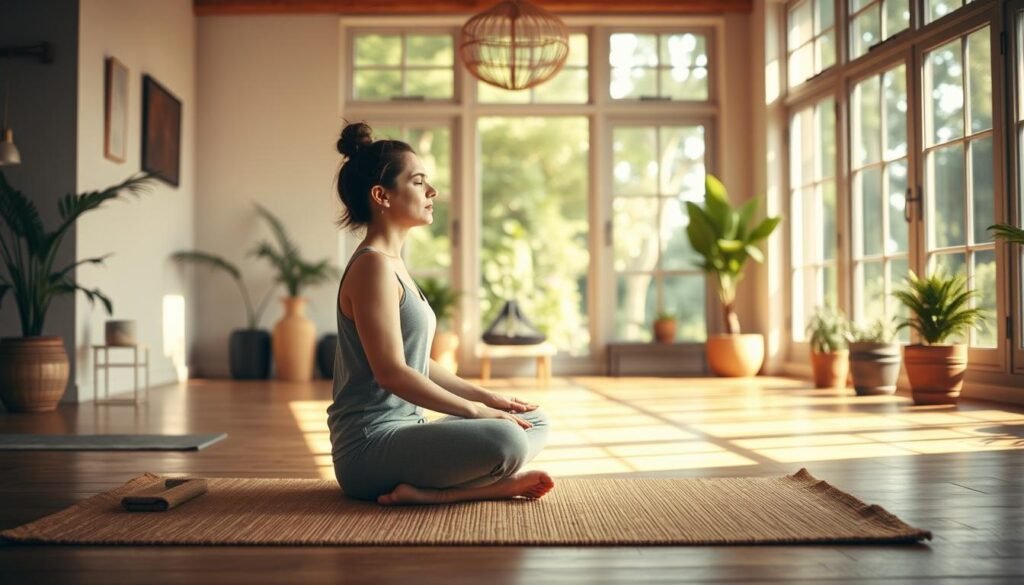
“Instructors often begin class by helping students separate from pre-class events and calm mind chatter, cultivating equanimity for effective learning.”
Off the mat, this approach improves how you show up in conversations, transitions, and evening wind-downs. Brief, repeatable moments—just a minute or two—can meaningfully shift state when done consistently.
For a concise primer on the philosophy behind this approach, see grounding and calming practices. To explore targeted stretches that release emotional hotspots, try this short guide.
Grounding vs. centering: what they mean and how they work together
A short, clear cue to the lower body and breath often resets the nervous system fast. Grounding connects your lower body to the earth for stability. Centering focuses your breath and attention so your mind feels steady and clear.
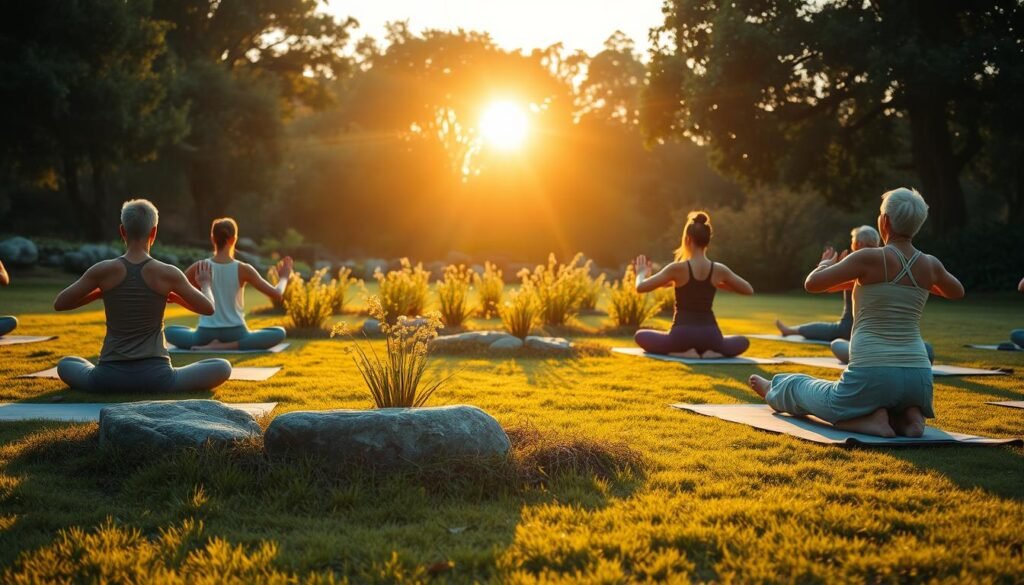
Lower-body anchors and the Muladhara
Define grounding in practice: cue weight into the feet and legs, sense the sit bones, and let the hips feel heavy. Gentle attention at the base of the spine—your root chakra—can create a “home in the body” sensation.
Simple cues a yoga teacher uses work well when self-directed: “press evenly through the feet,” “feel support under the sit bones,” or “let the hips feel heavy.”
Centering with breath, gaze, and intention
Define centering: steady the gaze, lengthen the exhale, and set a concise intention that links action to values. Diaphragmatic breathing calms the nervous system and balances energetic centers like the heart and solar plexus.
Try quick visualizations: imagine a snow-globe settling on the exhale, or tree roots spreading and drawing support upward. Experiment to see whether a lower-body anchor, slow breath, or a short phrase helps most today.
| Focus | Cues | Immediate effect |
|---|---|---|
| Lower body / Muladhara | Press feet, sense sit bones, relax hips | Stability, safety, reduced sway |
| Centering / breath & mind | Lengthen exhale, steady gaze, set intention | Calm attention, clearer decisions |
| Combined | Ground then center; use imagery | Prepared for mindful movement or stillness |
For how these approaches intersect with the endocrine system and selected poses, see this endocrine system and yoga resource.
Set your intention and assess your time: build a practice that fits your day
Decide how many minutes you have and choose a clear intention. An anchor like “stability” or “presence” keeps short sessions focused and effective.
Start with a quick time audit: are you working with 5, 10, or 20 minutes? Pick one and match the sequence length to that real window.
Choose your anchor: stability, safety, or presence
Decide how many minutes you have and choose a clear intention. An anchor like “stability” or “presence” keeps short practices focused and effective.
- Quick audit: pick 5, 10, or 20 minutes and commit to that window.
- Intention prompts: “I move with steadiness,” “I choose presence,” “I am safe in my body.”
- Pair with breath: lengthen exhales by one or two counts to downshift fast.
- Body anchor: press feet evenly for stability, let hips feel heavy for safety, soften gaze for presence.
- Sticky-note cue: write your intention near your mat or workspace as a visual reminder.
- Consistency over length: five grounded minutes daily beats an occasional long session.
- Yoga teacher-style cue: “arrive, breathe, anchor, move, close” — a five-step self-coaching loop.
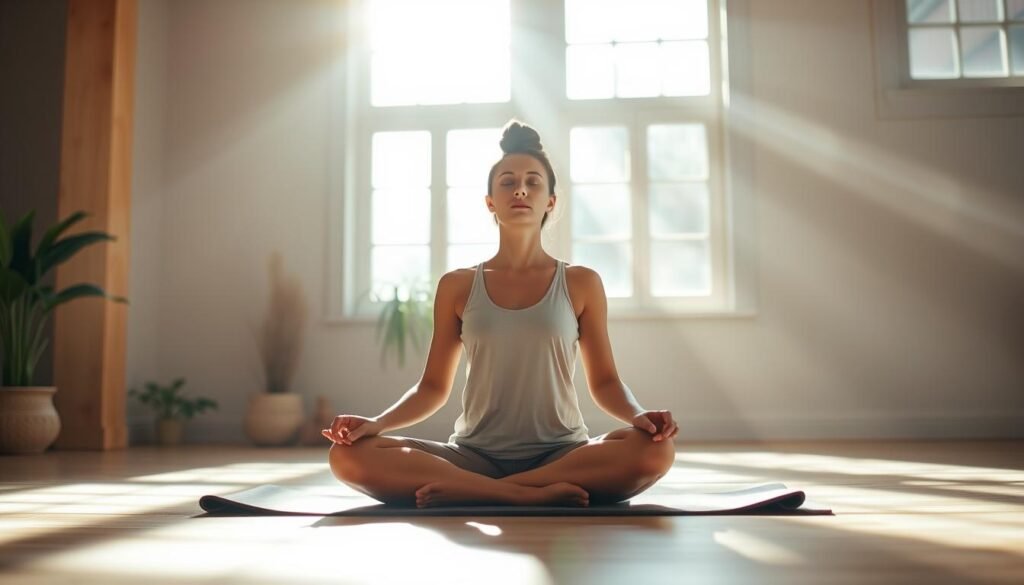
For a short primer on setting intention that fits busy life, see this how to start an intention setting. If you want reflective prompts to support focus, try these therapist-backed journal prompts.
Grounding Yoga Practice
You can feel more centered with three clear options that match your available time. Each option blends breath, simple yoga poses, and closing awareness to ground fast.
Five-minute reset: Mountain pose, 3-part breath, and body scan
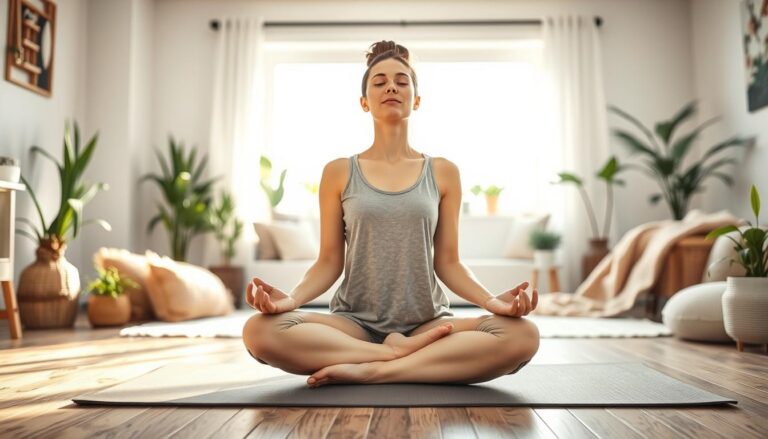
Stand in Mountain (Tadasana) with toes spread and a tall spine. Feel the heels root while you take 5–8 slow three-part breaths (Dirga pranayama).
Finish with a short body scan from crown to toes, releasing tightness down into the floor.
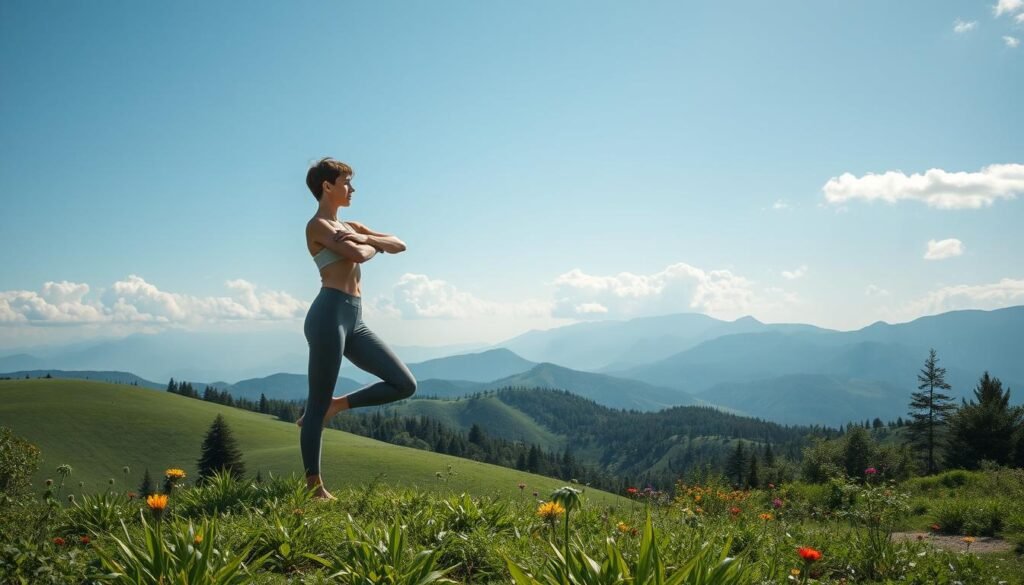
Ten-minute flow: standing roots to hip release
Begin standing with a steady base. Move through 4–6 gentle rounds between strong standing poses like Warrior II or Chair to build leg and hip stamina.
Finish seated with Pigeon or Garland to open hips and ease the low back.
Twenty-minute sequence: full-body grounding with Savasana
Build a flowing arc: Mountain → Warrior I/II → Triangle, then lower to Staff and Bridge. Close on the mat with a brief Savasana to integrate breath and energy.
| Duration | Core elements | Closing |
|---|---|---|
| 5 minutes | Mountain pose, Dirga breath, body scan | 2 slow sealing breaths |
| 10 minutes | Standing strength, gentle flow, hip openers | Calm seated finish |
| 20 minutes | Standing-to-floor sequence, back body work | Savasana for integration |
Keep transitions minimal and deliberate so attention stays focused. Use a timer and note how your spine, breath, and energy shift across durations. For targeted poses that support hormones and recovery, see yoga poses to support your hormones.
Foundational standing poses to root and stabilize
A few clear alignment cues make standing work for strength, balance, and calm. Prioritize simple alignment and breath to create dependable stability.
Standing shapes train your base so everything else feels steadier. Start by refining small details: where the feet press, how the legs engage, and how the spine finds length through the head.
Mountain pose (Tadasana): alignment checklist
Mountain pose checklist:
- Even weight under heels and balls of the feet.
- Soft, unlocked knees and engaged legs.
- Tall spine with length through the crown of the head.
- Shoulders relaxed; arms hang active without gripping the jaw or neck.
Single-leg and chair options for balance and strength
Tree strategy: press the standing foot evenly, keep the pelvis square, and imagine roots growing down to the root point beneath you. Arms can lift or stay at the heart to test balance.
Chair coaching: sit back as if to a stool, track the knees over second toes, and use the legs to power the lift rather than collapsing through the low back.
Warrior variations to steady hips and focus
Warrior I tips: square the hips as feels comfortable, anchor the back heel, and reach the arms without crowding the neck.
Warrior II tips: widen the stance to improve stability, press the outer edge of the back foot to ground, and hold a soft, unwavering gaze over the front hand for improved balance.
| Pose | Main focus | Quick cue |
|---|---|---|
| Mountain (Tadasana) | Posture, alignment | Even feet, tall spine, relaxed shoulders |
| Tree (Vrksasana) | Single-leg balance | Press standing foot, square pelvis, root down |
| Chair (Utkatasana) | Leg strength | Sit back, knees track toes, engage legs |
| Warrior I / II | Hips, legs, focus | Anchor heels, widen stance, steady gaze |
Use a wall or blocks when needed to refine balance without tension. Small adjustments in these standing yoga poses deliver big returns in stability for the rest of your session.
Floor-based shapes to settle the hips, spine, and nervous system
Floor work calms your system by easing hips and back. Combine hip openers with back-body strength for balanced grounding.
Moving to the floor often lets the spine and legs relax more deeply. Gentle contact points on the mat cue the nervous system to slow.
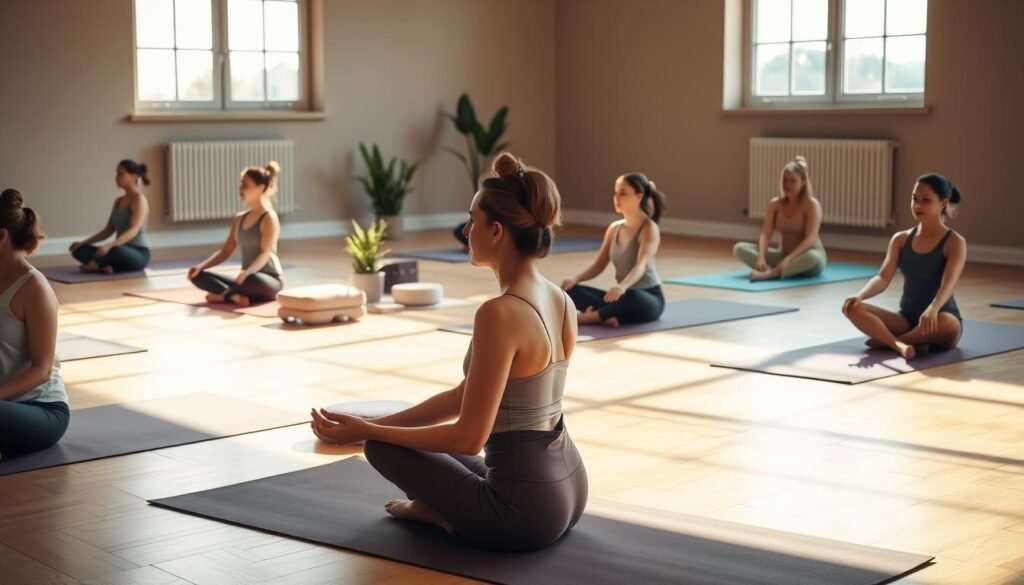
Extended one-legged pigeon and Garland options
Pigeon encourages hip and thigh release while you root down through the front shin and active the back leg. Breathe steadily and support the front hip with a folded blanket if needed.
Keep sensation in the muscles rather than the joints. For a related targeted stretch, try this targeted stretch.
Staff and Bridge for the back body
Staff strengthens the back line and core: press through heels, engage quadriceps, and sit tall. Imagine your spine as a steady staff rooted into the mat.
Bridge reawakens the posterior chain: drive feet and upper arms into the mat, lift hips smoothly, then lower the spine slowly to mobilize the back and lengthen hip flexors.
- Pigeon pointers: steady breath, blanket support, muscle-focused sensation.
- Garland options: use a block or bolster under the seat; support heels when ankles are tight.
- Bridge coaching: lift and lower sequentially to massage the spine.
| Pose | Main focus | Quick cue |
|---|---|---|
| Extended Pigeon | Hips, thighs | Root front shin, active back leg, steady breath |
| Garland (Malasana) | Groin openness, ground contact | Use block, keep chest lifted, heels supported |
| Staff (Dandasana) | Back line, core | Press heels, engage quads, sit tall on the mat |
| Bridge (Setu) | Posterior chain, hip flexors | Drive feet and arms into mat, lift hips smoothly |
Encourage slow breath and longer exhales to signal calm. Notice contact at shins, feet, and shoulders as anchors that help the nervous system settle.
Breathwork and micro-meditations for grounding anywhere
Use breath as a portable grounding tool. Short meditations and equal-count breathing calm your mind fast—no mat required.
You can steady your energy anywhere with just a few mindful inhales and exhales. These micro-tools fit into a coffee break, a queue, or the moments before a meeting.
Dirga pranayama: three-part breath to stabilize attention
How to: inhale into the belly, then the ribs, then the chest. Reverse the order on the exhale.
Do 4–6 smooth rounds to steady the nervous system and anchor the mind. These breaths bring a steady, full feeling through the torso and help center focus quickly.
Sama vritti: equal breathing for calm and clarity
How to: inhale and exhale for equal counts (try four). Breathe through the nose and keep the throat soft.
Equal counts balance the nervous system and clear scattered thoughts. Adjust the count so breathing stays easy and repeat as needed.
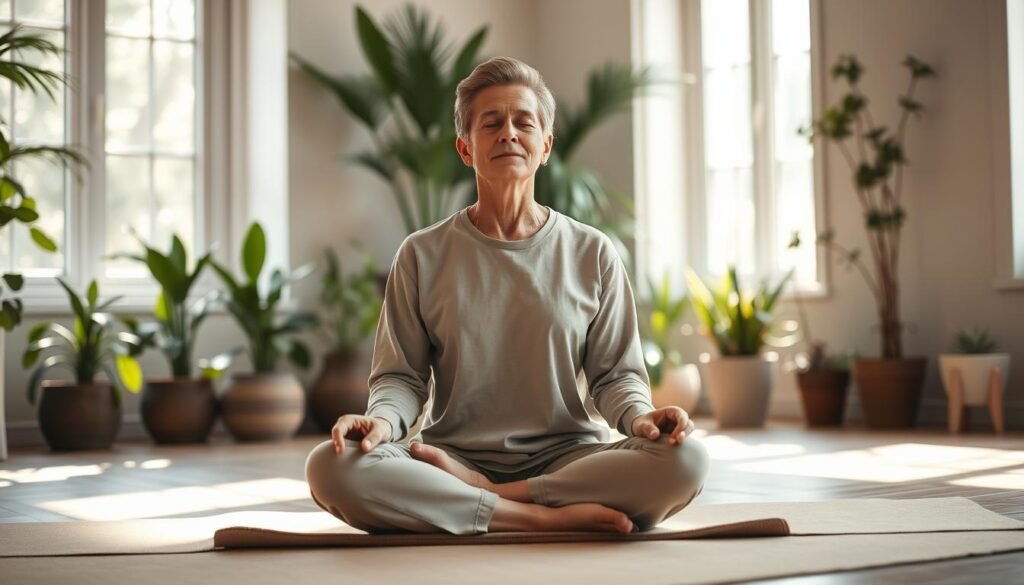
Standing root meditation: visualize feet growing roots
Stand tall with soft knees. Imagine roots from your feet drawing steady support up through the legs and into the root chakra.
Use this brief meditation before calls or during transitions. If you want a guided option, try a guided grounding session for a quick reset.
- Tip: use these tools in line, at your desk, or between flights—no outfit change needed.
- Keep it gentle: prioritize comfort so you repeat them across a busy life.
Alignment, safety, and props: feel stable and secure on the mat
Smart alignment and props make grounding feel safe and repeatable. After travel or long sitting, rehydrate fascia with gentle, fluid movement before intensity.
After long sitting or travel, fascia can take 30–40 minutes to rehydrate. Move with light, gliding actions and small bounces to restore ease in the back and hips.
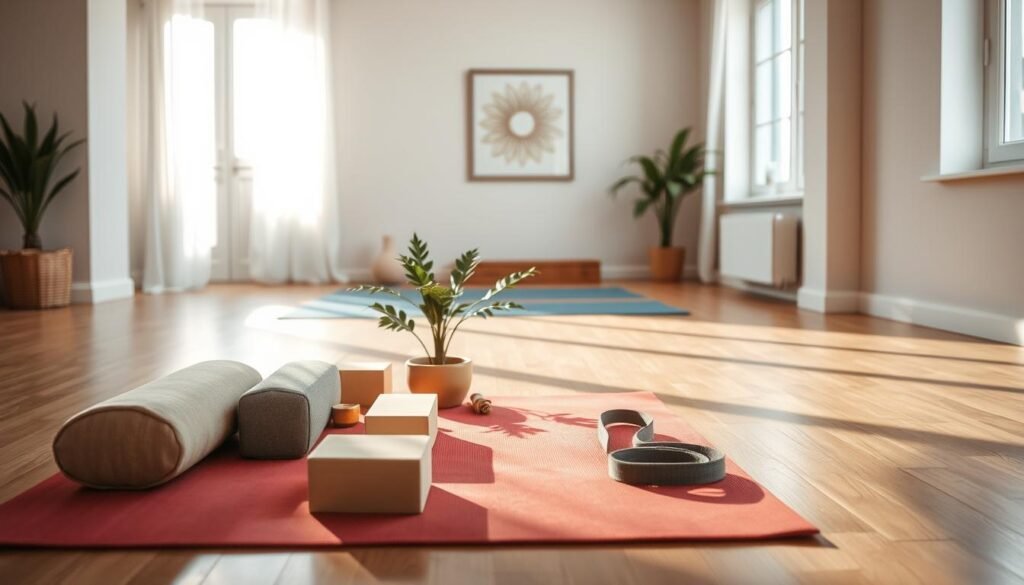
Fascia rehydration: ease in after sitting or travel
Start sessions with smaller ranges of motion. Let the spine and hips warm gradually before deep work. Use smooth, lateral glides and soft rebounds to wake tissue without strain.
Use blocks, bolsters, and wall support for reliable grounding
Place blocks under the hips in Garland so the floor comes up to you. A bolster eases supported backbends and reduces compressive load on the ribs.
For balance, use the wall to reduce wobble and let your nervous system settle. Track knees over second toes in squats and distribute pressure evenly through the feet and hands to protect joints.
- Keep shoulder space: soften the ribs and widen collarbones; avoid shrugging toward the ears.
- Stable first, then expand: only deepen a shape when breath stays smooth and attention is steady.
- Refine alignment: review alignment cues from an experienced yoga teacher and try an alignment cues guide for specifics.
For how support tools reduce strain and improve movement quality, read about functional training for injury prevention.
Make it stick: routine-building for life, work, and travel
Tie grounding to daily cues so it becomes automatic. Pack short travel sequences and breathwork to stay steady on the go.
Choose a consistent slot—wake-up, lunch, or post-commute—and link the sequence to a simple cue, like coffee brewing or closing your laptop. This small cue turns intention into habit and makes a short sequence feel natural each day.
Daily rhythm and cues: morning, mid-day, or evening resets
Pick three go-to options you can do without gear: a standing root check, a chair variation, and a 2–3 breath closing. Keep each under five minutes so you repeat them.
Track adherence with a habit app or calendar checkmark. Consistency beats duration: daily micro-sessions compound into more reliable energy and better back and body comfort.
Travel-ready sequences: airports, hotels, and tight spaces
Travel stiffens the body. Start with gentle standing work—Tadasana and a Standing Root Meditation—then add Chair, Low Lunge, Warrior II, or Tree as space allows.
In hotels, use the wall for balance and a towel as a mat. In airports, favor equal-count breathing and small shoulder and hip micro-mobilizations for discreet resets.
| Situation | Quick sequence | Finish |
|---|---|---|
| Morning at home | Tadasana → Chair → 3-part breath | 2 sealing breaths, short body check |
| Mid-day at work | Standing root check → Shoulder rolls → Low lunge | Equal-count breathing (4/4) |
| Travel: airport/hotel | Wall-supported Tree → Warrior II → gentle hip openers | 2–3 slow exhales to reset energy |
Keep a simple kit: a folded towel, a light block, a timer, and a short list of go-to shapes. Reassess every two weeks and adjust length and poses to fit your life and current energy.
For building a morning anchor that fits a busy schedule, see this easy morning routine guide.
Closing your practice: centering, Savasana, and reflection
Finish by slowing your breath and noticing earth contact points. Seal the session with a simple reflection and a carry-forward intention.
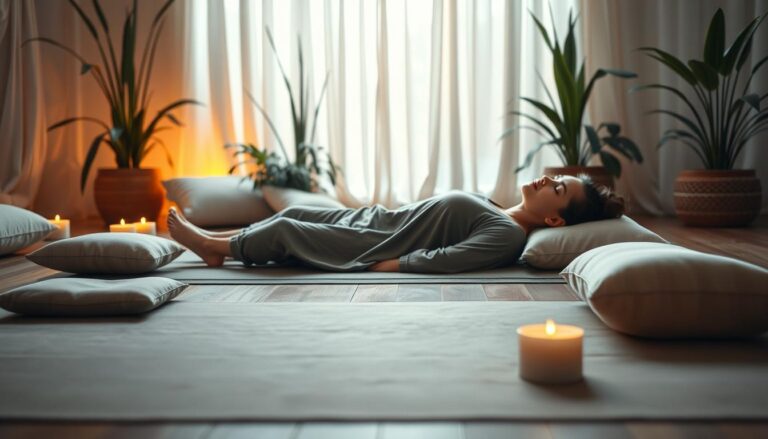
End by slowing the tempo of the breath and noting where the body meets the floor. Lie supine on the mat and let weight release into support beneath you.
Body scan, earth contact points, and breath down-regulation
Begin with four to six quiet breaths. With each exhale, soften the jaw and the soft tissue around the eyes.
Notice contact under heels, calves, hips, shoulders, and head. Move attention slowly from toes to crown and observe areas of ease or tension without judging them.
Set an intention to carry your grounded energy into the day
Reflect briefly: What changed since I began? Note subtle shifts in calm, clarity, or physical comfort.
Choose a one-line intention to carry forward—an anchor for your next context. Examples: “I bring steadiness to my next meeting” or “I act from calm presence.”
“Close with a moment of kindness toward yourself; small shifts in breath and attention change how you move through the rest of your day.”
Sit up slowly, acknowledge the time you took, and transition with purpose so the connection remains. For a scripted closing you can adapt for groups or classes, see a concise class closing script.
| Step | Action | Why it matters |
|---|---|---|
| 4–6 quiet breaths | Lengthen exhale; soften jaw | Down-regulates arousal and clears the mind |
| Body scan | Toes → crown; note ease or tension | Increases interoceptive awareness and presence |
| Earth contact check | Feel heels, calves, hips, shoulders, head | Reinforces physical support and stability |
| One-line intention | Pick a short carry-forward phrase | Helps transfer centered state into action |
Conclusion
Grounding is a practical, repeatable skill—start small and be consistent.
Use simple yoga poses, breath, and intention to build a steadier day and a clearer mind.
Tiny, repeatable habits transform how your body and mind respond across a busy day. The earth element and the Muladhara support stability and clarity in real-world moments.
Ground first, center second, then move with intention. That sequence keeps sessions efficient and meaningful for work, travel, or home life.
Keep it light: five minutes done often beats an occasional long session. Let a brief closing reflection guide choices so steadiness extends beyond the mat.
Revisit favorite shapes, breaths, and the root chakra regularly—depth grows from repetition, not complexity. Carry that centered energy into your day and notice the lasting connection to balance and calm.
FAQ
How long does a useful grounding session need to be if I’m short on time?
A meaningful session can be as short as five minutes. Use a focused sequence—Mountain pose for alignment, a three-part (Dirga) breath to calm the nervous system, then a quick body scan or standing root visualization. These elements reset posture, regulate breath, and anchor attention so you return to work feeling steadier and more centered.
What’s the difference between grounding and centering, and can I combine them?
Grounding involves connecting the body to the floor through feet, legs, hips and activating the root chakra for stability. Centering focuses on breath, mental clarity, and intention. They work together: start with grounding to establish safety and alignment, then use breathwork and a short meditation to center attention and carry calm into your day.
Which standing poses are best when I need immediate balance and focus?
Choose Mountain (Tadasana) for posture and spine alignment, Tree (Vrksasana) or Chair (Utkatasana) for single-leg balance and leg strength, and Warrior I or II for steady hips and a focused gaze. Hold each pose with steady breaths and imagine rooting through the feet to improve proprioception and mental clarity.
How can I adapt grounding work after long periods of sitting or travel?
Prioritize fascia rehydration and gentle hip-openers. Start with slow hamstring and back-body stretches like Staff (Dandasana) and Bridge to re-engage the posterior chain. Add Extended One-Legged Pigeon and Garland pose to release hips and thighs. Use blocks or a bolster for support and move deliberately to reduce stiffness and nervous-system reactivity.
What breath techniques help stabilize energy during a stressful meeting or commute?
Use three-part (Dirga) breath to expand belly, ribs, and chest—this increases vagal tone and calms the sympathetic response. Sama vritti (equal breathing) is also effective: inhale for a count, exhale for the same count to steady the mind. Both can be done seated or standing and require only a minute or two to lower heart rate and sharpen focus.
Are props necessary for feeling grounded, and which ones are most useful?
Props are helpful, especially when mobility or balance is limited. Blocks, bolsters, and a wall provide reliable support for stability and alignment. Blocks lift hips in seated or hip-opening poses, bolsters make Savasana and restorative holds accessible, and a wall helps train upright posture and foot-grounding in standing poses.
How do I build a routine that I’ll actually stick to with a busy schedule?
Pick a consistent anchor time—morning wake-up, mid-day break, or evening wind-down. Start with a short daily ritual (5–10 minutes) that combines one standing anchor, a breath practice, and a brief body scan. Gradually increase duration as it becomes habit. Use cues (alarm, coffee, walk) and track progress to reinforce routine.
Can grounding sequences help with anxiety or sleep issues?
Yes. Sessions that combine feet-to-floor contact, slow Dirga breath, and a calming body scan down-regulate the nervous system. For sleep, include longer exhalations and a restorative Savasana with earth-contact points (heels, sacrum) to encourage parasympathetic activation and improved sleep onset.
What’s a simple travel-ready sequence I can do in an airport or hotel room?
Do a standing five-minute reset: Mountain pose with three-part breath, ankle and calf stretches, a few rounds of Chair or Tree for circulation and balance, and a short standing root meditation visualizing roots through your feet. Use the hotel wall for support if needed—this keeps mobility up and stress down while traveling.
How should I close a short grounding session to carry the effect into my day?
Finish with a centering ritual: a brief body scan, an intention statement (one clear sentence), and two to three deep, equal breaths. Lie or stand with a sense of earth contact—notice relaxed shoulders, a soft belly, and an oriented crown. This helps integrate physical stability with mental focus so grounded energy persists off the mat.