
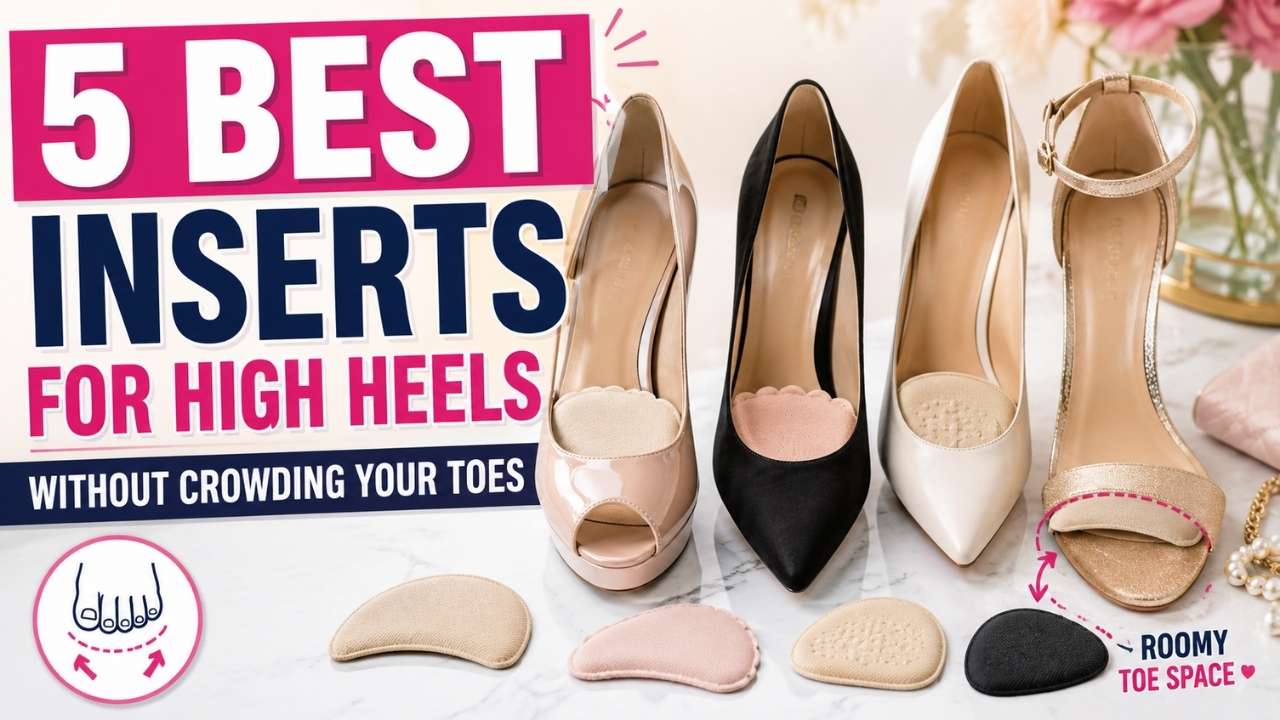

The best shoe inserts for high heels depend mostly on where the shoe is bothering you. If you want support through more of the foot, a structured 3/4 insert such as Superfeet Casual Easyfit High Heel is a strong fit for closed pumps, wedges, and other heels with enough interior room.
If the shoe is already snug, a larger insert can create a new problem by crowding your foot. Pedag Lady Gel keeps bulk low while cushioning both the forefoot and heel, while Foot Petals Tip Toes uses even less space by focusing only on the ball of the foot.
Start with the problem rather than the brand: use a forefoot cushion for pressure under the ball of the foot, a 3/4 insert for broader support, and a heel liner for rubbing or slipping at the back. There is no single insert that works best for every pair of heels.
Best Shoe Inserts for High Heels at a Glance
| Product | Best For | Key Strength | Main Tradeoff |
|---|---|---|---|
| Superfeet Casual Easyfit High Heel | Structured support | Thin 3/4 high-heel-specific design | More substantial and pricier than small pads |
| Pedag Lady Gel | Minimal-bulk cushioning | Very thin forefoot-and-heel cushioning | Less structured than Superfeet |
| Foot Petals Tip Toes | Ball-of-foot cushioning | Uses very little shoe space | No broader arch or heel support |
| Dr. Scholl’s Stylish Step High Heel Relief | Mainstream gel option | High-heel-specific gel format | Availability evidence is less straightforward |
| Dr. Scholl’s Stylish Step Gel Heel Liners | Heel slipping and rubbing | Targets the back of the shoe | Does not address forefoot pressure |
Best Shoe Inserts for High Heels
Superfeet Casual Easyfit High Heel — Best Overall / Best Structured Support

Amazon Link: Check Price on Amazon
Best For: Closed pumps, dress shoes, and wedges where you want support through more of the foot rather than cushioning in one small area.
Why It Stands Out: Superfeet Casual Easyfit High Heel is the most structured pick here. The thin 3/4 profile is made specifically for heeled footwear, so it gives you more support than a small gel pad without taking up the space of a conventional full-length insole. It also drops into the shoe without trimming.
Price Position: The manufacturer listed it at approximately $34.99 at research time, so it sits well above basic gel pads. Amazon pricing may vary.
Key Buying Details:
- Designed specifically for high-heeled footwear.
- Listed for heels of 1 inch or more.
- Thin profile with firm cushioning.
- Drop-in design requires no trimming.
- Slip-resistant ridges are designed to help keep it positioned.
- Microsuede top cover.
Key Pros:
- Gives you broader support than a small forefoot pad.
- Designed around the limited space inside high-heeled shoes.
- No trimming required.
Key Cons:
- Costs more than basic gel cushions.
- Can still take up too much room in a very tight or open shoe.
What Buyers Commonly Notice: Manufacturer-site reviews checked during research included favorable comments about stability, use in heeled boots, light arch support, and filling a little extra shoe volume. Those are recurring observations from the comments reviewed, not outcomes every wearer should expect.
Good Fit If: You want more structured support in a closed high heel and the shoe has enough room for a 3/4 insert.
Skip If: Your heels are already extremely tight, very strappy, or only need cushioning under the ball of the foot.
Bottom Line: Pick Superfeet when you want the insert to do more than cushion one pressure point. You are giving up some interior space and paying more, but you get the broadest support of the five options here.
View Superfeet Casual Easyfit High Heel on Amazon
Pedag Lady Gel — Best Ultra-Thin Gel Insert

Amazon Link: Check Availability on Amazon
Best For: Buyers who want cushioning beneath both the forefoot and heel but cannot spare much room inside the shoe.
Why It Stands Out: Pedag Lady Gel is useful when a tiny forefoot pad feels too limited but a more structured insert would make the shoe too crowded. At about 0.1 inch thick, it adds cushioning across more than one area without behaving like a bulky conventional insole.
- German-Made Ultra-Thin Insoles - High heel inserts crafted with slim gel and velour top for light support and cushioning. Perfect fit heel inserts for loose shoes.
- Velvety Comfort - Experience the plushness of our velour surface and gel cushion heel pads. Ideal for high heels, pumps, open toes, and sandals.
- Customizable and Vegan - Shoe sole inserts for women that are trimmable, washable, self-adhesive, removable, and reusable. Easy to maintain.
- Painless High Heel Experience - These gel inserts for high heels make walking and standing easier on your feet, transforming your shoe comfort.
Key Buying Details:
- Approximately 0.1 inch thick.
- Gel construction with a velour top.
- Includes metatarsal-area and heel cushioning.
- Self-adhesive.
- Listed as washable and reusable.
- The verified medium listing is for US women’s sizes 8–10 / EU 38–40.
Key Pros:
- Much slimmer than a conventional insole.
- Cushions more than one area of the foot.
- Works well for shoes where interior space is limited.
Key Cons:
- Does not provide the same firm structure as Superfeet.
- The verified listing applies to a specific size range rather than every size.
Good Fit If: You want low-bulk cushioning through more of a pump or dress heel without filling the shoe.
Skip If: Firm arch support is what you are primarily looking for.
Bottom Line: Pedag is the better fit when your shoes leave very little room but you still want cushioning beyond the forefoot alone. It trades structure for a noticeably slimmer profile.
Foot Petals Tip Toes — Best Ball-of-Foot Cushion
Amazon Link: Check Price on Amazon
Best For: Tight pumps, wedges, and dress heels where the discomfort is mostly under the forefoot and there is little room for anything larger.
Why It Stands Out: Foot Petals Tip Toes leaves most of the inside of the shoe alone. The pad sits under the ball of the foot rather than running through the arch or heel, which is useful when the front of the shoe hurts but a larger insert would crowd your toes.
Key Buying Details:
- Ball-of-foot cushion format.
- Approximate listed dimensions of 2.83 x 2.83 x 0.08 inches.
- Adhesive-backed design.
- PORON cushioning identified in current product information.
- Designed for several dress-footwear types including heels, pumps, and wedges.
Key Pros:
- Takes up very little space inside the shoe.
- Places cushioning directly under the forefoot.
- Leaves the heel and most of the shoe interior unchanged.
Key Cons:
- Does not add broader arch or heel support.
- The adhesive design is less convenient if you want to move one pair back and forth between several shoes.
What Buyers Commonly Notice: The limited comments checked during research included users who liked the cushioning for standing or dancing in heels. One wanted more thickness, while another noted that the standard adhesive version is not especially convenient for repeated transfers between shoes.
Good Fit If: Pressure under the ball of your foot is the main issue and your heels have almost no extra space for a conventional insole.
Skip If: You need support through the midfoot or are trying to stop rubbing at the heel.
Bottom Line: If a full or 3/4 insert would make your shoes too tight, this targeted pad is easier to live with. It solves a smaller problem, but that is exactly why it works well in low-volume heels.
View Foot Petals Tip Toes on Amazon
Dr. Scholl’s Stylish Step High Heel Relief — Best Mainstream Gel Option

Amazon Link: Check Availability on Amazon
Best For: Buyers who prefer a familiar foot-care brand and want a slim gel insert designed specifically for high heels.
Why It Stands Out: This Dr. Scholl’s option falls between the tiny footprint of a forefoot pad and the firmer structure of Superfeet. Its clear gel design gives you more coverage than a small cushion while still being shaped for high-heeled shoes rather than looking like a standard full-length insole.
- Designed specifically for women with foot pain from high heels
- Ultra-Soft Gel Arch - Shifts pressure off ball of foot
- Discreet Design – Clear gel and slim design won’t make shoes feel tight
- Designed for all high heels 2” and higher
Key Buying Details:
- Women’s size range listed as 6–10.
- Gel-based clear/slim design.
- Designed for high heels of 2 inches or more.
- Product information describes an ultra-soft gel arch and forefoot-focused design.
- One pair.
Key Pros:
- Made specifically for high-heel use.
- Covers more of the foot than a small ball-of-foot pad.
- Offers a familiar mainstream alternative to more specialized brands.
Key Cons:
- Current availability evidence is less straightforward than for the stronger shortlist options.
- Its sizing and coverage will not suit every foot or shoe equally well.
What Buyers Commonly Notice: A limited set of comments reviewed during research mentioned useful front cushioning and arch support. Another buyer raised concerns about sizing and how much of the foot the insert covered.
Good Fit If: You want a high-heel-specific gel insert with more coverage than a small forefoot pad but do not want a firmer structured design.
Skip If: You want the better-documented structured pick or only need a small cushion under the ball of the foot.
Bottom Line: This is a reasonable middle-ground gel choice, especially if you prefer Dr. Scholl’s, but it is worth checking the current listing and size coverage before ordering.
See Dr. Scholl’s High Heel Relief on Amazon
Dr. Scholl’s Stylish Step Gel Heel Liners — Best for Heel Slipping and Rubbing

Amazon Link: Check Price on Amazon
Best For: Heels that feel fine through the forefoot but rub at the back or allow too much movement around your heel.
Why It Stands Out: This is the odd one out in the shortlist, and that is useful. Instead of sitting beneath your foot, the liner goes at the back of the shoe. If the real problem is heel rubbing or movement, adding more padding under the forefoot would miss the point.
Price Position: Recent Amazon.com price-tracking data showed approximately $5.99, although current pricing can change.
Key Buying Details:
- Gel heel-liner format.
- One pair.
- One-size design.
- Intended to help reduce rubbing and slipping at the heel.
Key Pros:
- Deals directly with problems at the back of the shoe.
- Does not add extra material beneath the forefoot.
- Useful when the rest of the shoe already feels comfortable.
Key Cons:
- Does little for pressure beneath the ball of the foot.
- Does not replace a supportive insole when broader support is what you need.
Good Fit If: Your heel slips or rubs but the rest of the shoe fits reasonably well.
Skip If: Forefoot pressure is what sent you looking for an insert in the first place.
Bottom Line: Use heel liners for a problem at the heel. They are small and inexpensive compared with larger inserts, but they are not designed to solve forefoot discomfort or provide broader support.
View Dr. Scholl’s Gel Heel Liners on Amazon
Best Shoe Inserts for High Heels by Use Case
Choose a Ball-of-Foot Cushion When…
The pressure is mostly under the front of your foot and there is almost no spare space inside the shoe. Foot Petals Tip Toes is the most targeted option here because the pad leaves the rest of the shoe largely unchanged.
Choose a 3/4 Insert When…
You want support beyond the forefoot and your shoe has room for something more substantial. Superfeet Casual Easyfit High Heel is the strongest choice for that job.
Choose an Ultra-Thin Gel Insert When…
You want cushioning under more than one part of the foot but a conventional insole would take up too much space. Pedag Lady Gel is the lowest-bulk broader-cushioning option in this group.
Choose a Heel Liner When…
The shoe rubs or slips at the back, while the forefoot feels reasonably comfortable. In that case, Dr. Scholl’s Stylish Step Gel Heel Liners address the actual fit problem more directly than a larger insole.
Side-by-Side Comparison of the Top Picks
| Product | Best Use Case | Key Strength | Main Tradeoff |
|---|---|---|---|
| Superfeet Casual Easyfit | Broader structured support | 3/4 high-heel-specific design | Needs more room than a small pad |
| Pedag Lady Gel | Low-bulk overall cushioning | About 0.1 inch thick | Less structured support |
| Foot Petals Tip Toes | Forefoot pressure | Minimal shoe-space use | No broader support |
| Dr. Scholl’s High Heel Relief | High-heel-specific gel cushioning | Middle-ground gel format | Availability requires checking |
| Dr. Scholl’s Gel Heel Liners | Heel rubbing or movement | Targets rear shoe fit | Does not cushion the forefoot |
The main decision is not which insert has the most padding. It is where you need help and how much room the shoe gives you. A forefoot pad, 3/4 insert, and heel liner solve three different problems, even though all three may be sold as ways to make heels more comfortable.
What Actually Matters Before Buying an Insert for High Heels
Where Your Foot Needs Cushioning or Support
Start with the part of your foot that is uncomfortable. If the pressure is concentrated beneath the ball of the foot, adding a small forefoot pad may be enough. If you want support through more of the foot, look at a 3/4 insert. Rubbing at the back of the heel needs a different product altogether.
How Much Space Your Shoe Has
This matters more in heels than it does in many roomier shoes. Even a thin insert takes up some interior volume, and an already-snug pump can quickly become cramped. Pointed-toe dress shoes usually leave less room to work with than wedges or heeled boots.
Closed Pumps vs Open and Strappy Heels
Closed pumps can hide and hold a larger insert more easily. Very open or strappy heels may leave a 3/4 insert visible or may not hold it securely enough. Superfeet specifically does not recommend its Casual Easyfit High Heel for very open sandal-style footwear.
Insert Thickness
More cushioning is not automatically more comfortable. Extra material can crowd your toes or change how securely the shoe holds your foot. If space is tight, a thinner insert may give you a better overall fit even if it provides less padding.
Adhesive vs Drop-In Designs
Adhesive pads work well when you plan to leave them in one pair of shoes. They are less convenient if you want to move the same pad between several pairs. A drop-in insert is easier to remove and reuse, as long as your shoe has enough room to hold it securely.
Forefoot Cushioning vs Broader Support
OTC shoe inserts are consumer comfort and support products, not substitutes for prescription orthotics or medical care. Choose the format that matches the problem you are trying to address rather than assuming the largest or firmest insert will fix every source of discomfort.
Common High-Heel Insert Buying Mistakes
Adding Too Much Thickness
If the shoe already feels tight, adding layers of cushioning can simply move the discomfort somewhere else. Use the least bulky insert that addresses the problem you actually have.
Treating Heel Liners as Forefoot Cushions
A heel liner works at the back of the shoe. It is not an alternative to a ball-of-foot cushion just because it is smaller or cheaper.
Ignoring an Already-Poor Shoe Fit
An insert cannot turn a shoe that is clearly too short, too narrow, or excessively tight into a properly fitting shoe. If the basic fit is wrong, adding padding may make matters worse.
Assuming Premium Support Is Always Better
A structured 3/4 insole is useful when you genuinely want broader support. For a close-fitting pump worn occasionally, a small targeted cushion may be easier to wear and less likely to crowd the shoe.
Safety and Expectation Notes
High heels shift more pressure toward the front of the foot. Inserts may make a pair feel more comfortable or improve the fit, but they do not remove the effects of wearing elevated footwear.
Consumer shoe inserts can add cushioning or support, but they should not be treated as a cure for ongoing foot problems or as a replacement for professional assessment when symptoms persist.
If a particular pair repeatedly causes significant pain, numbness, swelling, or other recurring symptoms, adding more padding is not a good substitute for reconsidering the shoe itself or seeking appropriate professional guidance.
How to Use High-Heel Inserts at Home
- Identify the problem first. Work out whether you are dealing with forefoot pressure, a need for broader support, heel rubbing, or too much movement inside the shoe.
- Check available space. If the shoe already feels snug, start with the thinnest insert that addresses the problem.
- Position targeted pads carefully. A ball-of-foot cushion should sit under the forefoot rather than being pushed forward beneath the toes.
- Test the shoe indoors first. Walk around for a short time and make sure the insert has not created a new pressure point or crowded your toes.
- Do not stack products automatically. Several small pads can change the fit more than you might expect.
- Reassess the shoe itself. If it remains significantly uncomfortable, the shoe may be the problem rather than the insert.
How We Chose These High-Heel Inserts
We chose these products around different shoe and fit problems rather than ranking five similar inserts. The main factors were verified product type, listed thickness or format where available, intended use in heels, the amount of shoe space each option requires, and the specific problem it is meant to address.
Superfeet covers the structured-support role. Pedag is the low-bulk option when you want cushioning across more than one area. Foot Petals focuses narrowly on the forefoot. Dr. Scholl’s High Heel Relief gives buyers a more familiar gel-based alternative, while the heel liners are meant for rubbing and movement at the back of the shoe.
No hands-on testing is claimed. The recommendations are based on the verified product details supplied for each shortlisted option.
Final Verdict
If you want the most structured support and your closed pump, wedge, or dress shoe has enough room for it, Superfeet Casual Easyfit High Heel is the best overall pick in this group.
For tighter shoes, Pedag Lady Gel gives you broader cushioning with much less bulk. If nearly all of the discomfort is under the ball of your foot, Foot Petals Tip Toes is the more focused choice and leaves more room inside the shoe.
If the problem is rubbing or movement at the back, skip the forefoot inserts and use a product meant for that area, such as Dr. Scholl’s Stylish Step Gel Heel Liners. The best insert is the one that fixes the specific fit issue without creating a new one by making the shoe too tight.
Frequently Asked Questions
What type of shoe insert works best in high heels?
Match the insert to the problem. Ball-of-foot cushions are useful for targeted forefoot pressure, 3/4 inserts provide broader support, thin gel inserts add cushioning without much bulk, and heel liners are designed for rubbing or slipping at the back.
Are ball-of-foot cushions better than 3/4 insoles for high heels?
They can be better in a tight shoe because they take up less space. A 3/4 insole is more useful when you want support through more of the foot and the shoe has enough room for it.
Can shoe inserts make high heels feel too tight?
Yes. Every insert takes up some interior space. This is especially noticeable in pointed pumps, close-fitting dress shoes, and any pair that already feels snug.
Where should a ball-of-foot cushion sit inside a high heel?
Place it beneath the forefoot where you need the cushioning, not so far forward that it sits under the toes. With an adhesive pad, test the position carefully before pressing it firmly into place.
Can I use regular full-length insoles in high heels?
Many high heels do not have enough room for a conventional full-length insole. A slim 3/4 insert or targeted cushion is often easier to fit without crowding the shoe.
What kind of insert helps stop my foot from sliding forward in heels?
A forefoot cushion may improve contact and fit when your foot tends to move forward, but the shoe still needs to fit properly. An insert should not be used to compensate for a shoe that is clearly too large or poorly shaped for your foot.
What should I use if the back of my high heel rubs my heel?
A heel liner is the more relevant product type. Dr. Scholl’s Stylish Step Gel Heel Liners are designed for rubbing and slipping around the back of the shoe rather than pressure beneath the forefoot.
When is foot pain from high heels a reason to stop wearing them instead of adding another insert?
If a pair causes significant or persistent pain, numbness, swelling, or recurring symptoms, adding more cushioning should not be your only response. Reconsider the fit of the shoe and seek professional guidance if the symptoms continue.

Don’t Miss These Picks