


I used to wake up with a knot in my chest and a stream of worries already running through my mind. Small tasks felt heavier than they should, and I could spend too much time imagining what might go wrong before I had even started the day.
For 30 days, I tried a simple routine built around short journal prompts, CBT-informed questions, and sensory grounding. I usually spent only a few minutes writing. Over that month, I noticed fewer worry spikes and found it easier to move from repetitive thoughts toward something I could actually do.
That is my personal experience, not proof that journaling will affect everyone the same way. Research on expressive writing is mixed, but structured writing can be a useful self-help tool, while approaches such as cognitive behavioral therapy (CBT) have much stronger evidence for treating anxiety. The goal here is simple: use writing to notice what is happening, question unhelpful thoughts, and choose a useful next step.
Key Takeaways
- Short journal sessions can make recurring worries, triggers, and body signals easier to notice.
- CBT-informed questions can help separate a frightening prediction from what you actually know and can control.
- Sensory grounding redirects attention toward what is happening around you right now.
- You do not need long entries. A few focused lines can be easier to repeat consistently than a demanding journaling routine.
- Journaling can support anxiety management, but it should not be treated as a replacement for professional care when anxiety is severe or persistent.
Helpful Products at a Glance
If seeing time pass helps you keep journal sessions short, the TIME TIMER MOD is an optional visual timer; a phone timer works just as well if you do not want another device.
- TIME MANAGEMENT - use this 60 minute analog countdown clock to stay on task, assists with organization and concentration. As time expires, the visible display of the red disk disappears in clockwise direction. Ideal for individual use or small groups
- HIGHLIGHTS: Removable silicone cover offers an extra layer of protection from the bumps and falls of everyday life. Portable and easy to use anywhere from your office or school desk, in-home learning center, playroom, or kitchen.

Why Journaling May Help When Your Mind Gets Stuck in Worry
Anxiety can make the same thought feel urgent every time it appears. Writing creates a little distance between having a thought and automatically reacting to it. Instead of carrying everything in your head, you can look at the worry in front of you and decide what deserves attention.
This idea overlaps with CBT, which helps people notice inaccurate or unhelpful automatic thoughts, examine them, and change patterns of thinking and behavior. The National Institute of Mental Health describes CBT as a well-studied treatment for generalized anxiety disorder.

Journaling itself has a less predictable evidence base. Some studies of expressive writing have found improvements in anxiety in specific groups, while others have found little overall benefit. That is a good reason to think of journaling as a practical coping tool rather than a guaranteed anxiety treatment.
| Practice | Suggested Time | Main Purpose |
|---|---|---|
| Awareness check | 3–5 minutes | Notice thoughts, triggers, and body signals |
| CBT-informed reframe | 5–8 minutes | Question a worry and identify a useful action |
| Sensory grounding | 2–5 minutes | Bring attention back to the present |
Those times are practical starting points, not clinically proven doses. I found short sessions easier to repeat, which mattered more than trying to write a perfect journal entry.
How to Start a Journaling Routine You Can Actually Maintain
You do not need a special anxiety journal. Any notebook, loose paper, or secure notes app can work. Keep the setup simple enough that you can begin without preparing your environment first.
I also found it useful to set a short timer. Knowing that I only needed to write for a few minutes made starting easier and prevented the exercise from turning into an open-ended period of worrying on paper.
If checking a phone tends to distract you, a separate visual timer can provide the same boundary without opening notifications or other apps. The TIME TIMER 60 Minute MOD Education Edition is one option because it visually shows the remaining time. It is optional equipment, not part of the therapeutic technique.
- TIME MANAGEMENT - use this 60 minute analog countdown clock to stay on task, assists with organization and concentration. As time expires, the visible display of the red disk disappears in clockwise direction. Ideal for individual use or small groups
- HIGHLIGHTS: Removable silicone cover offers an extra layer of protection from the bumps and falls of everyday life. Portable and easy to use anywhere from your office or school desk, in-home learning center, playroom, or kitchen.
- SPECIAL NEEDS: The visual design of the Time Timer helps with anticipating transitions and encourages independence and productivity for all abilities, including those with Autism, ADHD, or other special needs – both at home and at school
- QUIET OPERATION: No loud ticking provides silence and focus for school, homework, and other silent activities. Intuitive Assistive Tech - Ideal for special needs, children, parents, teachers, office staff / professionals, and students
Choose one repeatable time of day rather than waiting until you feel motivated. You might write after breakfast, before starting work, or during an evening wind-down. Keeping your journal somewhere visible can also reduce the effort needed to begin.
For your first week, forget about writing beautifully. One honest sentence is enough. The purpose is to notice what is happening and respond more deliberately, not to create something worth rereading.

5 Journal Prompt Sets for Anxiety
You do not need to answer every prompt every day. Choose the set that matches what is happening in the moment. Some days you may need to understand a worry; on others, you may simply need to reconnect with the room around you.

Prompt Set 1: Notice Thoughts, Feelings, and Body Signals
Start by noticing what happens before anxiety becomes intense. Your earliest clue might be a thought, tight shoulders, a racing heartbeat, irritability, difficulty concentrating, or the urge to avoid something.

Questions to write about
- What was happening just before I started feeling anxious?
- What thought appeared first?
- Where do I notice tension or discomfort in my body?
- Was there a particular person, task, place, topic, or time of day involved?
- What did I feel like doing next: avoiding, checking, rushing, arguing, withdrawing, or something else?
Do not judge the answers. You are collecting clues. After several entries, look for patterns rather than treating one difficult day as proof that something is always a trigger.
A useful final question is: “Is this thought helping me respond to a real problem, or is it keeping me on alert without giving me anything useful to do?”
Prompt Set 2: Move from Worry to CBT-Informed Action
CBT does more than tell you to “think positively.” It teaches you to examine thoughts more carefully and look for more balanced ways of interpreting a situation. The American Psychological Association explains that CBT helps people understand how thoughts contribute to anxiety and learn ways to change unhelpful patterns.
Try writing one anxious prediction at the top of the page. Then slow the thought down instead of immediately treating it as a fact.
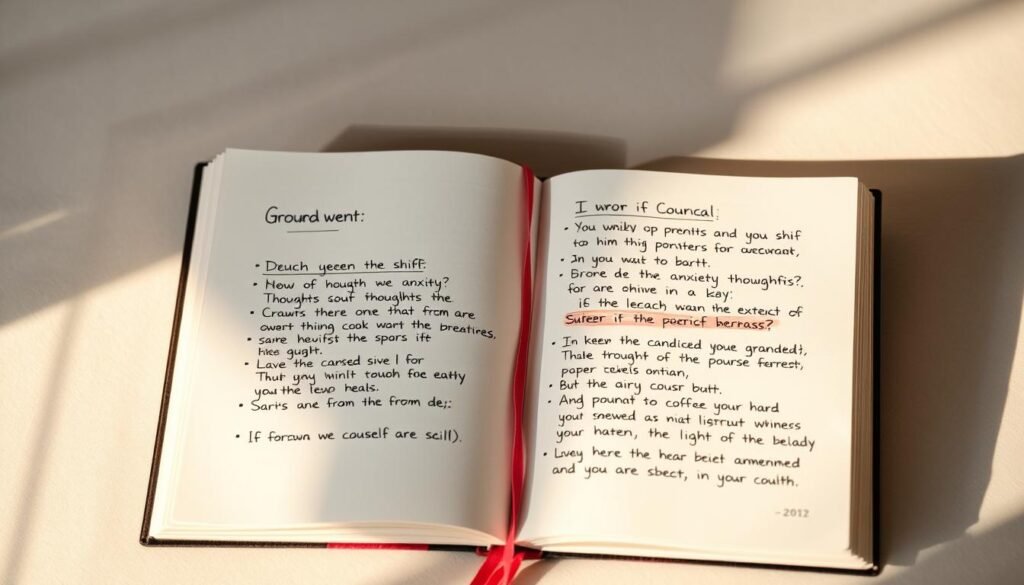
Use these questions
- What am I afraid will happen?
- What evidence supports that prediction?
- What evidence does not support it?
- What would I tell a friend who had this same worry?
- What is actually under my control?
- What is one useful step I can take today?
You can also divide a page into two columns: “What I fear” and “What I can do.” If the second column contains an action, choose the smallest realistic one. If there is nothing you can do right now, the next skill may be tolerating uncertainty rather than continuing to solve the same thought.
| Question | What It Helps You Examine |
|---|---|
| What do I know for certain? | Facts versus predictions |
| What am I assuming? | Unproven conclusions |
| What can I control? | Useful next actions |
| What would be “good enough”? | Perfection and excessive checking |
Prompt Set 3: Use Your Senses to Return to the Present
When your attention is pulled into a frightening future scenario, grounding shifts attention toward what is happening around you now. The U.S. Department of Veterans Affairs teaches sensory grounding as a way to help people focus on the present, including noticing what they can see, hear, and feel.

You can turn that technique into a very short journal exercise. Look around slowly and write what you actually notice rather than what your anxious mind predicts.
- See: What color, object, shape, or movement catches your attention?
- Hear: What is the closest sound? What is the farthest?
- Touch: What do the chair, floor, clothing, or an object feel like?
- Smell: Is there a noticeable scent nearby?
- Taste: What taste is present right now?
You do not have to use all five senses. The VA notes that grounding can be adjusted, and if a technique makes you more distressed instead of helping you orient to the present, stop and try something else.
Afterward, write one line: “What changed, even slightly?” You may feel calmer, unchanged, or still anxious. The point is to observe honestly rather than force yourself to report improvement.
For another approach to noticing the connection between physical sensations and emotions, see our guide to somatic therapy and mind-body awareness.
Prompt Set 4: Create a Small Intention for the Day
This set is useful when you understand what is bothering you but need help deciding how you want to respond. Keep the answers short so the exercise feels more like direction than another task.
- Today I’m practicing…
- One small action I can take is…
- I will know I am getting pulled into worry when…
- When that happens, I will try…
- Something I do not need to solve today is…
The goal is not to predict exactly how you will feel. Focus on actions you can choose even if some anxiety is still present.
Prompt Set 5: Add Self-Compassion and a Future-Focused Perspective
Anxiety can make a difficult moment feel permanent. A future-focused prompt can widen your perspective without pretending that everything is fine.
- What did I handle better today than I am giving myself credit for?
- What would I say to someone I care about in this situation?
- What is one thing I am grateful for without forcing myself to ignore what is difficult?
- What mistake or uncomfortable feeling can I respond to with more patience?
- What is one small way I want to show up tomorrow?
If gratitude prompts feel fake on a difficult day, skip them. Self-compassion does not require denying anger, fear, disappointment, or uncertainty.
How I Used the Prompts for 30 Days
I did not answer all five sets every day. I picked the one that matched what was happening and usually stopped after a few minutes. That made the routine much easier to maintain.
A simple weekly rhythm can look like this:
- Monday: awareness and body signals
- Tuesday: CBT-informed reframe
- Wednesday: sensory grounding
- Thursday: intention and action
- Friday: self-compassion and perspective
- Weekend: reread a few entries and notice patterns without grading yourself
Another option is to ignore the schedule and use the prompt that fits your immediate need. Consistency can help you learn your patterns, but there is no evidence that missing a day ruins the practice.
What to Do If Journaling Turns into More Rumination
Writing is not automatically helpful. If you notice yourself repeating the same frightening prediction for several pages without gaining clarity, add structure instead of simply writing longer.
End the entry with one of these questions:
- What fact do I know right now?
- Is there an action I can realistically take?
- If there is no action, what can I return my attention to?
- Would grounding be more useful than more analysis?
- What would help me stop revisiting this for the next hour?
Some expressive-writing research has produced mixed results, and one randomized study found that outcomes differed depending on individual characteristics. If writing repeatedly leaves you more distressed, it is reasonable to shorten the exercise, switch to grounding, or discuss the reaction with a mental health professional.
Conclusion: Start with One Prompt, Not All Five
You do not need a complicated journal routine. Choose one prompt, set aside a few minutes, and write an honest answer. If there is something useful you can do, name the smallest next step.
Over 30 days, that simple structure helped me notice worry earlier and spend less time automatically following it. Your experience may be different, so treat the prompts as tools to experiment with rather than a promise that anxiety will disappear.
If the routine helps, keep the prompts that consistently give you clarity and drop the ones that do not. A journal should make it easier to understand what is happening and decide what comes next—not become another thing you have to do perfectly.
Frequently Asked Questions
How quickly can journaling reduce anxiety?
There is no reliable timetable. Some studies have found anxiety improvements after structured writing programs, while other research has found little overall effect. Rather than expecting a change within a specific number of days, look for practical signs such as noticing patterns sooner, responding differently to a worry, or finding it easier to identify your next step.
Do I need a special anxiety journal?
No. A notebook, loose paper, or a secure notes app is enough. A guided journal can provide structure, but the prompts themselves matter more than the format.
What if I can only write for a few minutes?
That is fine. Try one question instead of an entire prompt set. A short routine that you can comfortably repeat may be more practical than forcing yourself through a long entry.
Are these prompts actually based on therapy techniques?
Some are adapted from ideas commonly used in evidence-based therapy, especially noticing automatic thoughts and testing them more carefully in CBT. Sensory grounding is also used in clinical settings to help bring attention back to the present. Journaling as a whole, however, should not be described as equivalent to CBT or professional treatment.
Can journaling replace therapy or anxiety medication?
No. Journaling can be a self-help or therapy-support tool, but treatment for significant anxiety may involve psychotherapy, medication, or both. If anxiety is persistent, severe, or interfering with work, school, sleep, relationships, or everyday activities, talk with a licensed mental health professional or another qualified health care provider.
What if journaling makes me feel worse?
Stop the entry instead of forcing yourself to continue. Try a present-focused grounding exercise, take a break, or bring the experience to a therapist if you have one. Writing about highly distressing experiences is not helpful for everyone.
Can I pair journaling with breathing or movement?
Yes, if those practices feel comfortable. You might take a few slow breaths, relax your shoulders, stretch briefly, or feel your feet against the floor before writing. Keep the extra step simple so it supports the routine instead of making it harder to begin.
How often should I review my journal?
Once a week is enough for many people. Look for repeated triggers, helpful responses, and actions that moved you forward. You do not need to analyze every sentence or repeatedly reread upsetting entries.
What should I do if anxiety becomes overwhelming?
Seek professional support rather than relying only on journaling. If you are in the United States and you are experiencing suicidal thoughts or an immediate mental health crisis, call or text 988 to reach the 988 Suicide & Crisis Lifeline. If there is immediate danger, contact emergency services.