


Sound can make a bedtime routine feel calmer, but the science is more nuanced than the idea that one “healing frequency” automatically switches the brain into sleep mode. Slow music, steady noise, singing bowls, and binaural beats may help some people relax, while responses vary widely.
Brainwaves are patterns of electrical activity measured with EEG. They are not the same thing as audible sound frequencies. Certain forms of rhythmic audio may influence attention, arousal, or brain activity, but researchers have not established a simple one-to-one rule such as “play a theta frequency and the brain enters theta.”
This guide explains what sound healing can realistically do, what research says about brainwave entrainment and sleep, and how to build a simple low-volume listening routine without turning relaxation into another complicated wellness project.
Key Takeaways
- Sound may support relaxation and create a predictable cue for winding down before bed.
- Binaural-beat research on direct brainwave entrainment remains mixed rather than conclusive.
- Singing-bowl meditation has shown promising short-term effects on tension and mood, but sleep-specific evidence is still limited.
- There is no single sound frequency proven to produce deep sleep for everyone.
- Comfortable volume, consistency, and personal preference matter more than chasing a supposedly perfect frequency.
Helpful Products at a Glance
For creating your own bowl-based meditation, the Ohm Store Tibetan Singing Bowl Set provides a compact bowl, striker, and cushion, although you do not need a physical instrument to practice sound-based relaxation.
- AUTHENTIC HAND-HAMMERED SOUND BOWL – Each singing bowl is 100% hand-hammered by skilled Nepalese artisans, creating a one-of-a-kind sound bath instrument. This traditional Tibetan singing bowl delivers a rich, calming tone for sound healing, yoga, and meditation.
- COMPACT & TRAVEL-FRIENDLY – At 3.5” in diameter, this small yet powerful meditation accessory fits in the palm of your hand, making it perfect for home, yoga studio, or travel use. Produces a clear, higher-pitched resonance ideal for personal mindfulness sessions.

For listening to relaxing tracks without conventional earbuds, the MUSICOZY Sleep Headphones eye mask combines flat Bluetooth speakers with a light-blocking mask, though a bedside speaker may be more comfortable if you do not like wearing anything while resting.
- Comfortable & Ergonomic Design: The MUSICOZY Bluetooth Eye Mask combines the benefits of Bluetooth headphones with a sleep mask; made from soft velvet and stretch cotton, it offers total darkness and comfort, ideal for side sleepers and those needing relaxation, naps, or peaceful sleep
- Long Battery Life with Type-C Charging: Featuring a 200mAh high-performance battery, these Bluetooth sleep headphones provide over 14 hours of continuous playtime on a single charge; perfect for a full night’s rest without worrying about interruptions or beeping alerts

What Is Sound Healing for Sleep?
Sound healing is a broad wellness term covering practices that use music, sustained tones, rhythmic audio, singing bowls, gongs, chimes, tuning forks, vocal tones, or environmental sounds to encourage relaxation.
A sound bath usually involves lying or sitting comfortably while a practitioner plays resonant instruments around the room. At home, the same general idea can be simplified to a quiet period of listening to relaxing music, nature sounds, bowls, or another audio track that feels calming rather than stimulating.
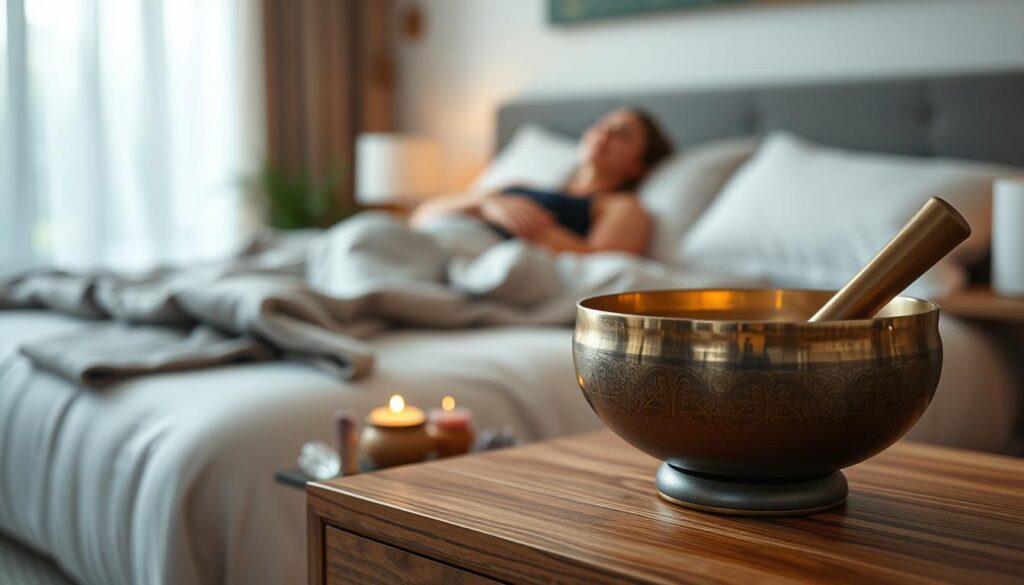
The appeal is easy to understand. Sound is noninvasive, requires little physical effort, and can become a consistent signal that the active part of the day is ending. That behavioral routine may be as important as the particular instrument or track you choose.
How Sound Frequencies and Brainwaves Are Actually Related
EEG recordings group brain activity into frequency bands that tend to appear more strongly during different states. Alpha activity is often associated with relaxed wakefulness, theta becomes more prominent during drowsiness and some stages of sleep, and delta activity is characteristic of deep non-REM sleep.
| Brainwave band | Approximate range | Common association |
|---|---|---|
| Beta | 13–30 Hz | Active thinking and alertness |
| Alpha | 8–12 Hz | Relaxed wakefulness |
| Theta | 4–8 Hz | Drowsiness and lighter sleep |
| Delta | 0.5–4 Hz | Deep non-REM sleep |

This does not mean that listening to an audible tone labeled “4 Hz” directly creates delta sleep. Most ordinary sound is far above EEG frequencies, and the auditory system and brain interact through much more complex processes.
What about binaural beats?
Binaural beats work differently. A slightly different audible tone is played into each ear. For example, 400 Hz in one ear and 410 Hz in the other can create the perception of a 10 Hz beat. Because that difference falls within EEG frequency ranges, researchers have investigated whether it can influence brain activity.
A 2023 systematic review of binaural-beat and EEG studies found inconsistent results: some experiments supported brainwave entrainment, while others did not. That makes binaural beats interesting, but not a proven shortcut for forcing the brain into a particular sleep stage.
What Does the Research Say About Relaxation and Sleep?
Research is more convincing for relaxation than for claims that specific sound frequencies reliably produce deeper sleep.
In an observational study of 62 adults, participants reported less tension, anger, fatigue, anxiety, and depressed mood after a Tibetan singing-bowl meditation. The design did not include a randomized control group, so the results cannot prove that the bowls themselves caused the changes. Still, the findings support further study of sound meditation as a relaxation practice. You can read the singing-bowl study here.

Sleep research on other types of audio is also mixed. A systematic review of white noise, pink noise, and combined audio interventions found positive results in some studies, but concluded that the overall evidence was not strong enough to confirm consistent sleep benefits. In practice, audio may still be useful when it masks distracting noise or helps you settle into a repeatable bedtime routine.
Sound-Healing Instruments: What Do They Actually Do?
Different instruments mainly change the texture, pitch, resonance, and duration of the listening experience. A gong produces a broad wash of overtones, while a small singing bowl creates a more focused sustained ring. Chimes provide shorter tones, and tuning forks produce relatively precise pitches.

There is no strong evidence that one of these instruments is universally better for sleep. What matters more is whether the sound feels pleasant, predictable, and nonintrusive to you.
You can start with a free recording before buying anything. If you enjoy creating the sound yourself, the Ohm Store Tibetan Singing Bowl Set is a compact hand-hammered bowl supplied with a wooden striker and cushion. Its value is practical: it gives you a physical instrument for meditation rather than promising a specific neurological or medical effect.
- AUTHENTIC HAND-HAMMERED SOUND BOWL – Each singing bowl is 100% hand-hammered by skilled Nepalese artisans, creating a one-of-a-kind sound bath instrument. This traditional Tibetan singing bowl delivers a rich, calming tone for sound healing, yoga, and meditation.
- COMPACT & TRAVEL-FRIENDLY – At 3.5” in diameter, this small yet powerful meditation accessory fits in the palm of your hand, making it perfect for home, yoga studio, or travel use. Produces a clear, higher-pitched resonance ideal for personal mindfulness sessions.
- COMPLETE SOUND HEALING SET – Includes a wooden striker and hand-sewn Tibetan cushion that allows the sound bowl to vibrate freely for longer, more soothing tones. Everything you need for meditation, sound healing instruments, or creating a peaceful space.
- DEEP MEDITATION & RELAXATION – The sound from this sound bowls meditation set helps entrain your brain into calming Theta states, supporting stress relief, emotional balance, and mental clarity. A must-have meditation accessory for anyone seeking inner peace.
If the ritual of striking or circling a bowl keeps you mentally engaged instead of relaxed, simply switch to a recording. A sound-healing routine should reduce effort, not create another task to perform perfectly.
A Simple 20-Minute Sound Routine for Bedtime
Begin about 20–45 minutes before your planned bedtime. Dim the lights, lower the room temperature if needed, and put away anything that keeps you actively scrolling or working.
Choose one gentle track: singing bowls, slow instrumental music, rainfall, pink noise, or another sound you already associate with relaxation. Keep the volume comfortable and resist the urge to constantly switch tracks looking for a “better” frequency.
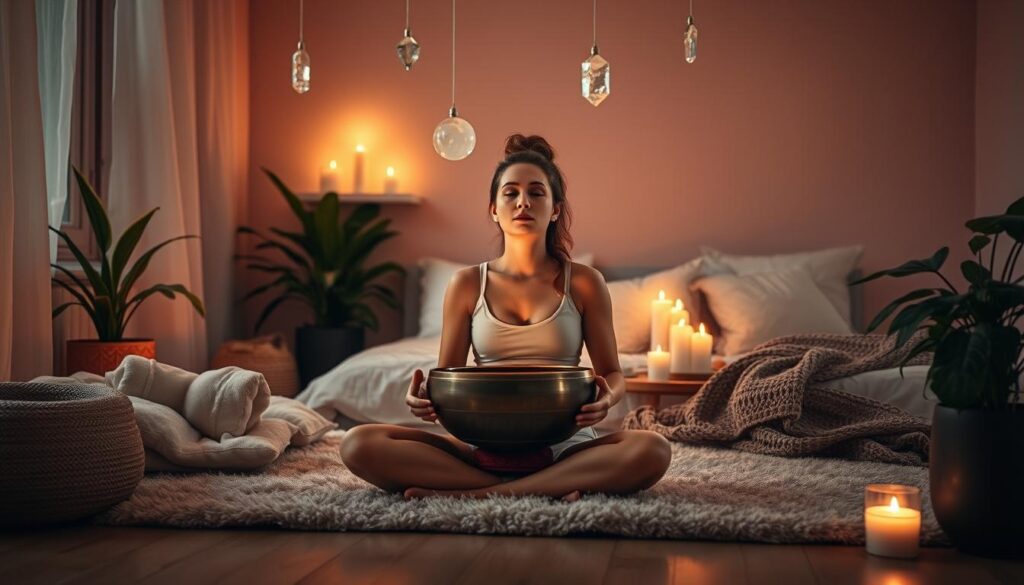
- Minutes 0–3: Get comfortable and slow your breathing without forcing it.
- Minutes 3–15: Listen quietly. Let the sound stay in the background rather than analyzing every tone.
- Minutes 15–20: Lower the volume further or turn the audio off and allow the room to become quiet.
A bedside speaker is the simplest option. If you share a room, travel often, or prefer a dark sleep mask, flat-speaker sleep headphones can be more practical than conventional earbuds.
The MUSICOZY Sleep Headphones Bluetooth 5.4 Sleep Eye Mask combines an adjustable light-blocking mask with built-in speakers and a washable design. Amazon currently lists the model with up to 14 hours of playback. It is mainly a convenience tool for private listening; it does not make the audio itself more effective.
- Comfortable & Ergonomic Design: The MUSICOZY Bluetooth Eye Mask combines the benefits of Bluetooth headphones with a sleep mask; made from soft velvet and stretch cotton, it offers total darkness and comfort, ideal for side sleepers and those needing relaxation, naps, or peaceful sleep
- Long Battery Life with Type-C Charging: Featuring a 200mAh high-performance battery, these Bluetooth sleep headphones provide over 14 hours of continuous playtime on a single charge; perfect for a full night’s rest without worrying about interruptions or beeping alerts
- Perfect Light Blockout Anywhere: The adjustable cartilage design of this Bluetooth sleep mask ensures a snug fit that effectively blocks light; extra cushioning enhances comfort, making it the ideal sleep mask with Bluetooth headphones for frequent travelers and those sensitive to light
- Washable & Adjustable Fit: With easily removable components, the MUSICOZY sleep mask with headphones is fully washable; the adjustable Velcro strap provides a custom fit for all head sizes, ensuring the Bluetooth eye mask stays in place whether you’re at home or on the go
If wearing a mask or headphones feels distracting, skip them. Comfort and consistency are more useful than forcing yourself to use equipment you dislike.
How to Get Better Results Without Chasing “Perfect” Frequencies
- Use a consistent cue: playing the same calm track at roughly the same point in your evening can strengthen the bedtime routine.
- Keep the volume modest: louder sound is not more therapeutic.
- Test one variable at a time: try bowls for several nights before switching to rain sounds or binaural beats.
- Track useful outcomes: note roughly how long it takes to fall asleep, nighttime awakenings, and how rested you feel in the morning.
- Do not obsess over the label: a track marketed as 432 Hz, 528 Hz, theta, or delta is not automatically superior to music or natural sound you genuinely find relaxing.

Safety and When Sound Is Not Enough
Volume matters more than the type of frequency. The World Health Organization’s safe-listening guidance recommends keeping personal audio devices below about 60% of maximum volume and limiting exposure as sound levels rise.
Stop or change the track if it causes headaches, dizziness, ringing in the ears, agitation, or greater difficulty relaxing. Do not use immersive audio when driving or during activities that require full attention.
Sound routines can complement healthy sleep habits, but persistent insomnia deserves attention. Seek medical evaluation if sleep problems continue for weeks, interfere with daytime functioning, or occur with symptoms such as loud habitual snoring, gasping during sleep, or severe daytime sleepiness.
Conclusion
Sound can be a useful relaxation tool, but the most credible explanation is not that a special frequency automatically “heals” the brain. A pleasant, predictable listening environment may lower stimulation, mask disruptive noise, support meditation, and make a bedtime routine easier to repeat.
Singing bowls and binaural beats are both worth exploring if you enjoy them, but research on brainwave entrainment and sleep remains incomplete. Start with 15–20 minutes at a comfortable volume, judge the practice by how you actually sleep and feel, and keep the setup as simple as possible.
FAQ
Can sound frequencies really change brainwaves?
Auditory stimulation can affect brain activity, but evidence that specific external frequencies reliably force EEG activity into matching brainwave bands is inconsistent. The effect is more complicated than matching one sound frequency to one mental state.
Are theta or delta frequencies proven to make you sleep?
No single theta or delta audio frequency has been proven to produce sleep reliably in everyone. Theta and delta describe EEG activity measured in the brain; they should not be treated as guaranteed sleep settings for an audio track.
Do binaural beats help with sleep?
Some studies have reported improvements in sleep-related outcomes, while broader research on brainwave entrainment remains mixed. They are reasonable to try at a comfortable volume, but they should not be presented as a proven insomnia treatment.
Are singing bowls supported by research?
Small studies have found short-term improvements in tension, anxiety, and mood after singing-bowl meditation. These findings are promising, but stronger controlled trials are needed before making firm claims about sleep or specific health effects.
Do I need special equipment for sound healing?
No. A phone or speaker playing comfortable music, nature sounds, or a bowl recording is enough to experiment. Physical bowls, sleep headphones, and other equipment are optional tools for convenience or personal preference.
How long should a bedtime sound session last?
About 15–20 minutes is a practical starting point. There is no evidence that longer sessions are automatically better. Keep the volume low, use the routine consistently, and shorten it if the sound begins to feel distracting.



Don’t Miss These Picks