


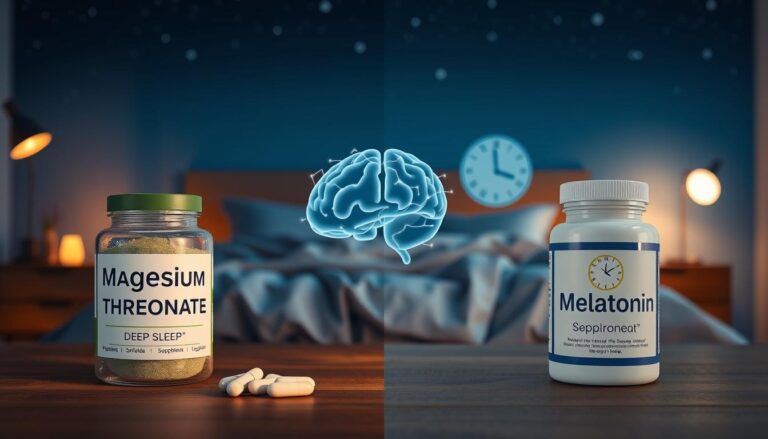
Magnesium glycinate and melatonin often get grouped together as “sleep supplements,” but they are not doing the same job. That matters, because many people are not really choosing between two versions of one remedy. They are choosing between relaxation support and sleep-timing support.
That is also why the question can get confusing. Someone who is restless at night may assume they need melatonin, while someone with a delayed sleep schedule may assume magnesium is enough. In practice, the better fit depends less on marketing language and more on what kind of sleep problem keeps showing up.
Quick answer
Melatonin is mainly about timing. It is most often used when the issue involves the sleep-wake rhythm, such as a delayed bedtime, travel-related disruption, or a schedule that feels out of sync.
Magnesium glycinate is usually about winding down. It is often chosen by people who want a calmer nighttime routine or a gentler relaxation-focused option, not a direct circadian signal.
Neither one should be framed as a guaranteed fix for insomnia, and neither reliably changes sleep stages in exactly the same way for every person.
| Question | Magnesium glycinate | Melatonin |
|---|---|---|
| Main role | Relaxation and nighttime routine support | Sleep timing and circadian support |
| Best-known use case | Feeling tense, wired, or unable to settle down | Bedtime feels shifted later than desired, jet lag, schedule mismatch |
| What it is not | Not a sleep hormone | Not a cure-all for every sleep complaint |
| Sleep-stage expectations | Should be discussed cautiously | Should be discussed cautiously |
Key takeaways
- Melatonin is mainly a timing support option.
- Magnesium glycinate is usually a relaxation support option.
- Neither one should be treated like a guaranteed treatment for insomnia.
- Sleep-stage claims should stay conservative and practical.
- The best choice depends on whether the real problem is timing, winding down, or a broader sleep issue.
Helpful products at a glance
These are the main products recommended in this article for readers who want a quick summary.
For winding down support
- MAGNESIUM GLYCINATE LYSINATE SUPPLEMENT: Our formula provides support for muscles, nerves, & sleep quality. It's 100% chelated, making it easy on the digestive tract & able to be taken any time of day
- MAXIMUM ABSORPTION: Magnesium glycinate is good, lysinate glycinate is even better. Our magnesium mineral supplement takes the most direct route into your system for up to 6x better absorption
For sleep timing support
- GIVE TRANQUIL REST Melatonin works in harmony with your natural sleep cycle to give you the tranquil rest you deserve; so you can awaken feeling refreshed (1)
- IMPROVE QUALITY OF REST Melatonin is a terrific choice for people experiencing occasional sleeplessness or anyone seeking to improve their quality of rest; (1) Nature’s Bounty Melatonin helps promote sleep so you can awaken refreshed and revitalized (1)
Why these are not the same kind of sleep aid
Melatonin is tied to the body clock. It helps signal that it is nighttime, which is why it usually comes up in conversations about circadian rhythm, shift changes, and sleep timing. Magnesium glycinate, by contrast, is generally discussed as a mineral form that may help some people feel more relaxed in the evening. Those are related goals, but they are not the same mechanism.
That difference is easy to miss when both products sit on the same store shelf. The label may say “sleep support” on both, but the reader question should be more specific: am I trying to feel calmer, or am I trying to shift my sleep schedule?
“The better choice is usually the one that matches the real sleep problem, not the one with the strongest sleep label.”
What melatonin is actually doing
Melatonin is best understood as a timing signal. It is commonly used when bedtime feels delayed, when travel has disrupted the body clock, or when someone is trying to support a more consistent sleep schedule. That does not mean it works the same way for every person, and it does not mean it is the answer for every kind of poor sleep.
A person can feel tired, stressed, wake frequently, or have fragmented sleep for reasons that melatonin does not meaningfully solve. In those cases, using it like a general “night pill” may not address the real issue.
When the melatonin question is usually about timing
Melatonin often makes more sense when the problem sounds like this: “I do not get sleepy until too late,” “my schedule is off,” or “travel threw my sleep timing off.” That is different from saying, “I am exhausted but still feel too keyed up to settle down.”
What magnesium glycinate is actually doing
Magnesium glycinate is usually approached as a practical magnesium option for people who want a calmer nighttime routine. In sleep conversations, it is often chosen by readers who are not looking to change their circadian signal as much as they are trying to make the evening feel less tense or restless.
That does not mean it directly “puts you to sleep,” and it should not be sold that way. Its role in an article like this is more modest: it may fit readers who want support for winding down, especially when their sleep difficulty feels more connected to evening restlessness than to body-clock timing.
Why the glycinate form often comes up
The glycinate form is often discussed because it is commonly positioned as a gentler, better-tolerated option for people who want magnesium support without turning the conversation into a harsh “sedation” claim. For this topic, that calmer framing matters more than hype.
Do they affect sleep stages in the same way?
This is where sleep content often gets too confident. It is tempting to reduce the comparison to a simple line like “magnesium helps deep sleep” and “melatonin helps you fall asleep,” but that is usually too neat for a real reader. Sleep stages are influenced by many factors, including stress, schedule, light exposure, alcohol, medications, sleep environment, pain, and underlying health issues.
A more careful way to say it is this: melatonin is usually discussed in relation to sleep timing, while magnesium glycinate is usually discussed in relation to relaxation support. That distinction can influence the overall sleep experience, but it does not mean either supplement predictably reshapes sleep architecture in the same clear, universal way for everyone.
What readers often get wrong
- Assuming stronger sedation means better sleep. Feeling knocked out is not the same thing as getting healthier, more restorative sleep.
- Treating melatonin like a fix for every sleep complaint. It may fit timing issues better than general nighttime stress or poor sleep habits.
- Assuming magnesium glycinate works like a sleep hormone. It does not fill the same role as melatonin.
- Expecting supplements to overcome everything else. Late caffeine, irregular sleep timing, stress, alcohol, screen exposure, and other factors still matter.
Which one may fit better in real life
If the problem is winding down, evening tension, or wanting a more settled nighttime routine, magnesium glycinate may make more sense as the comparison example. If the problem is sleep timing, such as an off schedule, a delayed bedtime pattern, or travel-related rhythm disruption, melatonin usually fits the conversation better.
There is also a middle ground: some readers are not looking for a “best supplement” at all. They are trying to understand why two products that both mention sleep can feel so different in use. For that reader, the main value of this article is not a strong product pitch. It is a clearer map of what each option is and is not likely to help with.
Practical product examples
When a magnesium glycinate example may make more sense
If your main question is about nighttime settling rather than body-clock timing, a mainstream glycinate-format option may be the more relevant example. Readers who want to compare real products can see this magnesium glycinate option on Amazon. The fit here is simple: it represents the relaxation-support side of the comparison, not a promise to “fix” sleep stages.
The tradeoff is straightforward. This product comes in a tablet format, which may not suit readers who prefer capsules or powders. It is also better framed as a practical nighttime mineral option than as a direct answer to chronic sleep complaints.

- MAGNESIUM GLYCINATE LYSINATE SUPPLEMENT: Our formula provides support for muscles, nerves, & sleep quality. It's 100% chelated, making it easy on the digestive tract & able to be taken any time of day
- MAXIMUM ABSORPTION: Magnesium glycinate is good, lysinate glycinate is even better. Our magnesium mineral supplement takes the most direct route into your system for up to 6x better absorption
- SLEEP AND MUSCLE RELAXATION: Magnesium supports healthy, restful sleep and relaxation by helping regulate melatonin, cortisol, and muscle function for overall wellness
- 200 MG PER SERVING: Our mag glycinate supplement is not buffered with fillers or additives and is 200mg per serving, vegan, non-GMO, gluten-free, and soy-free. Each bottle contains 240 tablets
When a low-dose melatonin example may fit better
If the confusion is really about schedule drift, travel, or the feeling that your sleep timing is off, a lower-dose melatonin example is usually the cleaner educational fit. Readers who want a simple example can view this gentle starter melatonin pick on Amazon. In this article, the point of using a lower-dose example is to keep the melatonin side practical rather than escalating immediately to stronger options.
That said, even a lower-dose melatonin product is not for every reader. Tablet format may not suit people who prefer other delivery forms, and melatonin should not be described as the answer to every form of fragmented sleep.

- GIVE TRANQUIL REST Melatonin works in harmony with your natural sleep cycle to give you the tranquil rest you deserve; so you can awaken feeling refreshed (1)
- IMPROVE QUALITY OF REST Melatonin is a terrific choice for people experiencing occasional sleeplessness or anyone seeking to improve their quality of rest; (1) Nature’s Bounty Melatonin helps promote sleep so you can awaken refreshed and revitalized (1)
- HELPS YOU FALL ASLEEP FASTER AND LONGER For those who experience occasional sleeplessness or jet lag, or if you want to improve your quality of rest; (1) Melatonin helps you fall asleep faster and stay asleep longer (1)
- SUPPORTS RELAXATION: Melatonin supports your body as it deals with occasional sleeplessness. (1) Helping you drift into a peaceful night’s rest. (1)
| Situation | More likely comparison fit | Why | Main caution |
|---|---|---|---|
| You feel too keyed up to settle down at night | Magnesium glycinate | Better matches a relaxation-support conversation | Do not treat it like a guaranteed sleep solution |
| Your bedtime feels delayed or your schedule is off | Melatonin | Better matches a sleep-timing discussion | Not every sleep issue is a circadian issue |
| You wake often for unclear reasons | Neither is an automatic answer | The cause may be broader than supplement choice | Persistent problems deserve medical evaluation |
| You want a practical example without making the article product-heavy | One magnesium example and one low-dose melatonin example | Keeps the comparison grounded and light | Avoid turning an explainer into a sales page |
Safety and practical use notes
Both supplements deserve a cautious frame. Sleep problems can be tied to stress, medication effects, pain, mood changes, sleep apnea, alcohol, caffeine, irregular schedules, or other health issues that a supplement article cannot diagnose.
- Be careful with self-directed long-term use if you have medication questions or ongoing health concerns.
- Keep expectations realistic. “May help support” is better language than “will fix.”
- Pay attention to next-day grogginess or a mismatch between the product and the problem you are actually trying to solve.
- If sleep trouble is persistent, severe, or getting worse, medical evaluation matters more than trying supplement after supplement.
FAQ
Is magnesium glycinate better than melatonin for sleep?
Not in a universal sense. Magnesium glycinate is usually a better fit for readers focused on winding down, while melatonin is usually a better fit for sleep timing questions.
Does melatonin help with deeper sleep?
That is too broad to promise. Melatonin is mainly discussed as a timing signal, not as a guaranteed way to improve every part of sleep quality or every sleep stage.
Can magnesium glycinate replace melatonin?
Only if the original reason for using melatonin was not really about circadian timing. They are not interchangeable in a simple one-for-one way.
Should you take either one every night?
That depends on the person, the reason for use, and any health or medication concerns. A persistent sleep issue should not be handled only through trial and error with supplements.
Conclusion
Magnesium glycinate and melatonin belong in the same conversation only up to a point. After that, the paths split. Melatonin is usually about timing. Magnesium glycinate is usually about winding down. The most useful comparison is not which one sounds stronger on the label, but which one actually matches the sleep problem in front of you.



Don’t Miss These Picks