


Can pairing breath with every step or lift really lower stress hormones and build safer strength? This question frames a simple idea: combine focused attention with physical action and you change how the body and mind respond to stress.
Short summary: evidence shows paired attention and exercise can cut stress by up to a third over eight weeks and improve body awareness for better mechanics.
Think of this practice as a skill, not a performance. You bring breath, attention, and present-moment awareness to walking, yoga, tai chi, or strength work to calm the nervous system and sharpen control.
This guide translates research into easy steps you can use today, even with limited time or equipment. Clinical-friendly sequences run 20–45 minutes but chair-based and bed-adapted options make it inclusive for many health needs.
For deeper study and program details, see the evidence review on PubMed and a practical discussion of related somatic trends for young adults at the PubMed article and a practical overview.
Key Takeaways
- Pairing attention with activity lowers stress responses and supports recovery.
- Short, regular sessions improve body awareness and reduce injury risk.
- Accessible options exist for all fitness and health levels.
- Evidence shows measurable mood and attention gains after structured programs.
- Even brief mindful interludes during the day add up to real change.
What Is Mindful Movement in the Present Moment
Bring gentle focus to each motion and you turn ordinary activity into a training ground for attention. This section explains a clear definition and simple steps to start a small, effective practice.
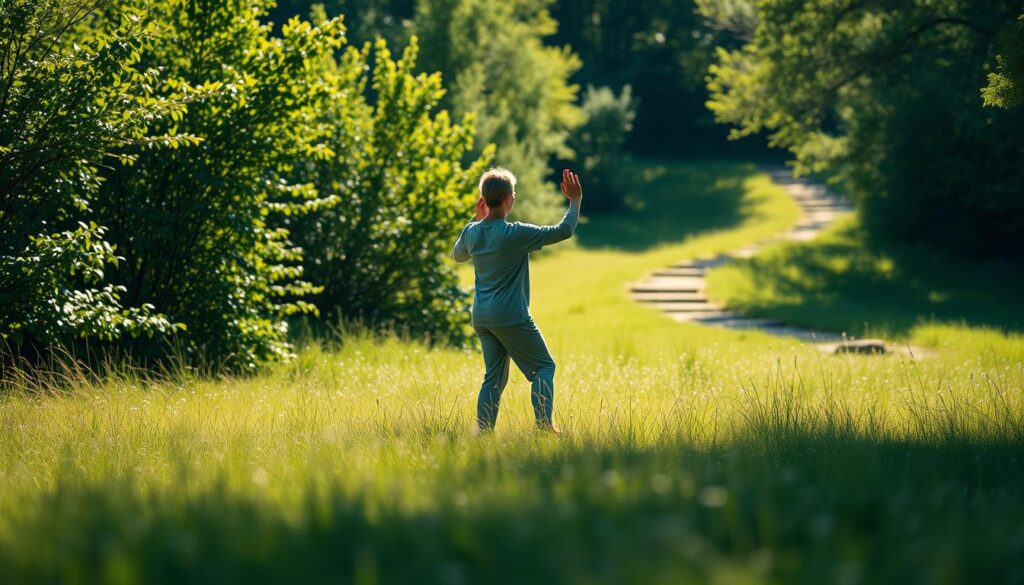
Core definition: attention on breath, body, and movements
Mindful movement means you pay attention to breath, body sensations, and movement as they unfold in the present moment.
You cultivate steady awareness without judgment. Name a muscle while stretching to deepen how you pay attention in real time.
Why slower, deliberate motion makes mindfulness easier
Slower pacing creates space to sense alignment, effort, and ease. When you move deliberately, subtle cues become clear.
Use an anchor—breath, feet, or posture—and gently return attention when the mind wanders. That return is the skill you are training.
- Practical start: pick one anchor and one simple stretch for 2–5 minutes.
- Flexible: this way applies to walking, lifting, or household tasks when breath and attention are linked.
The Science Behind Cortisol Reduction and Strength Gains
When breath and focused action pair, the nervous system shifts from alarm to repair. This pairing reduces stress and trains safer, stronger movement through clearer body feedback.
Mechanism: focused attention and paced breathing activate parasympathetic pathways. That downshift reduces physiological arousal and supports cortisol regulation.
Why combining the two beats doing either alone
Trials show additive effects: an 8-week program produced up to a 33% drop in reported stress levels (Russell, 2011). In real time, college students recorded lower negative affect during guided mindful movement than sitting (Yang & Conroy, 2018).
How this helps strength and safe form
Attention to alignment and sensation improves motor control and load tolerance. Syncing breath with exertion aids bracing and spinal stability during compound lifts. Sensing effort lets athletes autoregulate sets and avoid poor mechanics.
| Mechanism | Immediate Effect | Practical Tip |
|---|---|---|
| Focused attention + breathing | Parasympathetic activation, lower stress | Take 3 paced breaths before a set |
| Body awareness | Better alignment, fewer compensations | Name a muscle during a lift |
| Autoregulation | Smarter load choices | Pause one rep if form drifts |
Take-home: use breath and focus as in-session tools. Try one set on autopilot, then one with deliberate attention and note the difference in form and perceived effort. This low-cost practice yields real calm and performance gains.
Mindful Movement Benefits
Small sessions of guided attention plus action reduce stress and sharpen control. They offer mood, sleep, and cognitive wins that carry into daily life and training.
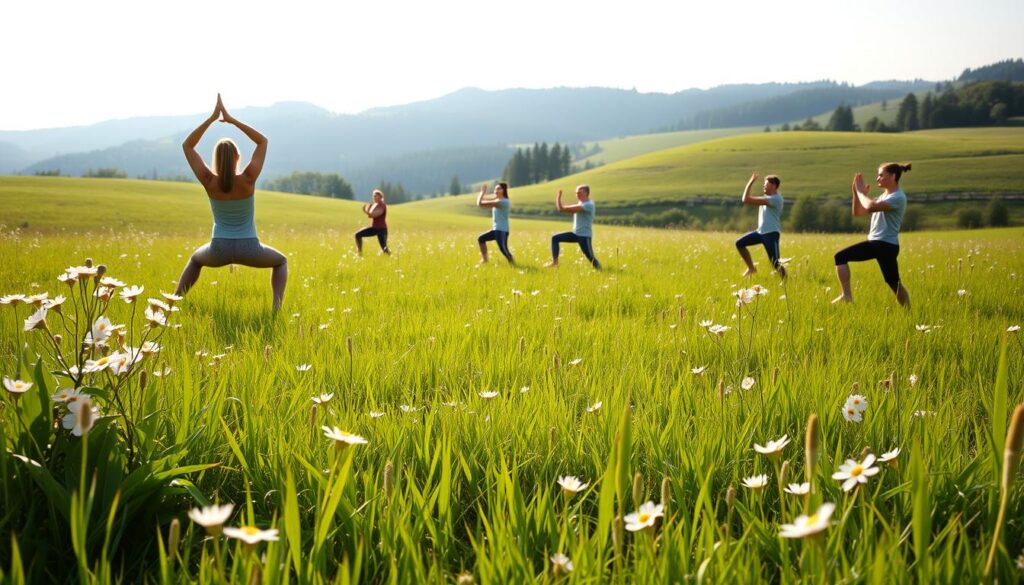
Lower stress and less anxiety during life and exercise
Pairing breath with simple body work helps down-regulate the nervous system. Studies report up to a 33% drop in perceived stress after eight-week programs (Russell, 2011).
Momentary negative affect is also lower during guided sessions than when sitting still (Yang & Conroy, 2018).
Better mood, relaxation, and sleep quality
Reviews in Frontiers in Psychiatry link meditative body practices to lower depression and calmer mood. Short evening sessions can ease arousal and help you fall asleep.
Sharper focus, self-regulation, and present-moment awareness
Training attention during activity strengthens cognitive control. That carries into work, study, and relationships by reducing rumination and improving decision-making.
| Outcome | Evidence | Practical tip |
|---|---|---|
| Lower stress/anxiety | Up to 33% reduction after 8 weeks | Try 10 minutes of breath-linked walking |
| Improved mood & sleep | Clinical reviews show mood gains | Do a short pre-bed routine |
| Enhanced focus & awareness | Lower negative affect in active practice | Use one-breath anchors during tasks |
Daily uses: pause for paced breaths on a commute, take a mindful warm-up between meetings, or tie a cue to routine tasks to make the practice effortless and accessible for lasting health.
Evidence Snapshot: What Recent Studies Show
Recent trials show consistent, real-world effects across ages and settings. The clearest signal: adding attention and paced breathing to activity lowers momentary distress and, with repeated sessions, cuts chronic stress.

Momentary mood and stress
In daily-life sampling, college students reported lower negative affect during mindful movement than while sitting (Yang & Conroy, 2018). Effects varied by time of day but held across contexts.
Program-level stress reduction
An 8-week structured program produced up to a 33% drop in stress and helped people with severe mental illness improve coping (Russell, 2011). Short, regular sessions drove meaningful change.
Child development and clinical outcomes
Kindergarteners in a 145-day program outperformed peers on verbal and nonverbal tests (Rosenstreich et al., 2022). Children with ADHD who did two 60-minute sessions weekly for 8 weeks showed gains in motor control, attention, and behavior (Clark et al., 2020).
Sohl et al. (2019) found perioperative eHealth sessions combining breathing and gentle activity reduced pain and distress for women having gynecologic surgery.
| Study | Population | Program | Key Outcome |
|---|---|---|---|
| Yang & Conroy (2018) | College students | Momentary guided sessions | Lower negative affect during activity |
| Russell (2011) | Adults with severe mental illness | 8 weeks, regular sessions | Up to 33% stress reduction |
| Rosenstreich et al. (2022) | Kindergarten children | 145-day classroom program | Improved verbal & nonverbal intelligence |
| Clark et al. (2020) / Sohl et al. (2019) | Children with ADHD / Surgical patients | 2×60 min weekly; perioperative eHealth | Better attention, motor control; less pain/distress |
Takeaway: across populations, the core mechanism — pairing attention with paced breath during movement — consistently explains observed gains. Aim for two or more short sessions weekly, or sprinkle brief practices through your day to mirror what research used.
Mindful Movement vs. Yoga: Overlap and Key Differences
Yoga often pairs breath, posture, and meditation, which makes it a natural vehicle for present-moment practice. But mindful movement is a broader skill set that can be applied across many activities, from walking to strength work.
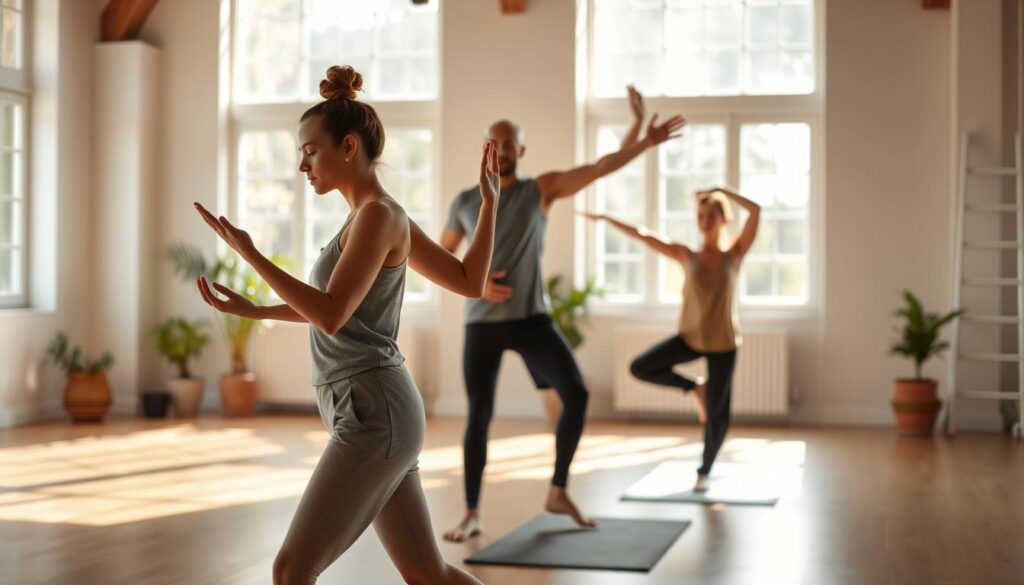
Overlap: Yoga frequently centers on breath, posture, and attention, so practised meditatively it functions as a form of mindful movement. Many gentle styles—restorative or hatha—encourage slow pacing and internal focus.
Key differences: The umbrella term includes walking, tai chi, qigong, stretching, clinical rehab, and even mindful strength training. Not every yoga class emphasizes meditation; some prioritize fitness, heat, or flow. Likewise, non-yoga forms can be deeply attentive when breath and notice lead the session.
| Feature | Yoga (typical) | Other mindful forms |
|---|---|---|
| Primary aim | Blend of body, breath, and meditation | Improve awareness, function, or rehab depending on the form |
| Pacing | Varies: slow (hatha) to fast (vinyasa) | Often slow for tai chi/qigong; variable for walking or strength |
| Best for | Flexibility, breath training, meditative sequencing | Mobility, balance, strength, or clinical recovery |
| How to choose | Pick gentle classes for meditation-focused practice | Match the form to your goal, then add breath and attention |
Choose the way that matches your goal—calm, mobility, or strength—and then layer attention and breath. Curiosity helps: try several types to find where awareness and comfort come easiest. Skills learned in yoga often transfer to walking, lifting, or therapy drills, so pick the practice you’ll keep doing.
For quick ideas to stay active without a gym, try this helpful infographic on simple routines: 10 free smart ways to stay fit without a.
Mindful Breathing and Attention Cues to Get You Started
Start with the breath you already have and let it guide the next simple action. This short primer gives clear steps and anchors you can use immediately to pair breathing with movement and build steady awareness.
Start by noticing the inflow and outflow of one breath without changing it. Take one deliberate full breath, watching how it begins, peaks, and finishes.
Simple breath-to-action steps
- Starter protocol: observe inflow and outflow, then take one full breath and note sensations from start to finish.
- One breath per motion: inhale to prepare or lengthen, exhale to move or release—match one breath to one step or rep.
- Micro-practice: two minutes of chair mobility using one-breath-per-motion resets focus during a busy day.
Anchors for steady attention
Use the soles of the feet, the length of the back, or the stack of head over shoulders to stabilize posture and attention. Lightly note temperature, light, or ambient sounds, then return to breath and body.
Curiosity over critique
Replace judgment with wonder: ask, “what do I notice?” if focus drifts. Soften knees, align ribs over pelvis, and lengthen the neck to support easy breathing and safer mechanics.
- Pacing: slow the cadence until you can keep awareness across a whole rep or transition.
- Safety: if breathing feels strained, reduce range or speed—coordinated breathing should remain smooth, not forced.
- Habit tip: begin sessions with three single full breaths to prime attention before you move into a longer 20–45 minute series.
Walking and Running with Awareness
A short, focused walk can act as a reset for both body and mind. Use foot strike, gait rhythm, and simple breathing patterns to turn casual steps into a clear training ground for awareness.

Start by noticing your cadence and the feeling of the feet hitting the ground. Sync a 2–4 step pattern with breath to smooth effort and reduce wasted tension. Try inhale for three steps, exhale for three to four, and adjust to comfort.
Foot strikes, gait rhythm, and breath syncing outdoors
- Notice foot strikes and the rhythm of your walk; a steady cadence helps focus attention.
- Use simple cues—“light feet,” “tall posture,” “soft jaw”—to ease tension while you walk or run.
- Begin running with short, mindful segments in easy efforts to build skill without forcing form changes.
Switching between environment and body scans on the move
Alternate short blocks scanning the body (feet → calves → hips → shoulders) with blocks observing the environment. Use a landmark—tree or block—to mark intervals.
“Even 5–10 minutes of focused walking can clear mental clutter and reset mood.”
| Practice | How to do it | What it helps |
|---|---|---|
| Cadence + breath | 2–4 step breath sync | Smoother effort, calmer breathing |
| Alternating scans | Body block then environment block | Balanced awareness, less mind-wandering |
| Landmark intervals | Use a tree or block as checkpoint | Measure perceived effort and attention |
Finish with one quick reflection: what changed in how I feel? This simple question boosts learning and makes you more likely to repeat the walk or run later. For a longer take on running paired with breath and focus, see this practical piece on running and meditation.
Yoga, Tai Chi, and Qigong as Moving Meditation
These slow-flow traditions pair breath and steady attention so each transition becomes a training cue for posture and calm. Short, regular sessions teach you to sense tension, shift safely, and restore the nervous system without strain.
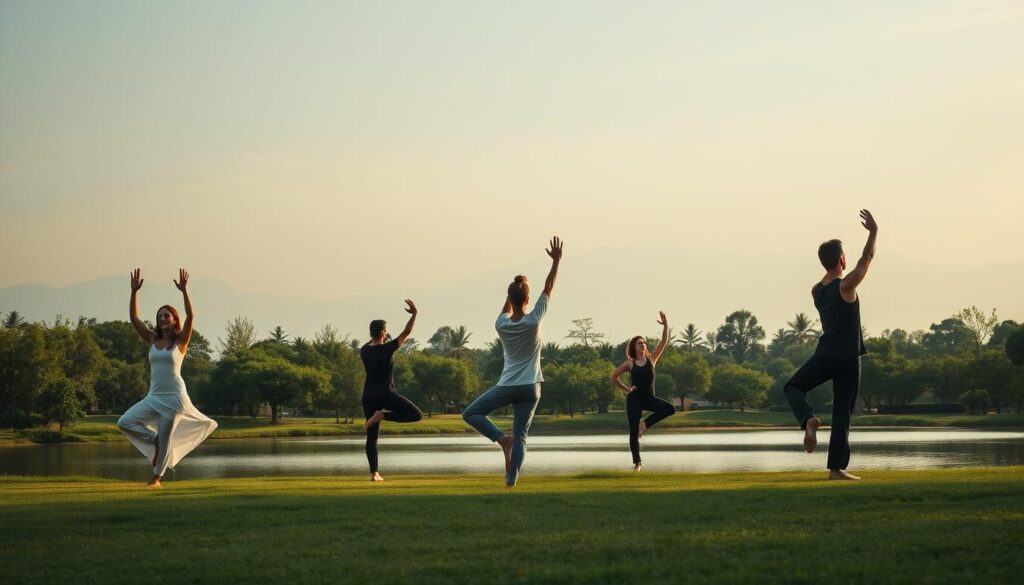
Gentle flows: hatha yoga and mindful sequencing
Hatha or restorative yoga favors slower sequencing and holds. Use two to five breath cycles per pose to notice alignment and muscle tone.
Keep sessions 10–20 minutes for a quick reset. Focus on quality of attention, not depth of range.
Tai chi and qigong: slow transitions with deep breathing
Tai chi emphasizes weight shifts, spirals, and coordinated breath to build balance and calm.
Qigong pairs simple, rhythmic patterns with visualization to mobilize joints and fascia for all ages.
- Selection tip: pick instructors who cue breath, alignment, and inner sensation over speed.
- Consistency: two to three short sessions weekly grows sensing skill and postural tone.
- Safety: move within comfort and avoid forcing depth; attention quality matters more than extremes.
“Treat each transition as a chance to check posture, soften tension, and sync breath.”
| Type | Key Feature | Quick Practice |
|---|---|---|
| Hatha yoga | Slow holds, alignment focus | 10–20 min gentle flow |
| Tai chi | Weight shifts, spiral actions | Short form sequences; 10–15 min |
| Qigong | Rhythmic patterns, visualization | Accessible joint mobilization, 8–15 min |
Stretching Routines to Reduce Tension and Support Recovery
A short, targeted stretch sequence can unwind tight areas and speed recovery after activity. These small routines focus on gentle pacing, clear cues, and breath to ease the body and reset nervous-system tone.
Seated spinal warm-ups and forward folds
Start tall on your sit bones. Inhale to arch the spine and open the chest; exhale to round and lengthen the back.
For forward folds, hinge from the hips first. Only allow the spine to round after the pelvis tips to keep ranges safe.
Shoulder, hip, leg, and ankle care
Use a clasp-and-reach shoulder stretch and a figure-four hip stretch to release common tension spots.
Don’t skip ankles: point-flex cycles and slow rotations boost circulation and prep the lower body for recovery.
- Breath pacing: inhale to prepare or lengthen, exhale to move into the stretch.
- Hold time: 20–45 seconds per position, one to two rounds.
- Posture cue: sit tall, knees track over feet, weight balanced on sit bones.
- Reflection: scan the body after sets to notice reduced tightness or ease of attention.
| Sequence | How to do it | Why it helps |
|---|---|---|
| Seated spine warm-up | Inhale arch, exhale round; 6–8 slow reps | Mobilizes thoracic and lumbar segments |
| Forward fold (seated) | Hinge at hips, then round slightly; hold 20–30s | Stretches posterior chain safely |
| Shoulder & hip stretch | Clasp-and-reach; figure-four hold 20–45s | Releases common tension zones |
| Ankle and leg prep | Point-flex, 10–15 rotations per ankle | Improves circulation and mobility |
Use this sequence before or after training, or on rest days to support recovery. For practical stretching routines and additional guidance, see this stretching guide.
Mindful Strength: Bringing Presence to Weightlifting and HIIT
Add present attention to heavy lifts and you change how your body signals effort and safety. This short guide shows clear, practical cues to pair breath and sensing with strength work so you train harder and smarter.
Curiosity in squats: stance, depth, breath, and sensation
Start each set by exploring stance. Try small changes in foot width and toe angle until knees, hips, and back feel aligned.
Scan the back and hips before the first descent. Inhale to prepare and brace; exhale through the ascent while keeping a steady spine.
Ask, “what’s stable, what’s wobbling?” This question guides adjustments without harsh self-criticism.
Tempo, form feedback, and knowing when to push or pause
Use slow eccentrics and controlled pauses to reveal weak points. Tempo teaches where form breaks before load increases.
Check the back, hips, and knees at varied depths. If breath strains or form degrades, reduce load or reps—autoregulate intensity rather than forcing progress.
- Pair breath with reps: inhale to brace, exhale on effort; notice trunk stability and bar path.
- Gather feedback: record which stance and tempo felt safest to speed future gains.
- HIIT tip: track cadence and breath recovery; keep technique ahead of speed.
- Reset: take one to two slow breaths between sets to restore focus and lower tension.
Practice this way to build long-term resilience: progressive overload balanced with attention improves performance and protects the back.
Hospital and At-Home Medical Contexts: Safe Practices
Simple, gentle sequences can keep joints mobile and ease stress before, during, and after care. Use short sessions, props, and coordinated breath to protect healing tissues and feel steadier each day.
Before care: chair-based mobility and breath
Start with seated spine warm-ups and a forward bend to loosen the hips. Add shoulder, leg, and ankle stretches and one seated twist to prepare the body.
Take three full breaths before each set and pair one breath per simple action to keep practice safe and organized.
During stay: wrist, elbow, shoulder, neck mobility; bed stretches
Keep ranges small: wrist flex/extend and circles, gentle elbow rotations, shoulder rolls, and neck bends maintain function without overexerting.
In bed, try knee drops side-to-side, ankle circles, and supported spinal twists to boost circulation while resting.
After care: child’s pose, cat-cow, reclined bound-angle, legs up the wall
Progress to floor poses as tolerated: child’s pose and cat-cow restore the spine. Add a gentle cross-legged twist and a supported bound-angle to open hips.
Try legs up the wall with a pillow by the wall; exit slowly. Stop any pose that causes pain and seek provider guidance if discomfort persists.
- Session length: aim for 20–45 minutes when energy allows, or break into shorter sets.
- Safety first: keep feet grounded when seated, use pillows for support, and favor slow, gentle movements coordinated with breath.
- Practical tip: take small steps and ask for clinical support when needed to increase comfort and stability.
When Minds Feel Overwhelmed: Anxiety, Trauma, and ADHD
When busy thoughts make stillness painful, hands-on practice gives attention a reliable anchor. It’s a practical choice for people whose anxiety or trauma history makes seated meditation hard to sustain. Movement provides a concrete focus—steps, joint position, or contact points—that redirects the nervous system and reduces rumination.
How active focus helps when sitting increases distress
Gentle activity offers a tactile target for attention. Instead of fighting thoughts, you track a step, a shoulder roll, or the pressure beneath your foot.
This simple swap can lower physiological arousal and make practice feel doable for those with severe mental health symptoms.
Evidence and practical guidance
Research: an 8-week program reduced stress in people with psychosis (Russell, 2011). Children doing two 60-minute sessions weekly for eight weeks showed better motor control, attention, and behavior (Clark et al., 2020).
These findings support using movement as a legitimate form of meditation when stillness is not possible.
- Quick anchors: count steps, note joint angles, or feel contact points while matching breath to action.
- Short drills: 5–10 minutes of slow marching in place, side steps, or shoulder rolls calms racing thoughts and centers attention.
- Predictable sequences: routine patterns reduce cognitive load and free mental capacity for sensing and soothing.
“If focus drifts, treat it as data — pause, take one full breath, and begin the next simple movement.”
Accessibility and collaboration: these practices require no equipment and scale to energy or symptom changes. Work with a clinician to tailor choices to triggers and goals; movement-based practice is a valid, evidence-informed path for many people managing anxiety, trauma, or ADHD.
Build Your Weekly Mindful Movement Routine
A small, steady schedule beats sporadic effort when the goal is calmer physiology and safer strength. Aim for predictable sessions so the body and mind learn to respond the same way each week.
Time targets: 20–45 minutes sessions and bite-size daily moments
Hospital guidance and trials point to a 20–45 minute full session as a useful target. If energy is low, split that time into two shorter blocks.
Plan short daily check-ins of one to three minutes between tasks to reinforce skill and lower stress across the day.
Mixing types across the week for balance and adherence
Use a simple template: 3–4 sessions per week of 20–45 minutes plus quick daily anchors. Rotate types to cover mobility, calm, and capacity.
- Sample week: one balance (tai chi/qigong), one mobility/recovery, one strength session, and one mindful walk.
- Calibrate intensity: choose gentler sessions on high-stress days and stronger work when rested.
- Track minutes, not perfection: consistency over weeks matters more than a single long session.
“Small, regular steps build habit faster than occasional marathon efforts.”
Keep setup light: a mat and a chair are enough. Reflect weekly on which ways felt restorative or energizing and adjust the ratio to improve adherence. Invite a friend for a walk or class to boost accountability and joy.
Conclusion
Combining focused breathing with everyday action gives you a practical tool to lower stress and move with more control.Short, regular sessions—20–45 minutes or a few minutes each day—build calmer physiology and clearer motor habits over weeks.
Take a simple next step: pick one form (walking, yoga, tai chi, or a brief strength set) and try a breath-coordinated, 5–10 minute session today. Track what changes in posture, breath, or mood after each practice.
This approach fits rehab settings, workouts, and quick resets during a busy day. Use consistent practice as a sustainable way to improve focus, lower stress, and make each moment of movement more useful.
FAQ
What is the core idea behind mindful movement and present-moment attention?
Mindful movement is paying deliberate attention to breath, bodily sensations, and each motion as it happens. By slowing and sequencing actions—whether walking, lifting, or stretching—you create a clear attention anchor that reduces automatic, distracted behavior and strengthens body–mind connection.
How does focused breathing help lower cortisol and stress response?
Slow, intentional breathing activates the parasympathetic nervous system and interrupts the sympathetic “fight-or-flight” cascade. Paired with attention on the breath and motion, this downshifts heart rate and cortisol release, producing measurable reductions in acute stress and anxiety.
Are there advantages to combining movement with mindful attention versus practicing them separately?
Yes. Combining deliberate motion with focused attention multiplies benefits: it reduces stress more reliably than passive breath work alone and improves motor control and strength gains better than unfocused exercise. The synergy improves learning, form, and recovery.
How does increased body awareness make strength training safer and more effective?
Paying attention to posture, joint alignment, and breathing helps you choose smarter loads, refine tempo, and avoid compensatory patterns. That leads to better force production, fewer injuries, and clearer indicators of when to progress or rest.
What mental health improvements can people expect from a regular mindful movement practice?
Regular practice reduces daily stress and anxiety, improves mood, supports relaxation and sleep, and enhances concentration and emotional self-regulation. Even short, consistent sessions produce meaningful change over weeks.
What does research say about short-term effects during practice?
Studies show that momentary negative affect often falls during mindful movement sessions, with participants reporting immediate calm, clearer thinking, and reduced reactivity while they move and breathe intentionally.
How large are typical stress reductions after structured programs?
Published programs report stress reductions commonly in the range of up to about one-third for some measures after several weeks of practice. Results vary by program length, participant baseline stress, and adherence.
Can children and people with ADHD benefit from these practices?
Yes. Research indicates improvements in attention, motor control, and classroom behavior for children, and many people with ADHD report that movement-based attention strategies help sustain focus more easily than still meditation.
How does mindful movement compare to yoga, tai chi, or qigong?
There’s strong overlap: all emphasize breath, intention, and slow transitions. Yoga often includes more static holds and breath–posture sequencing; tai chi and qigong emphasize continuous, flowing transitions. The common thread is attention to sensation and timing.
What simple breathing and attention cues can beginners use right away?
Use a single full breath per motion, anchor attention to the feet, back, or posture, and adopt a curious, nonjudgmental tone toward sensations. Short cues—“inhale, lengthen; exhale, soften”—keep practice practical and portable.
How do I bring awareness into walking or running without overthinking form?
Focus on foot strikes, gait rhythm, and syncing breath to steps (for example, one breath every four steps). Alternate short environment scans with body scans to stay present without rigid self-monitoring.
Which stretching routines best reduce tension and help recovery?
Gentle seated spinal warm-ups, forward bends for the hamstrings, and shoulder and hip openers performed with slow exhalations reduce tension and support recovery when combined with attentive breathing.
How can I apply presence to weightlifting and HIIT safely?
Use curiosity in basic lifts—check stance, depth, breath, and sensation—maintain controlled tempo, and prioritize form feedback. Pause when fatigue blurs technique and scale intensity based on real-time body cues.
What adaptations are safe for hospital or at-home medical contexts?
Chair-based mobility and breath work before care, gentle wrist/shoulder/neck mobility during stays, and restorative poses like child’s pose or legs-up-the-wall after discharge can be helpful. Always coordinate with care teams first.
Can mindful movement help when anxiety, trauma, or hyperactivity make sitting still impossible?
Yes. Movement provides a concrete focus that anchors attention and reduces rumination, making it an effective entry point for people who struggle with stillness, while offering grounding strategies for trauma-sensitive practice.
How much time should I aim for each week to build a useful routine?
Aim for sessions of 20–45 minutes several times a week plus bite-size daily moments (5–10 minutes) of breath-and-body awareness. Mixing walking, stretching, gentle yoga, and strength keeps engagement high and supports consistent gains.



Don’t Miss These Picks