
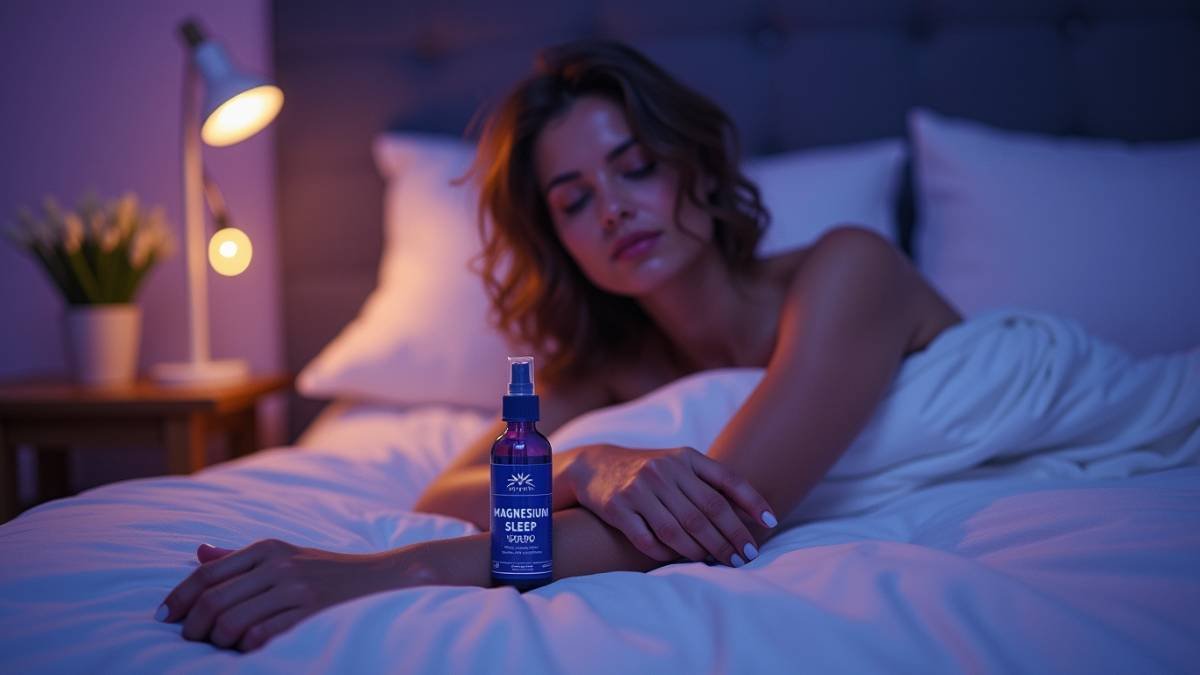

Magnesium plays an important role in normal nerve and muscle function, and researchers have studied magnesium supplements for sleep. But that does not mean spraying magnesium on your skin has been proven to improve sleep. Evidence for meaningful magnesium absorption through intact skin is limited, and research specifically showing that magnesium spray improves insomnia, deep sleep, or nighttime awakenings is lacking.
That distinction matters because many magnesium sprays are marketed using the broader science of magnesium. Oral magnesium has at least been tested in randomized sleep trials, although the results remain inconsistent. Topical magnesium adds another unanswered question: how much magnesium actually crosses the skin and reaches the body in a clinically meaningful amount?
So magnesium spray can be a reasonable optional topical routine for someone who likes the format and tolerates it well, but it should not be treated as a proven sleep treatment or a reliable way to correct magnesium deficiency.
What Is Magnesium Spray?
Magnesium sprays typically contain magnesium chloride dissolved in water. Although these products are often called “magnesium oil,” they usually do not contain an actual oil. The name comes from the slightly slippery or oily feel that concentrated magnesium chloride solutions can leave on the skin.
The appeal is easy to understand. Instead of swallowing a supplement, you apply the product directly to your skin according to the label directions. Some people prefer this format because it fits easily into a shower, massage, exercise-recovery, or bedtime routine.
The important question, however, is not whether magnesium can be placed on the skin. It is whether enough magnesium crosses intact skin to meaningfully affect magnesium status or sleep. Those are much bigger claims, and the evidence is considerably weaker.
What Magnesium Does in the Body—and What That Means for Sleep
Magnesium is an essential mineral involved in hundreds of enzyme systems as well as normal nerve function, muscle function, energy production, blood glucose regulation, and other physiological processes. The NIH Office of Dietary Supplements provides a detailed overview of these established roles.
Because magnesium is involved in nervous-system and muscle function, it is biologically plausible that magnesium status could be relevant to sleep in some people. That does not establish magnesium as an insomnia treatment, though. A plausible biological role and a demonstrated clinical benefit are two different things.
The same distinction becomes even more important with topical products. Evidence about dietary magnesium or oral supplements cannot automatically be used to conclude that a magnesium spray produces the same effect.
The Claim-Versus-Evidence Guide
| Claim | What the Evidence Supports |
|---|---|
| Magnesium is important for normal body function. | Well established. Magnesium has essential roles in normal nerve, muscle, and enzyme function. |
| Oral magnesium improves sleep. | Possible for some outcomes, but uncertain overall. Randomized trials have produced inconsistent results, and current evidence is low certainty. |
| Magnesium is efficiently absorbed through intact skin. | Not established. Human evidence remains limited and does not demonstrate reliably meaningful systemic absorption. |
| Magnesium spray improves deep sleep, REM sleep, or insomnia. | Not established. Strong route-specific evidence demonstrating these benefits is lacking. |
| Tingling from magnesium spray means you are magnesium deficient. | Unsupported. Tingling or irritation should be treated as a skin reaction, not a deficiency test. |
| Topical magnesium works better because it bypasses digestion. | Unproven. Avoiding oral ingestion does not prove that magnesium crosses the skin efficiently. |
Does Magnesium Absorb Through the Skin?
This is the central question behind most magnesium-spray claims. Human skin is designed to act as a protective barrier, so demonstrating clinically meaningful transdermal mineral delivery requires more than showing that a product contains magnesium.
A 2017 review of transdermal magnesium research concluded that the evidence available at the time was inadequate to support common claims of efficient magnesium absorption through the skin. That review does not prove that absolutely no magnesium can ever cross the skin. Instead, it shows that dependable systemic delivery has not been convincingly demonstrated.
A small human pilot study of topical magnesium cream also illustrates the uncertainty. Researchers measured serum and urinary magnesium after topical use, but the study was small and exploratory, and its main findings did not establish reliable systemic magnesium repletion. It also tested a cream rather than the magnesium chloride spray discussed in this article, so the findings cannot be directly applied to every topical magnesium product.
The practical conclusion is straightforward: topical magnesium absorption should be described as uncertain, not as either proven highly efficient or proven impossible.
Does Magnesium Spray Actually Improve Sleep?
There is an important evidence gap here. Magnesium itself has been studied in relation to sleep, but most controlled research involves oral supplementation rather than topical sprays.
A 2026 systematic review of randomized controlled trials evaluated 12 trials of oral magnesium for sleep, insomnia, or poor sleep. The results were inconsistent, the certainty of evidence was rated low to very low, and the review did not support routine oral magnesium treatment for insomnia. Some subjective sleep outcomes showed possible modest benefits in certain groups, but the evidence was not strong enough for broad conclusions.
This matters for magnesium spray because even the better-studied oral route does not have clear, high-certainty evidence as a general insomnia treatment. A topical spray has an additional hurdle: clinically meaningful absorption through intact skin has not been established.
The National Center for Complementary and Integrative Health has also noted that research on magnesium for insomnia has historically been limited and inconsistent. Taken together, the evidence does not justify claims that magnesium spray reliably produces deeper sleep, improves REM sleep, reduces nighttime waking, or raises sleep scores.
Magnesium Spray vs. Oral Magnesium
Oral and topical magnesium should not be treated as interchangeable simply because both contain magnesium.
Oral magnesium has the advantage of a clearer dosing route and a substantially larger body of human research. That research is still mixed for sleep, but at least oral magnesium has been directly studied in randomized trials. Oral supplements can also cause gastrointestinal effects such as diarrhea in some people, depending on the form and dose.
Magnesium spray avoids swallowing a supplement, which may appeal to people who prefer a topical routine. But avoiding the digestive tract is not automatically an advantage if the amount absorbed through the skin is uncertain. A spray may therefore be easier or more pleasant for some people to use without being more effective.
If the goal is specifically to correct a suspected magnesium deficiency, a topical spray should not be assumed to provide a reliable systemic dose. Assessment of magnesium status and an appropriate treatment strategy are different questions from whether someone enjoys using a topical magnesium product before bed.
Who Might Consider Magnesium Spray?
A magnesium spray makes the most sense for someone who specifically prefers a topical format and understands the limits of the evidence. You might reasonably try one as part of a bedtime or skin-care routine if the product does not irritate your skin and you are not expecting it to function as a proven insomnia treatment.
The decision is less about finding a “stronger” way to take magnesium and more about accepting the tradeoff: topical application is convenient, but systemic absorption and sleep benefits remain uncertain.
On the other hand, magnesium spray is a poor match for someone looking for a reliable treatment for persistent insomnia, a proven way to increase deep sleep, or a dependable method of correcting magnesium deficiency.
Sleep difficulty can have many causes, including sleep disorders, medications, pain, stress, mood conditions, breathing problems, and lifestyle factors. If trouble falling asleep or staying asleep is persistent or starts affecting daytime functioning, the NHLBI’s insomnia guidance supports discussing the problem with a healthcare professional rather than relying on a wellness product alone.
How to Use Magnesium Spray More Safely
If you decide to try a magnesium spray, follow the directions on the specific product rather than assuming that more sprays will produce a stronger effect. Topical magnesium products can cause tingling, stinging, or irritation in some people.
- Start conservatively. Use the amount directed on the label and consider trying a small area first if your skin is sensitive.
- Avoid irritated skin. Do not spray it into the eyes, onto mucous membranes, or onto areas that are already irritated or especially sensitive.
- Do not interpret tingling as a deficiency test. Stinging or itching can simply reflect local skin irritation.
- Rinse if irritation becomes uncomfortable. The approved product’s usage guidance also allows dilution with purified water if irritation occurs.
- Stop using it if your skin reacts significantly. A wellness routine is not worth persistent burning, rash, or discomfort.
There is also no good reason to claim that applying magnesium to damp skin meaningfully increases systemic absorption. Applying it after a shower may suit someone’s routine, but that is different from proving that more magnesium reaches the bloodstream.
What to Look for in a Magnesium Spray
If you still want to try topical magnesium, a simple formulation can make the decision easier. Look for a clearly labeled magnesium form, straightforward ingredient information, usable application directions, and as few unnecessary additives as possible if you are sensitive to fragrances or other cosmetic ingredients.
One verified example is Ancient Minerals Magnesium Oil Spray. The Amazon listing identifies it as an 8 fl oz topical spray containing Genuine Zechstein magnesium chloride, water, and trace minerals, and describes the formulation as fragrance-free and water-based.

The listing states that approximately 100 mg of elemental magnesium is present per six-spray application. That figure describes the amount of magnesium in the applied product. It does not establish that 100 mg enters the bloodstream through the skin.
This product is best viewed as an option for someone who specifically wants a magnesium chloride spray and prefers a short ingredient list. Its relevance comes from matching the topical format discussed here, not from evidence that this particular spray improves sleep or corrects magnesium deficiency.
The main tradeoff remains the same as with the category overall: the format is simple and convenient, but clinically meaningful transdermal delivery has not been established. If you are choosing it specifically for sleep, that uncertainty should be part of the buying decision.
- Elemental Magnesium, Straight from the Source – Formulated with Genuine Zechstein magnesium chloride, this topical spray supports your skin with water-based mineral care—no added fragrance, no greasy feel.
- Fast-Absorbing Mineral Spray – Apply to legs, arms, or torso as part of your daily skincare or wind-down ritual. The lightweight spray texture absorbs easily and leaves skin feeling refreshed.
- Genuine Zechstein Purity You Can Trust – Our magnesium is harvested from a pristine seabed over a mile underground—valued for its unmatched purity and clean mineral profile.
- Clean Formula, Consistent Application – Each six-spray application delivers approximately 100 mg of elemental magnesium. Designed for simplicity, this spray can be rinsed or left on depending on your preference.
What Results Should You Realistically Expect?
It is easy to overinterpret what happens after adding a new bedtime product. Feeling calmer after applying a spray does not prove that magnesium entered the bloodstream or changed sleep physiology. The routine itself—showering, dimming lights, massaging the feet or legs, and slowing down before bed—can also become part of a relaxing wind-down ritual.
Likewise, one unusually good night of sleep does not establish that the spray caused the change. Sleep naturally varies from night to night based on stress, exercise, caffeine, alcohol, illness, room conditions, and many other factors.
If a magnesium spray feels pleasant and helps you maintain a consistent bedtime routine, that may still have practical value to you. It is simply different from saying the product has been clinically shown to improve deep sleep, REM sleep, or insomnia.
Key Takeaways
- Magnesium is an essential mineral with established roles in normal nerve, muscle, and enzyme function.
- Current evidence for oral magnesium and sleep is mixed and low certainty rather than clearly positive.
- Clinically meaningful magnesium absorption through intact skin has not been firmly established.
- There is not convincing human evidence that magnesium spray reliably improves insomnia, deep sleep, REM sleep, or nighttime awakenings.
- Tingling or stinging from a spray should not be interpreted as proof of magnesium deficiency.
- A magnesium spray can still be an optional topical routine for someone who likes the format and understands the uncertainty.
Frequently Asked Questions About Magnesium Spray for Sleep
Does magnesium spray actually help you sleep?
It has not been convincingly shown to do so. Magnesium has been studied for sleep primarily through oral supplementation, and even that evidence is inconsistent and low certainty. Evidence specifically supporting magnesium spray for better sleep is much thinner.
Can magnesium be absorbed through the skin?
Some magnesium may potentially cross the skin under certain conditions, but research has not established dependable, clinically meaningful systemic absorption from ordinary topical magnesium use. Claims of efficient transdermal delivery remain unproven.
Why does magnesium spray sting or itch?
Magnesium chloride solutions can irritate the skin and cause tingling or stinging in some people. This should not be interpreted as evidence that you are magnesium deficient. Follow the product directions, rinse it off if irritation becomes uncomfortable, and stop using it if your skin reacts significantly.
Is magnesium spray better than oral magnesium?
Current evidence does not show that magnesium spray is superior. Oral magnesium has been directly studied in randomized trials, although its sleep benefits remain uncertain. Topical magnesium has less evidence and the additional unresolved question of how much magnesium is actually absorbed through intact skin.
Final Takeaway
Magnesium spray sits in an interesting middle ground. Magnesium itself is unquestionably important to normal physiology, but that fact should not be stretched into a claim that topical magnesium is a proven sleep aid. Oral magnesium research remains mixed, while magnesium spray has both an absorption question and a lack of strong sleep-specific evidence.
If you enjoy the convenience of a topical magnesium routine and your skin tolerates it, trying a spray can be a reasonable personal preference. Just make the decision with realistic expectations: use it as an optional topical product, not as proof-based treatment for insomnia or a guaranteed way to raise magnesium levels.