


Can a simple, dim evening lamp actually change how fast you fall asleep or how you feel in the morning? I tested a two-week nightly protocol to find out, tracking key metrics like sleep onset, total time in bed, and morning alertness.
I compared my real-world notes to controlled findings from a published sleep study that measured how pre-bed exposure affected healthy adults and people with insomnia.
Short version: the goal was honest, evidence‑based testing—using dim pre-sleep exposure, safe wavelengths, and careful tracking—so you can see where this approach may help and where it may backfire.
Key Takeaways
- Expect mixed effects: some people fall asleep faster, others get more light sleep or microarousals.
- Intensity and timing matter — dim, short sessions before bed are safest and most practical.
- Mood and alertness can shift; anxious states may delay sleep even if onset seems faster.
- Real-world trials differ from one-hour lab exposures; use wearables and logs across two weeks.
- Combine this approach with blue-blocking and strict lights-off sleep hygiene for best outcomes.
Why I Tested Red Light at Night and What You’ll Learn
I wanted to test whether a dim evening lamp could help me fall asleep faster without leaving me groggy the next morning. This short section explains why I picked a low-intensity, melatonin‑friendly approach and what practical takeaways you’ll get.
Evening light affects the body through specialized retinal cells called ipRGCs. Blue wavelengths suppress melatonin and boost alertness, while longer red wavelengths are far less disruptive. Experts recommend keeping pre-bed brightness low (≤10 lux) to avoid shifting your circadian rhythm.
I chose this approach to explore a gentle, less melatonin‑suppressive option than screens. My aim was to improve sleep and preserve next‑day performance by limiting high-energy exposure at night.
- What you’ll learn: how to set up a dim pre‑bed routine, control intensity and timing, and track objective metrics like SOL, TST, and SE.
- Who may benefit: people sensitive to evening brightness or with mild insomnia, plus those curious about reduced sleep inertia after waking.
- Practical setup: short, consistent sessions, strict blue reduction, and lights‑off at bedtime to avoid microarousals.
For precise device choices and session timing I used, see a detailed guide and protocol in this short primer: evening lamp setup. I also explain how to log subjective alertness alongside wearable data so you can compare objective and felt changes over two weeks.
Red Light, Blue Light, and Your Circadian Rhythm
Evening wavelengths shape how your brain reads night versus day, so what you expose your eyes to before bed matters. Low-energy, warm hues tend to keep melatonin intact, while cooler, blue-rich sources signal daytime and raise alertness.
How different wavelengths affect melatonin and alertness
ipRGCs containing melanopsin relay light information to the brain and drive circadian responses. These special retinal cells peak in sensitivity near ~480 nm, so blue light at night strongly suppresses melatonin and boosts alertness.
Longer wavelengths exert a smaller circadian impact at equal brightness. Still, human studies report that warm exposure can raise subjective alertness without major melatonin loss. Device intensity and duration matter—keep brightness low.
ipRGCs 101: Why blue stimulates and red is less suppressive
- Blue light: signals daytime via ipRGCs, lowers melatonin, and elevates alertness.
- Warm wavelengths: less effective at stimulating those cells, so they tend not to shift circadian timing as much.
- Practical limit: animal data show effects above ~10 lux; aim below that at home.
| Wavelength | Typical effect | Practical note |
|---|---|---|
| ~480 nm (blue) | Strong melatonin suppression; high alertness | Avoid screens in last hour |
| ~600–700 nm (warm) | Smaller circadian impact; may raise subjective alertness if bright | Use dim, indirect exposure |
| Intensity (lux) | Higher lux increases effect on rhythm | Stay near or below ~10 lux for wind-down |
What Counts as “Red Light Therapy” for Sleep?
Match device specs to research: spectrum, modest eye-level brightness, and session length determine practical benefit. Choose a dim, pre-bed routine that mirrors the exposures tested in trials to limit unwanted alerting effects.
A useful starting point is to match wavelength and intensity to what studies actually tested. Common therapeutic ranges cluster around 660–870 nm, which support tissue interaction without strong circadian drive.
Keep evening brightness low. Aim for ≤10 lux at eye level to avoid shifting alertness or sleep architecture. Short, regular sessions (about 20–30 minutes nightly) are the pattern most home trials use.
| Parameter | Research-backed range | Practical note |
|---|---|---|
| Wavelength | 660–870 nm | Targets photobiomodulation with low circadian impact |
| Intensity | ≤10 lux (eye level) | Dim, indirect exposure reduces alerting effects |
| Session time | 20–30 min (home); 30–60 min (lab) | Two-week trials often show measurable quality gains |
| Device specs | Check peak output & spectral data | Prefer FDA-cleared models for safety and accuracy |
Note: Longer, bright pre-bed exposures can alter architecture differently across participants. For a clear primer on evening use and trade-offs, see is red light good for sleep.
My Two-Week Night Routine: The Exact Protocol I Used
I followed a concise, repeatable evening protocol so you can see exact timing, brightness, and behavior choices. This captured practical effects on sleep timing and next‑day alertness while staying within expert safety limits.
I used a modest, home‑friendly plan rather than lab‑level exposures. The aim was consistency: same start times, measured brightness, and a clear wind‑down window before lights‑out.
When I scheduled sessions
I ran 30‑minute sessions about 60–90 minutes before my target bedtime. This left a full wind‑down period and matched common expert guidance for evening use.
How I set intensity and distance
I kept eye‑level brightness at or below ~10 lux using a lux meter app and the dimmest device setting. I angled the device and averted my gaze to avoid staring into LEDs.
Room setup and wind‑down habits
The bedroom was otherwise dark: no overheads and screens off. I paired the session with breathing and light stretches to lower arousal.
- Consistency: same start time most nights to stabilize circadian cues.
- Documentation: logged session times, distance, and perceived alertness each night.
- Adjustments: if I felt wired I shortened to 15–20 minutes or moved it earlier.
How I Tracked Sleep Quality and Scores
I combined objective device data with quick self-ratings to spot real changes in my nightly metrics. This approach let me compare week-to-week averages and avoid overreacting to single-night noise.
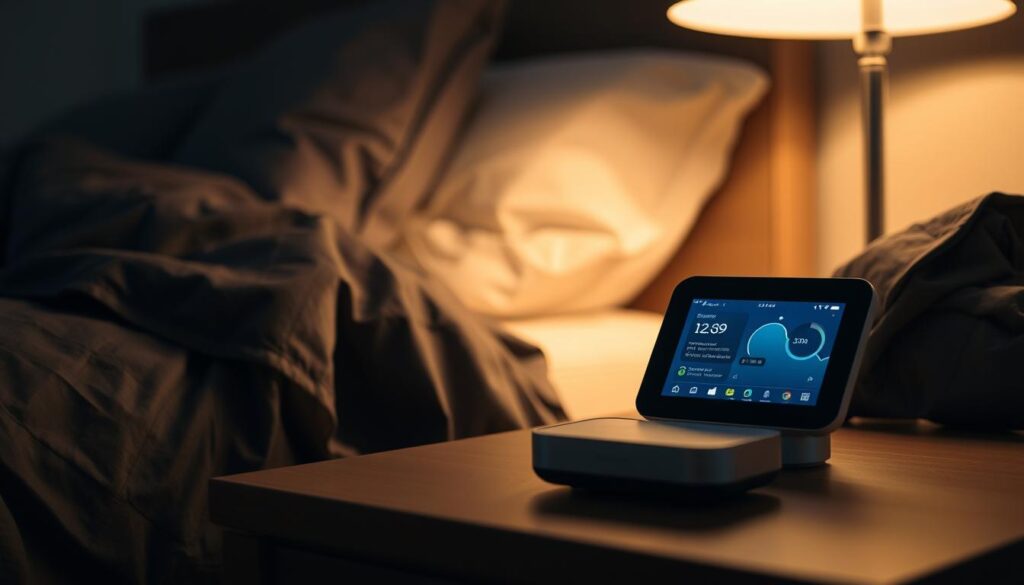
Metrics I monitored
Core measures mirrored what lab work reports: SOL, TST, SE, WASO, stage percentages, REM cycles, and microarousal-like events.
- I set a one-week baseline for SOL, TST, SE, and WASO before any evening exposure.
- I logged light sleep proportion, REM duration and cycle count, and spikes in brief awakenings flagged by my device.
- Subjective alertness was rated at lights-out and on waking to capture perceived readiness and morning clarity.
Tools and baselines: wearables vs. lab
Polysomnography tracks EEG and gives precise MAI and stage percentages. Wearables use motion and heart rate to estimate trends. I used both concepts, treating wearable output as directional rather than definitive.
| Measure | Polysomnography | Wearable (my unit) |
|---|---|---|
| SOL | EEG-defined latency | Estimated from motion & HR |
| Microarousals / MAI | Counted from EEG spikes | Proxy via frequent movement |
| Stage % / REM cycles | Accurate staging | Approximate stage estimates |
I annotated caffeine, exercise, and stress so any changes tied to the evening exposure could be isolated. Weekly averages and device settings were recorded so findings could be compared to participants in published studies and reproduced reliably.
Red Light Therapy Sleep Results: Week-by-Week Changes
Across the two-week trial I tracked nightly patterns to see where gains and trade-offs emerged. The first week showed an adaptation curve; week two brought clearer trends in efficiency and total time.
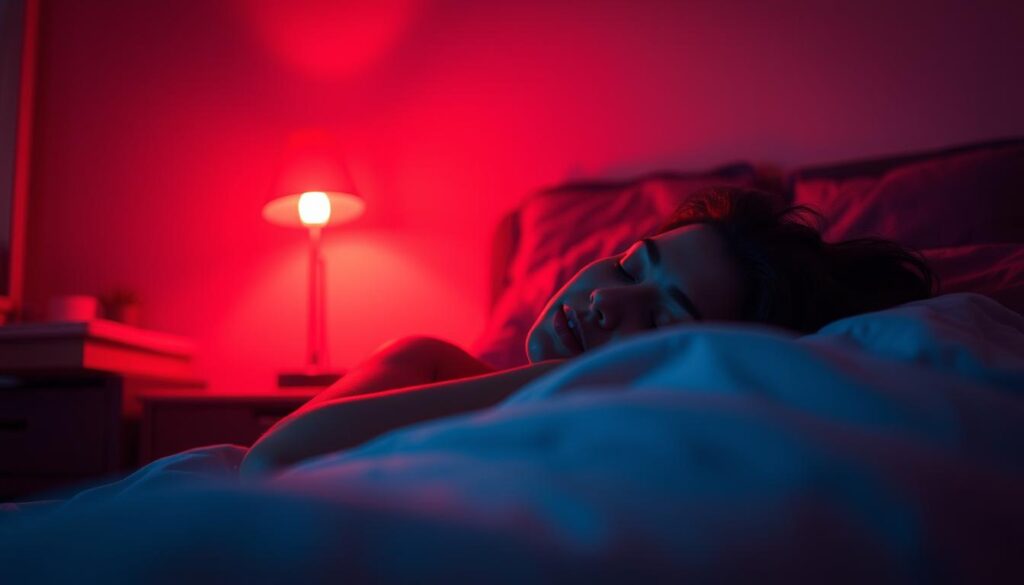
Week one: adaptation effects on sleep onset and alertness
During the first week I saw several nights with modestly shorter sleep onset latency. Wearable data matched my notes on faster lights-off drift on those evenings.
At the same time, subjective alertness sometimes felt higher right after sessions. That suggested sensitivity to timing and intensity for some nights.
Week two: trends in sleep efficiency, total sleep time, and microarousals
By week two sleep efficiency stabilized and total time in bed drifted slightly up on nights with very low brightness and earlier sessions.
Microarousal-like awakenings fell when I kept exposure below the recommended lux ceiling. When I edged closer to higher brightness, light sleep rose and brief awakenings increased.
Score breakdown: nightly variability and average deltas
Average deltas across the fortnight showed small improvements in latency and efficiency when sessions ended at least 45 minutes before lights-off and brightness stayed well below 10 lux.
- Best nights: very low lux + strict blue blocking = higher sleep quality and fewer awakenings.
- Worse nights: later sessions or screen exposure = more light sleep and fragmented rest.
- Morning alertness improved on several days, echoing some studies that link evening exposure with wake performance, but this was not universal.
| Metric | Week 1 | Week 2 |
|---|---|---|
| SOL (latency) | Modest decrease | Small sustained decrease |
| Sleep efficiency | Variable | Stabilized + slight gain |
| Light sleep / awakenings | Occasional increase | Fewer when dimmest |
Bottom line: real-world, dim, shorter sessions over these two weeks leaned toward cautious optimism. Individual factors like late exercise, stress, and timing influenced effects as much as the exposure itself.
How the Results Stack Up Against Current Research
Comparing my two-week trial to peer-reviewed research shows a mixed but interpretable pattern: timing and dose drive whether evening exposure helps or hinders rest. Lab work and field studies point to clear differences between healthy people and those with insomnia, and they highlight distinct uses for pre-sleep versus morning routines.
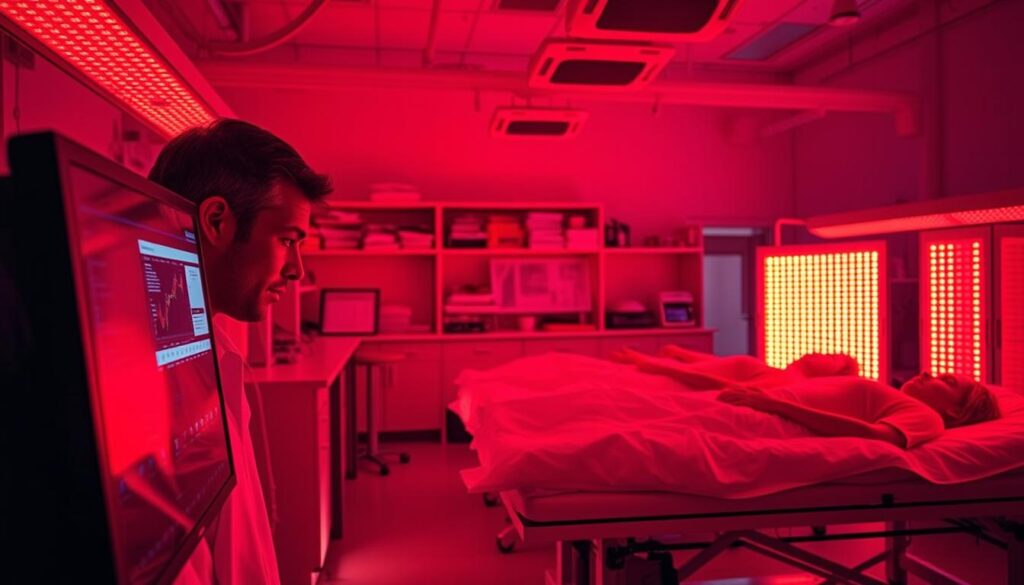
Why healthy sleepers and people with insomnia respond differently
Polysomnography studies report that healthy participants under pre-bed exposure had shorter sleep onset versus bright white, yet poorer sleep efficiency and total time when compared with darkness.
Those changes often showed higher N1% and more microarousals. In contrast, some insomnia participants gained TST and SE versus white light, though they still trailed darkness.
Takeaway: the brain’s arousal pathways likely explain divergence—baseline hyperarousal or anxiety alters how light cues affect sleep.
When evening exposure helps morning alertness and performance
Certain studies, including an athlete trial using 30 minutes nightly for two weeks, found improved sleep quality and higher melatonin levels. Other work shows saturated evening exposure can reduce sleep inertia and boost morning alertness and performance.
That suggests separating goals: an evening routine aimed at wind‑down should stay dim and early, while targeted post‑wake exposure can aid daytime alertness without risking fragmented rest.
| Group | Main lab finding | Practical implication | Best approach |
|---|---|---|---|
| Healthy participants | Shorter SOL vs white, worse SE/TST vs darkness; more N1 and microarousals | Pre-bed exposure can fragment rest if too bright or late | Keep sessions dim, earlier, end ≥45 min before lights‑out |
| Insomnia | Sometimes higher TST and SE vs bright white; still inferior to darkness | May benefit from low-energy evening cues compared with bright sources | Use very low lux and consistent timing; monitor individual response |
| Athletes / performance | 30 min/night over 2 weeks improved sleep quality and melatonin in one study | Short, repeated nightly exposure may aid recovery and morning function | Follow lower-intensity, two-week protocols; consider morning exposure for alertness |
Overall: align your routine with the gentlest effective dose—dim, short, and earlier—especially if you are a healthy sleeper. If morning performance is the priority, shift exposure to after waking and keep evenings darker.
How to Use Red Light Before Bed Safely
Begin with short, dim sessions that aim to support wind-down rather than stimulate alertness. Keep dose, timing, and device choice conservative so you can measure benefits without risking fragmented rest.
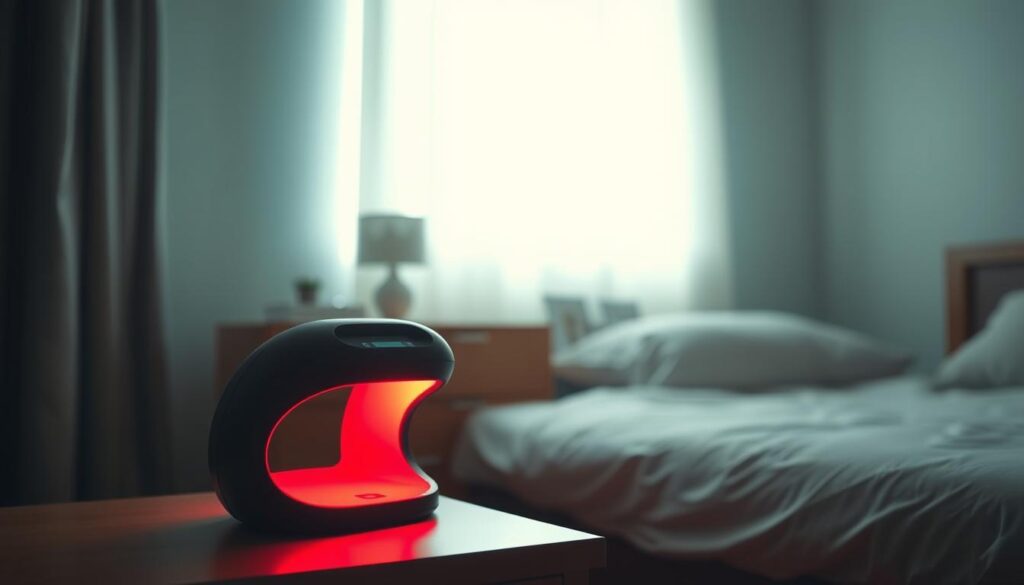
Which device should you pick?
Choose an FDA-cleared product that publishes spectral data near 660–870 nm. That range targets tissue and body systems while limiting stimulation of circadian cells.
Look for vendor specs, third-party testing, and clear safety notes. An FDA-cleared unit reduces guesswork about output and helps ensure consistent exposure levels.
Session plan and timing
Experts advise keeping intensity at or below ~10 lux at eye level. Use a lux meter app and position the device so you do not stare into the emitter.
- Starter option: 30 minutes, three times per week, 1–2 hours before bedtime.
- Evaluation option: nightly sessions for 14 days, then reassess benefit and tolerance.
- Adjust: shorten to 15–20 minutes or move earlier if you feel unusually alert at lights-off.
Do not run panels overnight
Turn all room sources off during actual rest. Continuous overnight exposure can raise microarousals and alter stage distribution and mood.
Use the device only during the planned pre‑bed window. Then allow darkness so melatonin production and restorative processes proceed uninterrupted.
| Focus | Practical guidance | Why it matters |
|---|---|---|
| Device | FDA-cleared; spectral data 660–870 nm | Ensures correct wavelength targeting and verified output |
| Intensity | ≤10 lux at eye level; use lux app | Limits circadian cell stimulation and preserves melatonin production |
| Timing | 30 min sessions; 3×/wk or nightly for 14 days | Balances dose and assessment period to spot benefits |
| Overnight | Lights off during sleep; no continuous exposure | Prevents microarousals and sleep-stage disruption |
Practical tips: pair sessions with strict blue light reduction, keep consistent timing, and log perceived alertness each night. If you want a deeper primer on evening trade-offs, see this review on whether does red light affect your sleep.
Troubleshooting, Sensitivities, and When to Adjust
If evening exposure raises alertness or changes mood, small fixes often restore balance. Start by treating intensity, timing, and direct eye exposure as the main levers you can control.
Noticing higher alertness or mood shifts? What should you tweak?
If alertness spikes after a session, reduce intensity and increase distance. End sessions at least 60 minutes before lights-out.
For mood changes, cut session length to 10–15 minutes and angle the device so the eyes aren’t exposed directly. Consider eye shields for LED masks.
If awakenings or more light sleep show up, check lux at eye level, move the session earlier, and remove other ambient sources.
How does light affect versus affect sleep — what to test first?
Assume proximity and level drive most unwanted arousal. Verify readings with a meter and drop settings until nights calm.
People with insomnia should ramp up slowly: start with two weekly sessions and increase only if tolerated. If problems persist, stop evening use and try morning application.
| Issue | Quick fix | Why it helps |
|---|---|---|
| Post-session alertness | Lower intensity; end ≥60 min before bed | Reduces acute arousal and preserves wind-down |
| Mood or anxiety shifts | Shorten time; angle device; use eye shield | Limits direct retinal exposure that can raise alertness |
| More awakenings | Check lux; move earlier; remove ambient light | Keeps night truly dark so restorative stages proceed |
Track time, levels, and perceived alertness nightly. If adjustments don’t help, consult a sleep specialist—CBT-I remains the first-line option for chronic insomnia.
Conclusion
After a controlled two‑week trial, modest evening exposure can help some people improve sleep and morning clarity when used carefully.Stick to safe wavelengths, low intensity, and an early pre‑bed window to protect melatonin and circadian rhythm.
The evidence is mixed: some studies and athlete trials report improved sleep quality after 14 nights of short sessions, while PSG work shows higher microarousals in healthy participants at brighter or later exposures.
Practical takeaways are simple. Choose devices that report 660–870 nm output, keep eye‑level brightness at or below ~10 lux, end sessions well before lights‑out, and avoid blue light around bedtime. Treat red light therapy as a supportive treatment, not a cure; measure your personal response for two weeks and adjust based on objective and felt changes.
FAQ
What did the two‑week bedside light experiment measure?
I tracked objective sleep metrics — sleep onset latency (SOL), total sleep time (TST), sleep efficiency (SE), wake after sleep onset (WASO), REM and light sleep proportions — using a consumer wearable alongside nightly subjective ratings. The goal was to compare baseline nights to two weeks of nightly exposure and note trends in onset, depth, and fragmentation.
Why test evening exposure to long‑wavelength devices?
Evening exposure targets the circadian system and melatonin timing without the stimulating effects of short wavelengths. I wanted to see if low‑intensity, warm spectrum sessions during wind‑down improved sleep onset and restoration compared with baseline habits and to compare findings with published studies.
How do different wavelengths affect melatonin and alertness?
Shorter wavelengths (blue) strongly suppress melatonin and raise alertness via ipRGC pathways. Longer, warmer wavelengths have much less impact on melatonin suppression at comparable illuminance, making them a better option for pre‑bedtime exposure when the goal is relaxation rather than stimulation.
What are ipRGCs and why do they matter for evening light use?
Intrinsically photosensitive retinal ganglion cells (ipRGCs) detect ambient light and send signals to the brain’s circadian center. They’re especially responsive to blue light, so minimizing blue reduces circadian phase shifts and melatonin suppression — a key reason to choose warm spectrum devices before sleep.
What wavelengths and intensities did research support for evening sessions?
Studies typically cite longer wavelengths in the 600–900 nm range with low photopic illuminance. Practical evening protocols use low lux levels (single digits to low double digits) and moderate exposure times to avoid alerting effects while still engaging tissue responses.
What exact protocol did you use for the two‑week trial?
I sat 30–40 minutes before bedtime, roughly 20–24 inches from the panel, for 20–30 minutes nightly. I kept ambient room lighting low, eliminated blue sources (phones, screens), and followed a consistent wind‑down routine to isolate the device’s effects.
How did you control intensity and distance during sessions?
I measured brightness with a lux meter and adjusted distance so measured photopic lux stayed low (around or below 10 lux aiming for a non‑stimulating zone). Where meters weren’t available, I used manufacturer distance guidance and kept the device off axis to reduce direct glare to the eyes.
What environment did you create for the sessions?
Sessions occurred in a dim, quiet bedroom with screens disabled or blue‑light filtered. I combined the exposure with standard sleep hygiene: consistent bedtime, limited caffeine, and a relaxation routine to reduce confounding variables.
Which sleep metrics moved first during week one?
In week one, the most noticeable change was a modest reduction in sleep onset latency for several nights — an adaptation effect. Subjective ease falling asleep improved before major changes in total sleep time or efficiency became apparent.
What trends emerged in week two of the trial?
Week two showed small, consistent gains in sleep efficiency and slight reductions in microarousals for some nights. Total sleep time varied by individual night, but averaged improvements in consolidation were more evident than large increases in total duration.
How variable were nightly scores across the two weeks?
Night‑to‑night variability was common: lifestyle factors, stress, and prior activity influenced outcomes. Averages showed modest benefit, but responders and nonresponders both appeared — highlighting the need for multi‑night tracking to see true trends.
How do these results compare to published research?
The observed modest improvements align with controlled trials that report small to moderate benefits in healthy adults and larger effects in people with insomnia or circadian delay. Results are consistent with evidence that pre‑bed warm spectrum exposure can aid sleep onset without suppressing melatonin like blue light.
Who is most likely to benefit from nightly sessions?
People with delayed sleep timing, mild sleep onset insomnia, or those sensitive to evening screen stimulation may see the biggest gains. Healthy sleepers may notice smaller changes, while those with clinical insomnia should consider trials under clinician guidance.
Which devices and specs are safest to use before bed?
Choose established brands with clear spectral specs and safety claims; some medical‑grade options are FDA‑cleared for specific indications. Aim for devices targeting longer wavelengths in the 600–900 nm range, with adjustable output and clear distance guidance.
What session frequency and duration worked in your test?
I used 20–30 minutes nightly for 14 days. Research protocols vary — some use 15–30 minutes nightly or several sessions per week — but consistency in timing relative to bedtime appeared more important than strict daily frequency.
Should the device stay on during sleep overnight?
No. Continuous overnight exposure can disrupt sleep architecture and consolidation. Turn the device off when lights go out and keep the sleeping environment dark for optimal melatonin production and restorative sleep.
What if the sessions increase alertness or interfere with mood?
Reduce intensity, shorten sessions, or move exposure earlier in the evening. If alertness or mood changes persist, pause use and consult a sleep specialist or medical provider to rule out sensitivity or underlying conditions.
How can you fine‑tune timing and intensity for better results?
Start with low intensity and 20 minutes about 30–60 minutes before planned bedtime. Track sleep for a week, then adjust duration or distance in small steps. Avoid screens during the same window and prioritize a consistent sleep schedule.
Can evening exposure replace other sleep therapies or medications?
It’s an adjunct, not a replacement for proven therapies. Cognitive behavioral therapy for insomnia (CBT‑I) and medications prescribed by clinicians remain primary options for chronic or severe insomnia. Evening light exposure can complement behavioral approaches.
How long until you should expect noticeable change?
Some people notice quicker sleep onset within days; others need two to four weeks of consistent use to see consolidated changes. Track objective and subjective metrics across multiple weeks to determine true response.
Are there specific groups who should avoid evening exposure to warm spectrum devices?
People with photosensitivity disorders, certain retinal conditions, bipolar disorder with light sensitivity, or who take photosensitizing medications should consult a clinician before use. Pregnant people and children should also seek medical advice first.
What objective vs. subjective tools did you use and which matter most?
I used a consumer wearable for nightly metrics and a sleep diary for subjective sleep quality. Wearables capture trends well but can misclassify stages; combining objective data with how you feel provides the best real‑world assessment.
How do effects differ between people with insomnia and healthy sleepers?
People with insomnia often show larger relative improvements in onset and consolidation, since they have more room for change. Healthy sleepers may experience smaller gains or none at all — individual physiology and baseline sleep quality strongly influence outcomes.
Can pre‑bed warm spectrum sessions reduce sleep inertia and improve morning performance?
Some evidence suggests improved sleep consolidation can reduce morning grogginess for certain users. However, effects on sleep inertia vary and depend on overall sleep duration and consistency, not just pre‑bed exposure.
What steps help troubleshoot lack of benefit?
Verify device specs and distance, reduce intensity, adjust timing earlier in the evening, and control blue light sources. If no improvement after several weeks, reassess other sleep factors (caffeine, stress, schedule) and consult a clinician.
How should one manage sensitivity to evening exposure?
If you feel more alert or experience mood changes, cut sessions to 10–15 minutes, increase distance, or stop nightly use and try every‑other‑night. Monitoring responses and adjusting gradually helps identify a personalized sweet spot.

Don’t Miss These Picks