


Do special screen lenses really protect your eyes, or are they clever marketing?
This piece separates clear evidence from hype and shows what the best research actually says.
The most rigorous reviews find little short-term benefit of tinted or coated lenses over clear lenses for reducing eye strain. A Cochrane review of 17 randomized trials (5–156 participants; durations
The American Academy of Ophthalmology does not endorse special eyewear for computer use, noting that discomfort stems from how people use devices rather than harmful emissions.
Public Health England also concluded that everyday sources, even at high brightness, do not pose a public health risk. For more background on wavelength and effects, see this summary on blue light and eye health.
Here we compare orange-tinted blockers to clear filters, weigh clinical evidence, and offer practical steps—like ergonomics and breaks—that reliably ease digital strain.
Key Takeaways
- High-quality trials show little to no benefit of specialty lenses for short-term eye strain relief.
- Professional groups advise changing behavior and workspace setup over buying gear.
- Device emissions are minor compared with daylight; everyday exposure is unlikely to harm vision.
- Some people with migraine-related sensitivity may benefit from targeted lenses.
- Simple fixes—ergonomics, regular breaks, and evening dimming—have stronger evidence than filters.
Setting the stage: why blue light glasses surged and what people expect them to do
As screens moved into every corner of life, many saw filtered lenses as a quick fix for tired eyes and poor sleep. Marketing promised protection, simpler relief, and better nights—so demand climbed fast.
Surge and expectations: Headlines tied blue light to discomfort and sleep shifts, and that message stuck. Consumers began to expect that wearing specialty lenses would cut eye strain during long screen sessions and help sleep after evening device use.
Market momentum followed. An Australian survey in 2019 found about 75% of optometrists had written a prescription for blue-blocking options, which reflects both demand and clinical acceptance in the marketplace.
The evidence picture is different. High-quality randomized studies and a Cochrane review show little benefit for vision fatigue versus clear lenses, and sleep gains remain inconclusive. In short, advertising is louder than the data.

Why did this happen? Longer screen time, more continuous near work, and indoor lighting trends pushed people to try new tools. The real question becomes: glasses vs. habits. We’ll next separate claims from controlled studies and practical steps that truly reduce strain and improve sleep.
What blue light is doing in your body: wavelengths, ipRGCs, and circadian signals
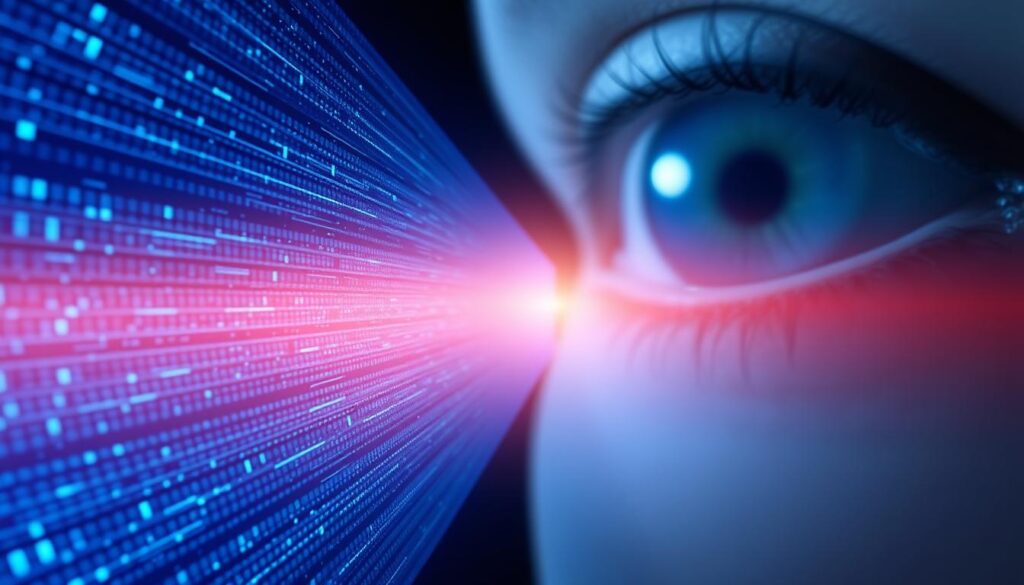
Short, high-energy wavelengths are prime signals for the body clock. Specialized retinal cells called ipRGCs respond best to wavelengths around 400–500 nm and send timing messages to the brain.
How retinal cells shift sleep timing
ipRGCs don’t help vision the way rods and cones do. They gauge ambient spectral content and tell the brain whether it’s day or night. That pathway alters melatonin release and can delay sleep when stimulated in the evening.
Devices versus the sun
Your screens do emit blue light, but the sun delivers far more. Public Health England and experts note device output is orders of magnitude lower—often under 1% of midday sun—so real-world retinal harm from normal exposure is unlikely.
- Takeaway: timing and dose matter—reduce bright evening screen use and seek morning outdoor light.
- Lab studies showing cell damage use much higher intensities than people normally receive.
- For circadian health, focus on when you get light, not just filtering coatings.
For deeper technical reading on retinal photoreceptors and timing signals, see this ipRGC research review.
The current evidence base: what Cochrane reviews and the American Academy of Ophthalmology actually say
Top reviews and clinical guidance converge: routine prescribing of specialty filters for screen discomfort lacks strong support. Most benefits in trials are small or absent, and comfort gains link more to habits than to coatings.
Large randomized trials and systematic reviews show few measurable benefits of specialty filters for common screen discomfort.
Randomized trials on eyestrain and visual acuity: little to no advantage over clear lenses
The Cochrane review pooled 17 randomized trials (sample sizes 5–156, durations under a day to five weeks) and found no short-term benefit of filtered lenses over clear lenses for reducing eye strain.
Visual acuity measures also showed little to no change. Trials rarely reported long-term retinal outcomes, so clinical implications beyond days or weeks remain unknown.
AAO guidance: digital eye strain is about use habits, not device damage
The American Academy of Ophthalmology states there is no evidence that everyday screen emissions damage the eye. The academy ophthalmology guidance recommends behavioral fixes—blinking, breaks, and ergonomics—over special eyewear.
“Digital eye strain stems largely from how devices are used, not from routine screen emissions.”
Study quality caveats: mixed lens types, short durations, and limited endpoints
Many trials mixed orange-tinted blockers with clear-coated filters and omitted lens specifics. That heterogeneity muddies the picture.
Future research needs standardized lens specs, longer follow-up, and clinically meaningful endpoints to raise evidence quality.
| Outcome | Trials Pooled | Result | Notes |
|---|---|---|---|
| Eye strain symptoms | 17 RCTs | No clear advantage | Short durations; mixed lens types |
| Visual acuity | Multiple small trials | Little to no effect | Short-term measures only |
| Retinal outcomes | None reported | No data | Long-term safety unknown |
For an accessible summary of trial findings, see this review on do blue light glasses help with.
Bottom line: current scientific evidence does not justify routine prescribing of filtered lenses solely for eye strain prevention. Focus on breaks, blink habits, and workspace setup for reliable relief.
Blue Light Glasses Science: orange-tinted blockers vs. clear “blue-filter” lenses
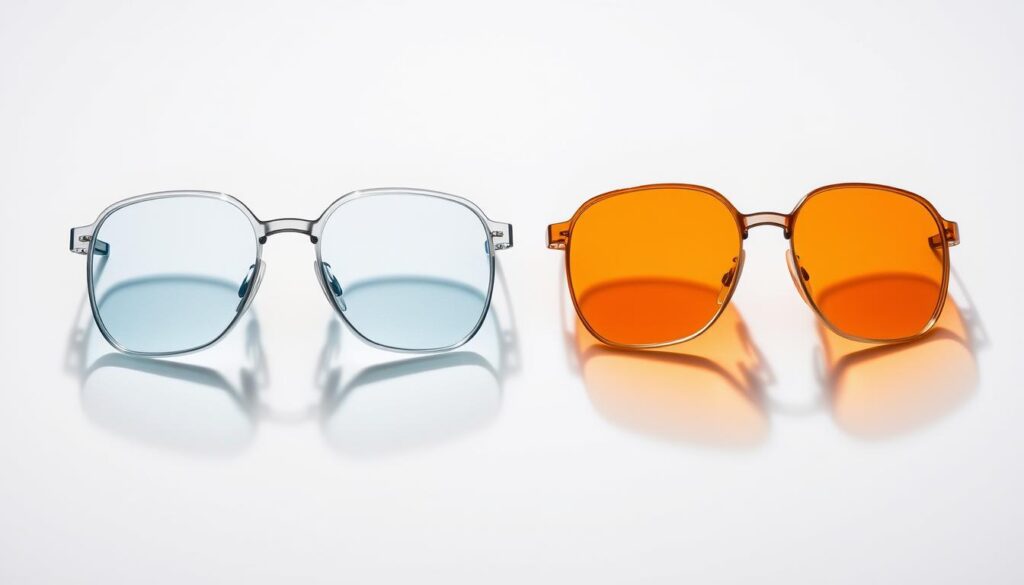
Orange tints cut a large share of short wavelengths, while clear coatings aim for subtle filtering and true colors. That trade-off affects appearance, comfort, and real-world usefulness.
How the filters differ
Orange-tinted lenses substantially suppress short wavelengths. They change color perception but block a lot of the targeted band.
Clear, colorless filters preserve color. Some block only ~20% of the targeted band to avoid distortion.
Do they reduce symptoms during tasks?
A blinded 2021 randomized computer task (n=120) found no significant change in eye strain scores between heavy blockers and a clear placebo. The Cochrane review also noted trials mixed tint types, which muddies conclusions.
| Feature | Orange-tinted | Clear-coated |
|---|---|---|
| Typical suppression | High (strong) | Low–moderate (~20% in some products) |
| Color fidelity | Reduced, warmer tint | Preserved |
| Reported symptom benefit | No consistent advantage | No consistent advantage |
| Best use case | Specific photo-sensitivity or migraine | Everyday wear, color work |
Interpretation: If controlled trials show no clear effect, filtering alone likely misses main drivers of strain—blink rate, dryness, glare, and posture. For more on retinal pathways and timing, see this clinical review.
Sleep claims under the microscope: do glasses before bed help more than settings and habits?
Many people buy specialty filters hoping for better sleep after evening screen use. The biology makes sense—short wavelengths can suppress melatonin—but clinical results are mixed.

Mixed trial outcomes: Systematic reviews, including the Cochrane analysis, report inconsistent sleep outcomes. Small studies show some subjective benefit, yet objective measures often disagree.
Research notes that melatonin suppression from evening exposure blue light recovers quickly—roughly 15 minutes after a prolonged 2-hour exposure. Specialized groups sometimes show gains: hospitalized bipolar patients improved sleep efficiency in one small trial, and a tiny athlete study found faster sleep onset.
Practical alternatives that work
- Reduce brightness and dim lamps in the evening rather than relying only on filters.
- Enable Night Shift or dark mode to lower blue content and perceived glare, but still keep overall luminance low.
- Aim for a calm, darker room 1–2 hours before bed and avoid high-luminance content.
Bottom line: For most people, adjusting screens and room lighting at night likely offers as much—or more—benefit than buying specialty lenses. If you want user experiences, read an honest reviews that include practical sleep tips.
If your eyes feel tired, look beyond blue: practical fixes for computer vision syndrome
When digital tasks leave your eyes sore, small routine shifts often cut symptoms far more than special coatings. Focus first on how you work: posture, breaks, and moisture solve most complaints.
Primary drivers: glare, reduced blinking, dry eye, posture, and screen distance
Digital discomfort usually stems from behavior, not device emissions. Prolonged near focus reduces blink rate and raises dryness. That leads to blurred vision, headaches, and neck pain.
The 20-20-20 rule and timed breaks: simple routines to cut strain
Every 20 minutes, look about 20 feet away for 20 seconds. This resets focusing muscles and eases eye fatigue quickly.
Optimize ergonomics and moisture: viewing angles, arm’s-length distance, artificial tears
- Identify main culprits: prolonged near focus and low blink rate drive most strain and symptoms.
- Reduce glare: adjust lights, tilt your monitor, or add a matte protector.
- Blink and breathe: set reminders to blink fully; micro-breaks relax muscles.
- Tune ergonomics: sit at arm’s length (~25 inches), keep the top of the monitor at or slightly below eye level, and relax shoulders.
- Hydrate the surface: preservative-free artificial tears can ease dryness from long computer use.
- Check your prescription: outdated corrections can amplify eye discomfort—schedule routine exams.
Build simple habits: timed breaks, posture resets, and lighting tweaks outperform most lens claims for reducing daily strain.
Bigger-picture comparisons: blue light vs. sunlight, IOLs for cataract, and migraine lenses
Public health reviews put device exposure in context: natural sun exposure far exceeds screen output, and routine device viewing is low risk. Choose protection based on real-world exposure and the specific vision condition you face.

Exposure context: why sunlight overwhelms screens
Regulators note that a bright day delivers far more short-wavelength energy than any phone or monitor. Public Health England concluded that even extreme screen use does not create a public health concern.
Outdoors, ultraviolet—not visible short wavelengths—drives most photodamage. Use sunglasses and sunscreen as first-line protection.
Blue-blocking intraocular lenses after cataract surgery
Some intraocular lenses include dyes to absorb shorter bands. A 2018 Cochrane review found similar distance vision at one year versus standard IOLs and insufficient evidence to claim AMD prevention.
In short, visual outcomes look comparable, and retinal protection remains uncertain in current studies. For deeper reading, see the systematic review.
When photophobia or migraine drives lens choice
For people with true light sensitivity, precision filters designed for migraine may work better than generic blockers. These purpose-built lenses target broader problematic bands and often improve comfort.
But benefits for migraine do not generalize to everyday device users. Match lens technology to the condition; most people see bigger gains from better lighting, breaks, and sleep hygiene.
Conclusion
Evidence and clinical guidance favor behavior over branded filters for everyday comfort and better sleep. Practical changes—dimming, breaks, and ergonomic setup—deliver the clearest, most consistent relief.
Current reviews and the American Academy Ophthalmology agree: specialty lenses rarely beat clear options for reducing eye strain. Public Health England likewise finds normal device exposure is not a public health risk.
So where to invest? Lower screen brightness at night, follow the 20-20-20 rule, reduce glare, and check your prescription. If symptoms persist or you have a specific condition, consult an eye care professional about targeted options.
Bottom line: prioritize proven habits and informed care rather than product hype when protecting your eyes and sleep.
FAQ
What should I expect an optometrist to say about blue light eyewear?
Most eye care professionals explain that evidence for specialty lenses protecting eyes from long‑term damage is weak. They acknowledge that certain tinted lenses can shift evening circadian signals and that reducing screen glare and improving habits often does more for comfort and sleep than filtered lenses alone.
Why did these protective lenses become so popular and what do people hope they will do?
Sales grew as device use rose and people sought simple fixes for tired eyes and poor sleep. Buyers commonly expect reduced eye strain, better sleep, and protection from screen emissions. In practice, expectations often exceed what trials show—behavior changes and brightness adjustments usually account for most benefits.
How do short wavelengths affect the body and sleep timing?
Shorter visible wavelengths have more energy and stimulate intrinsically photosensitive retinal ganglion cells (ipRGCs), which signal the brain’s circadian system and suppress melatonin. Evening exposure to strong short‑wavelength light can shift sleep timing, but the effect depends on intensity and duration more than small spectral tweaks from typical lenses.
Are device emissions as strong as sunlight when it comes to impacting circadian rhythms?
No. Sunlight contains far higher levels of short wavelengths and overall intensity. Screens emit less by comparison, so while late‑night device use can delay sleep through timing and brightness, outdoor daylight exposure remains the dominant driver of circadian cues.
What do major reviews and the American Academy of Ophthalmology say about these lenses?
Systematic reviews and AAO guidance emphasize limited, low‑quality evidence that clear blue‑filter coatings reduce eye strain or prevent ocular disease. The AAO highlights that digital eye strain is mainly due to viewing habits, glare, and tear film issues rather than retinal injury from routine device use.
Do randomized trials show improved visual acuity or reduced computer eyestrain with filtered lenses?
High‑quality randomized trials generally find little to no advantage of modest spectral filters over standard clear lenses for visual acuity or most symptom scores. Studies vary in lens type and duration, and strong orange tints can change comfort and sleep but also alter color perception.
How do orange‑tinted blockers compare with clear filter coatings?
Orange or amber tints strongly suppress short wavelengths and can meaningfully reduce circadian stimulation at night, but they noticeably change color balance and are less practical for daytime tasks. Clear coatings provide modest filtering with minimal color shift but deliver smaller physiological effects.
Will wearing tinted lenses before bed reliably improve sleep more than using device settings and good habits?
Evidence is mixed. Small trials sometimes report subjective sleep improvements with strong tints, but objective measures like total sleep time or sleep efficiency show inconsistent changes. Lowering screen brightness, enabling night modes, and practicing good sleep hygiene are simpler, better‑proven strategies.
If my eyes feel tired, is filtering the spectrum the first fix I should try?
No. Eye fatigue is usually driven by glare, reduced blinking, dry eye, posture, and close viewing. Start with the 20‑20‑20 rule, adjust screen distance and angle, reduce ambient glare, and use lubricating drops if needed. These steps often reduce symptoms more than spectral filters alone.
What practical steps reduce computer vision syndrome besides lenses?
Take regular timed breaks (look 20 feet away for 20 seconds every 20 minutes), set screens to comfortable brightness, increase font sizes, maintain arm’s‑length distance, and optimize chair and monitor height to keep your gaze slightly downward.
How does screen exposure compare to sunlight and clinical choices like IOLs for cataract patients?
From a public health perspective, natural daylight far exceeds screens in intensity and short‑wavelength content. Blue‑blocking intraocular lenses are available, but trials haven’t shown clear protection against age‑related macular degeneration and visual outcomes are similar to standard lenses.
When are specialized lenses useful, for example with migraines or photophobia?
People with light sensitivity or migraine may benefit from tinted lenses specifically designed for photophobia; these reduce overall glare and contrast‑related triggers. In such cases, tailored lenses can help where generic filters do not.
Should I buy prescription lenses with a clear filter coating to protect my eyes long term?
If your primary goal is comfort during screen use, consider addressing ergonomics and environment first. Clear filter coatings add minor spectral changes and may reduce perceived glare, but current evidence doesn’t support a strong protective effect against retinal disease for routine device exposure.
How long and how bright does evening exposure need to be to affect melatonin and sleep?
Circadian responses are intensity‑ and time‑dependent. Bright, prolonged evening exposure—especially within a few hours of bedtime—has the largest effect on melatonin suppression. Short, dim exposures are much less likely to shift sleep timing.
Are there safety concerns with wearing strong amber or orange filters during the day?
Yes—highly tinted lenses alter color perception and can reduce contrast in low‑light settings, which may be unsafe for tasks like driving at dusk. Reserve strong tints for evening indoor use and use neutral options for daytime activities.
Where can I find reliable, peer‑reviewed information about these claims?
Trust sources like PubMed, Cochrane Reviews, the American Academy of Ophthalmology, the National Institutes of Health, and Mayo Clinic for evidence summaries. Look for randomized trials and systematic reviews rather than marketing materials.


Don’t Miss These Picks