

Could switching to red light in the evening help you sleep better? The answer starts with how your brain responds to light and darkness.
Dim red light is generally less likely to suppress melatonin than bright, blue-rich light. That makes it a reasonable choice when you need some lighting before bed. However, using a red light therapy device to increase melatonin or treat sleep problems is a different question, and the research is still developing.
Melatonin is a hormone that helps your body recognize nighttime. Your brain normally releases more of it as evening darkness approaches. Bright light, especially light rich in blue wavelengths, can interrupt that process.
This guide explains how red light affects melatonin, what human studies have found, how ordinary red bulbs differ from therapy panels, and which evening habits can help you protect your sleep. For a related personal account, you can also read our 30-day at-home red light therapy experience.
Key Takeaways
- Red light is less disruptive, not automatically sleep-promoting. Dim red lighting generally has less effect on melatonin suppression than blue-rich lighting.
- Brightness and timing matter. Even a red light can be stimulating when it is intense or used at the wrong time.
- Early research is promising. Small studies and a recent research review suggest possible sleep-quality benefits from red and near-infrared therapy, but stronger evidence is needed.
- Red bulbs and therapy panels serve different purposes. A dim bulb provides room lighting, while photobiomodulation devices deliver targeted light to body tissues.
- Start with proven habits. Morning daylight, dim evenings, reduced screen brightness, and a consistent bedtime are more established ways to support healthy sleep.
How Light Controls Melatonin Production in Your Brain
Your body has an internal clock called the circadian rhythm. It helps coordinate sleep, alertness, body temperature, and hormone release across roughly 24 hours.
Light is one of the strongest signals that keeps this clock aligned with the outside world. Your eyes collect that information and pass it to the brain.
The connection between your eyes and melatonin
Your retina contains special cells called intrinsically photosensitive retinal ganglion cells (ipRGCs). These cells contain melanopsin, a light-sensitive pigment that responds strongly to blue wavelengths.
They also receive information from other light-detecting cells in your eyes. Together, these pathways send signals to the suprachiasmatic nucleus (SCN), a small region of your brain that acts as your master biological clock.
The SCN helps control when the pineal gland releases melatonin.
- During daylight: Light signals tell your brain it is daytime and help keep melatonin levels low.
- As darkness approaches: Reduced light allows your normal evening melatonin rise to begin.
- Under bright evening lighting: The brain may continue receiving daytime-like signals, delaying or reducing melatonin release.
According to the National Institutes of Health, melatonin typically rises during the evening and reaches higher levels overnight, helping align sleep with nighttime.
Why evening brightness matters
A 2011 laboratory study involving 116 healthy young adults compared ordinary room lighting with very dim lighting before bedtime.
Evening room light was associated with a later melatonin rise and a shorter period of melatonin production. Compared with dim lighting, the duration was shortened by about 90 minutes.
This helps explain why turning down household lights can matter even when you are not looking directly at a screen.
Red Light vs. Blue Light: What Is the Difference?
Different wavelengths of light affect the body’s clock differently. Wavelength is measured in nanometers (nm).
Blue light, particularly near the wavelengths that strongly activate melanopsin, is effective at influencing circadian timing. Longer red wavelengths generally have a weaker effect on this pathway at comparable light exposure levels.
Does red light stop melatonin suppression?
Not completely. Red light is generally less effective at suppressing melatonin than shorter-wavelength light, but the effect depends on more than color.
Three details are especially important:
- Wavelength: The actual spectrum emitted by the light source matters more than how red it looks.
- Intensity: A powerful red panel may deliver substantial light to your eyes, while a tiny red nightlight delivers much less.
- Duration and timing: A brief exposure and several hours of continuous illumination are not equivalent.
A human laboratory study published in 2022 demonstrated that melatonin suppression and circadian responses vary with wavelength, intensity, and exposure duration.
The practical lesson: If you need light near bedtime, choose something dim and comfortable rather than assuming that anything colored red is harmless to your sleep.
Can Red Light Therapy Actually Increase Melatonin?
This is where two different ideas often get mixed together.
Using dim red room lighting may reduce the disruption caused by brighter, blue-rich lighting. It mainly changes the signals entering your eyes.
Red light therapy, also called photobiomodulation, uses selected red or near-infrared wavelengths to influence biological processes in exposed tissues.
Researchers are studying whether these tissue-level effects can improve sleep, but they have not established that ordinary home therapy panels directly stimulate the pineal gland to produce more melatonin.
What happens inside cells?
Some photobiomodulation research suggests that carefully delivered red and near-infrared light can affect mitochondria, the structures that help cells produce energy.
Researchers have investigated several possible responses:
- Changes in ATP production, which supplies energy for cellular activity.
- Changes in oxidative stress, a process involving potentially damaging reactive molecules.
- Effects on inflammation and cellular signaling.
- Possible changes in tissue recovery and other biological processes.
These mechanisms are scientifically interesting, but they do not prove that a consumer device improves sleep. Effects depend on the tissue, wavelength, light dose, and treatment method.
Melatonin also performs functions inside tissues beyond its role as a circulating nighttime hormone. These local cellular functions should not be confused with the pineal gland’s regulation of sleep timing.
What Human Studies Say About Red Light and Sleep
Several studies have explored red light exposure, melatonin, sleep quality, and alertness. Their findings are worth understanding, but the studies do not all investigate the same treatment or outcome.
1. Female basketball players: A 14-day study
A 2012 study published in the Journal of Athletic Training examined 20 female basketball players.
Ten received 30 minutes of red light treatment every night for 14 days, while the other ten formed a comparison group without light treatment.
After the intervention, the red light group showed improvements in reported sleep quality, serum melatonin levels, and endurance performance.
Important limitation: This was a small study involving trained athletes. Its results cannot establish that the same treatment works for everyone with poor sleep or insomnia.
2. Office workers: Red light increased afternoon alertness
A 2019 workplace study involving 19 participants examined a lighting schedule combining blue light in the morning, white light around midday, and red light in the afternoon.
Participants showed more consolidated rest-activity patterns and reported improved afternoon alertness.
As described by Rensselaer Polytechnic Institute, afternoon red light helped reduce post-lunch sleepiness.
This is an important reminder that red light does not automatically make you sleepy. Depending on its timing and intensity, it may also support wakefulness.
3. Red light and morning grogginess
A 2019 study involving 30 adults investigated whether red light delivered through closed eyelids or through goggles after waking could reduce sleep inertia.
Sleep inertia is the groggy, slow-thinking feeling that sometimes occurs immediately after waking.
Some performance measures improved with red light exposure, without a detected effect on melatonin levels under the tested conditions.
However, reducing morning grogginess is different from helping someone fall asleep at night.
4. What a newer research review found
A 2026 systematic review and meta-analysis combined five randomized controlled trials involving 240 participants.
Overall, photobiomodulation was associated with a modest improvement in scores on the Pittsburgh Sleep Quality Index, a questionnaire used to assess sleep quality.
However, the authors emphasized that the evidence remained limited. The trials used different treatment methods, and the estimated benefit was not precise enough to establish an ideal treatment protocol or reliable long-term results.
What the research means: Red and near-infrared therapy may help certain people, but more large, well-controlled studies are needed before it can be recommended as a proven treatment for sleep disorders.
Red Nightlights, Colored Bulbs, and Therapy Panels: Which Is Different?
You do not need an expensive therapy panel simply to reduce evening exposure to bright light.
It helps to separate lighting tools by what they are designed to do.
Dim red nightlights
These are useful when you need enough light to move safely through a hallway, reach the bathroom, or handle a quick nighttime task.
- Main benefit: Low-level illumination without turning on bright ceiling lights.
- Look for: Gentle brightness, convenient placement, and a switch or sensor that works for your routine.
- Limitation: A red nightlight is not a medical sleep treatment and does not need to emit a clinical therapy wavelength.
Red or warm-colored bulbs
Ordinary red bulbs and warm-colored lamps can create a comfortable evening environment. However, their output varies widely.
A red-tinted cover does not necessarily eliminate shorter wavelengths, and some red bulbs are bright enough to feel stimulating.
If you already have an adjustable warm lamp, lowering its brightness may be sufficient. A replacement bulb is optional.
Dedicated red light therapy panels
Therapy panels commonly advertise wavelengths around 660 nm in the visible red range and 850 nm in the near-infrared range.
Near-infrared light is largely invisible to human eyes, but it still delivers optical energy to exposed tissue.
Unlike room bulbs, panels may deliver concentrated light at specified distances. Their light output is often described using irradiance, measured in milliwatts per square centimeter (mW/cm²).
That is different from the brightness of ordinary room lighting measured in lux. A panel’s tissue exposure cannot be judged accurately using room lux alone.
How to Choose and Use a Red Light Device Safely
If you are considering photobiomodulation for a broader wellness routine, focus on clear specifications and safe operation rather than promises of better sleep.
What to check before choosing a device
- Wavelength: Look for clearly stated peak wavelengths rather than descriptions such as “healing red light.”
- Output: Check whether irradiance is stated at a specific treatment distance.
- Controls: A timer and adjustable intensity can make exposure easier to manage.
- Eye protection: Follow the device’s instructions and use the recommended protective eyewear when required.
- Safety documentation: Look for clear electrical safety information and model-specific documentation. Do not confuse safety certifications with proof of clinical effectiveness.
A device offering 660 nm or 850 nm does not automatically match a published sleep study. The dose, treatment area, timing, and other features may be different.
How long should a session last?
There is no established universal red light therapy schedule for improving melatonin production or treating insomnia.
The 2012 athlete study used 30-minute sessions for 14 nights, but that protocol should not be treated as a recommended dose for every home device.
If you choose to use a panel, follow its device-specific instructions and avoid exceeding recommended exposure times. Do not assume that longer sessions produce greater benefits.
For people whose main goal is better sleep timing, reducing evening brightness is a more established starting point than adding a therapy session.
How Dim Should Your Bedroom Be Before Sleep?
A 2022 expert consensus published in PLOS Biology recommends reducing evening light exposure during the three hours before bedtime.
The researchers proposed a maximum of 10 lux of melanopic equivalent daylight illuminance at eye level during the evening, with an even lower target during sleep.
This is a specialized measure of how strongly light stimulates the melanopsin system. It is not the same as ordinary lux from a standard light meter.
For home use, you do not need to chase an exact number. Focus on these practical habits:
- Lower the brightness of household lights as bedtime approaches.
- Choose a small, low-output lamp instead of bright overhead lighting.
- Keep necessary nighttime lighting pointed away from your face.
- Close curtains or use blackout shades when outdoor light enters your bedroom.
- Sleep in darkness when possible while keeping nighttime movement safe.
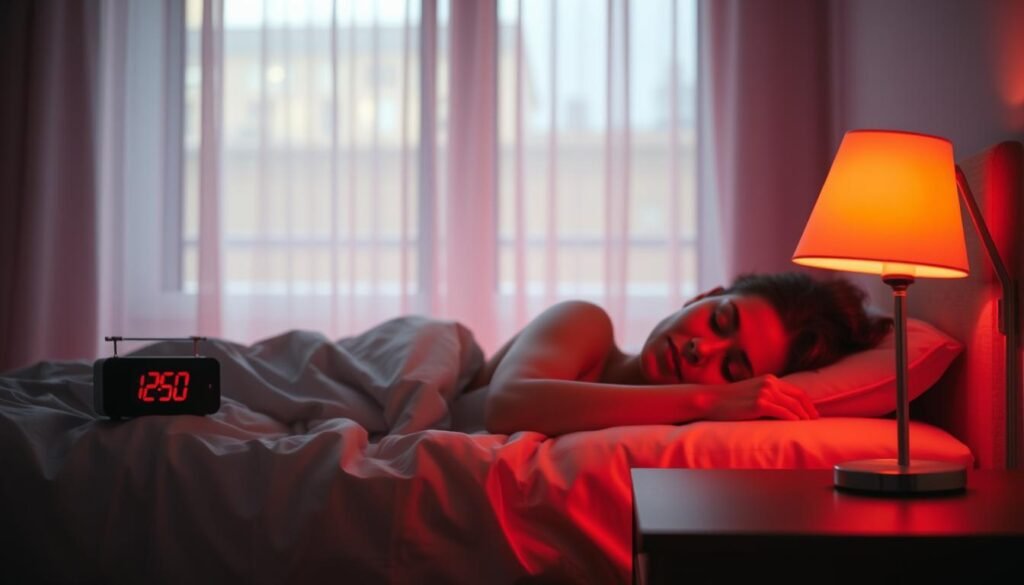
Red lighting can be useful for brief nighttime navigation because it generally disturbs dark adaptation less than bright white light. Still, the lowest practical brightness is preferable.
A Simple Evening Routine to Protect Your Melatonin
You can support your body’s natural sleep-wake rhythm without buying a therapy device.
Try this routine consistently before deciding whether additional equipment is worthwhile.
- Get daylight after waking. Spend time outdoors in the morning when possible. Daylight helps anchor your internal clock and supports daytime alertness.
- Keep a regular schedule. Aim for reasonably consistent sleep and wake times, including weekends.
- Dim the lights before bedtime. During the last two to three hours of the evening, reduce bright overhead lighting and favor gentler light sources.
- Reduce screen exposure. Lower brightness, turn on a warmer display setting, and consider putting devices away during the final 30–60 minutes before bed.
- Make your bedroom comfortable. Keep it dark, quiet, and comfortably cool. Use a dim nightlight only when necessary for safety.
- Track how you sleep. Record bedtime, how long falling asleep seems to take, nighttime awakenings, and morning energy for one to two weeks.
According to the CDC’s guidance on light and circadian rhythms, brighter light during the day and dimmer light before bedtime can help align sleep timing.
Screen night modes can be useful, but they are not complete protection. A bright screen with a warmer color setting can still provide substantial light exposure, and stimulating content may keep you awake independently of its color.
Safety Considerations and When to Seek Help
Not everyone responds to light in the same way. Some people are sensitive to glare, certain wavelengths, or changes in their sleep schedule.
If you use a concentrated light therapy device, keep these precautions in mind:
- Protect your eyes. Do not stare into powerful LEDs or lasers. Follow all manufacturer eye-safety instructions.
- Check medications. Some medicines increase light sensitivity. Ask your clinician or pharmacist before using a treatment device if this applies to you.
- Consider existing eye problems. People with eye disease or recent eye surgery should seek appropriate medical guidance before using intense light devices.
- Stop if symptoms occur. Discontinue exposure if it causes eye discomfort, unusual visual symptoms, headaches, or skin irritation.
- Avoid treating insomnia with equipment alone. Persistent sleep difficulties may have causes that red lighting cannot address.
For chronic insomnia, cognitive behavioral therapy for insomnia (CBT-I) has stronger supporting evidence. The American Academy of Sleep Medicine strongly recommends it as a treatment for adults with chronic insomnia.
Talk with a healthcare professional if poor sleep continues, affects your daily life, or occurs alongside symptoms such as loud snoring, breathing pauses, or severe daytime sleepiness.
Frequently Asked Questions
Does red light naturally boost melatonin production?
Dim red light is generally less likely to suppress nighttime melatonin than brighter, blue-rich light. That does not mean exposure actively boosts production above your body’s normal nighttime levels. Small therapy studies have reported increased melatonin, but a reliable general effect has not been established.
What wavelength of red light is best for sleep?
There is no clinically established best wavelength for sleep. Red room lighting and therapeutic light exposure have different purposes. Some studies use red light near 660 nm or near-infrared wavelengths, but choosing one of those numbers does not guarantee a sleep benefit.
Can I leave a red nightlight on all night?
Use the lowest light level that allows safe movement. If you do not need a light while sleeping, darkness is preferable. A dim, indirect red light may be a practical compromise when nighttime visibility is necessary.
Is red light therapy better than reducing screen time?
Not for protecting your normal evening melatonin rhythm based on current evidence. Reducing unnecessary bright light is supported by established circadian research, while the added sleep benefits of photobiomodulation remain uncertain.
How soon could red light therapy improve sleep?
There is no reliable timeline. A small athlete study found changes after two weeks, but results from one group cannot predict what will happen for other people. Sleep improvements may also come from changes in routine rather than the device itself.
Does a red-colored bulb work like a therapy panel?
No. Ordinary red bulbs provide illumination, while photobiomodulation panels are intended to deliver controlled light exposure to tissues. Neither the color of a bulb nor the wavelengths advertised on a panel establish that it will treat insomnia.
Can red light replace medical treatment for insomnia?
No. Red lighting may be one part of a comfortable bedtime environment, but it should not replace evaluation or evidence-based treatment for ongoing insomnia. CBT-I is a recommended treatment for chronic insomnia.
Conclusion: Should You Use Red Light for Better Sleep?
Dim red light can be a sensible lighting choice in the evening because it generally disrupts melatonin signaling less than bright, blue-rich light. But there is an important difference between protecting your normal melatonin rhythm and using a therapy panel to actively increase melatonin.
Human research on red light therapy shows some promising sleep-quality findings, including a newer review of controlled trials. However, researchers still need to establish which people benefit, what treatment methods work, and whether the effects last.
For now, begin with the simplest improvements: get daylight in the morning, dim your evenings, reduce bright screens before bed, and keep a regular sleep schedule.
If you need lighting at night, a small, gentle red nightlight may be useful. A dedicated therapy panel is optional, not a requirement for healthy sleep.
Bottom line: Protecting your natural light-dark cycle has stronger evidence than buying a red light therapy device specifically to increase melatonin. Good sleep habits should remain the foundation.