

You do not need to train all five functional exercises at the same level. A better starting point is to identify the everyday task that currently feels most difficult, then practice the movement pattern that most closely matches it.
If getting out of a chair is challenging, start with sit-to-stands. If reaching and lifting overhead feels like the bigger limitation, practice a controlled press. If steadiness is the issue, give balance work more attention. Pulling and pushing movements can be prioritized when those actions show up more often in the tasks you want to improve.
The useful question is not “Which five exercises should everyone master?” It is: Which movement do I need to practice, what version can I control now, and what would tell me I am ready to progress?
What Functional Exercise Can—and Cannot—Do
Functional exercise trains movement patterns that resemble actions used outside the gym: standing up, reaching, lifting, pulling, pushing, walking, and controlling your balance. That makes it useful for building strength and movement capacity around tasks you actually perform.
Its role should still be kept realistic. Functional exercise is not a guarantee against pain, injury, mobility problems, or age-related decline. It also should not be treated as a substitute for individualized care when pain, weakness, dizziness, or instability is persistent or concerning.
Maintaining physical activity becomes particularly relevant with age because changes in muscle mass, strength, and physical function can occur over time. The National Institute on Aging’s guidance on age-related changes in muscle strength and function provides broader context for why regular movement and strengthening matter as people get older.
The goal here is simpler: choose movements that reflect the daily tasks you care about and train them at a level you can manage with reasonable control.
Which Exercise Matches Your Everyday Challenge?
| Everyday challenge | Movement to prioritize | Useful starting point | Progress when |
|---|---|---|---|
| Standing up from a chair | Chair sit-to-stand | Higher chair or light hand support | You can stand and sit with steady control |
| Reaching or lifting upward | Overhead press | Unloaded movement or very manageable resistance | You can press without losing control or forcing the range |
| Feeling less steady while walking | Heel-to-toe walk | Practice beside a stable support | You need less support while staying controlled |
| Pulling objects toward you | Bent-over row | Supported position with light or no resistance | Your trunk position stays steady through the movement |
| Pushing doors or objects away | Wall push-up | Hands on a wall | You can complete repetitions without losing body position |
This framework also helps identify when progression is not the next step. If you cannot find a comfortable starting position, feel unstable despite support, or symptoms repeatedly worsen during or after a movement, making the exercise harder is unlikely to be the right response.
How to Start Safely
Choose a variation that feels manageable rather than beginning with the hardest version you can complete. For a new movement, control matters more than adding weight, increasing range, or chasing a high repetition count.
A practical first-week approach is to choose one or two movements that match your main daily challenges. Try a small amount of well-controlled practice, then see how you respond before adding more. You can build the routine gradually instead of treating every example set or repetition range as mandatory.
Use stable support where appropriate. That is particularly important with balance work and with exercises that place you in a position you do not yet control confidently.
If a movement causes sharp, worsening, or otherwise concerning symptoms, stop using that version. Persistent pain, unusual weakness, significant dizziness, or repeated instability is a reason to consider individualized guidance rather than simply pushing through.
1. Chair Sit-to-Stand: Best for Practicing Standing Up
The chair sit-to-stand closely matches one of the most common daily transitions: moving from sitting to standing. It can be a useful priority if getting up from a chair feels harder than the other tasks in this article.
How to Do It
- Sit toward the front of a stable chair with your feet placed comfortably on the floor.
- Lean forward slightly while keeping your movement controlled.
- Press through your feet and stand.
- Pause briefly, then lower yourself back to the chair without dropping quickly into the seat.
Best starting point: Use a higher chair or light hand assistance if standing without support is currently too difficult.
Progress when: You can stand and sit with consistent control. Progression might mean using less hand support, practicing a slightly greater range, or adding repetitions before considering external resistance.
If standing from a chair produces significant pain, sudden weakness, or a sense that the leg may give way, do not assume that more repetitions are the answer.
2. Overhead Press: Best for Controlled Reaching and Lifting
An overhead press trains a pushing pattern used when reaching or moving objects upward. The movement does not have to begin with dumbbells. Practicing the path without added resistance may be the better starting point if overhead movement itself is already challenging.
How to Do It
- Stand or sit in a stable position.
- Begin with your hands around shoulder level.
- Press upward through a comfortable range.
- Lower your hands slowly back to the starting position.
Do not force the arms into a range that feels restricted or uncomfortable simply to make the movement look more complete. The useful range is one you can control.
Best starting point: Begin unloaded or with a very light object if you are still learning the movement. Add resistance only when the basic press is manageable.
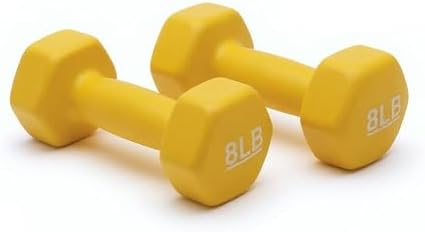
A fixed dumbbell can make resistance easier to repeat from one session to the next. One verified example is the Amazon Basics neoprene dumbbell pair, but an 8-pound pair is not automatically an appropriate starting load for every reader.
Progress when: You can complete the press without excessive leaning, rushing the lowering phase, or forcing the overhead range. If overhead movement repeatedly causes symptoms, use a more suitable variation or seek guidance before adding load.
3. Heel-to-Toe Walk: Best for Challenging Balance Control
A heel-to-toe walk narrows your base of support and makes balance more demanding than ordinary walking. That can make it useful as a balance exercise, but it should be practiced in an environment where you can reach a stable support if needed.
How to Do It
- Stand near a wall, counter, or another secure support.
- Place one foot directly in front of the other so the heel of the front foot is close to the toes of the back foot.
- Take slow, controlled steps while looking ahead.
- Use support as needed rather than trying to prove you can do the drill without it.
Balance deserves particular attention for some older adults. Current strength and balance recommendations for older adults include balance activity as part of weekly physical activity for adults 65 and older. That does not mean this single drill prevents falls; it simply explains why balance practice can deserve its own place in a broader routine.
Best starting point: Practice beside a stable surface and shorten the walking distance if necessary.
Progress when: You can move with less reliance on support while staying controlled. Do not progress by deliberately creating instability you cannot manage.
4. Bent-Over Row: Best for Pulling Strength
Rows train a pulling pattern that shows up when drawing an object toward you. The main challenge for some beginners is not the resistance itself but maintaining a stable trunk position while the arms move.
How to Do It
- Begin in a comfortable standing position.
- Hinge forward only as far as you can while keeping the position controlled.
- Let your arms hang toward the floor.
- Pull your hands toward your sides.
- Lower them again without rushing.
If the unsupported bent-over position is difficult, use a supported variation rather than adding weight immediately. A hand placed on a stable surface can make it easier to focus on the pulling movement.
Resistance bands can also be used for some rowing variations when they are set up appropriately. Unlike a dumbbell, a band’s resistance changes as the material stretches, so its stated resistance should not be treated as identical to a fixed free weight throughout the movement.
The WHATAFIT set is one example of a handled band system with several stated resistance levels for readers who prefer a compact resistance option.

Progress when: You can maintain the position of your trunk and perform the pulling motion smoothly. If the position itself is uncomfortable or unstable, adjust the setup before increasing resistance.
5. Wall Push-Up: Best for Accessible Pushing Strength
The wall push-up practices a horizontal pushing pattern without requiring you to support as much body weight as a floor push-up. That makes it a practical entry point for readers who want to train pushing strength but are not ready for lower surfaces.
How to Do It
- Stand facing a wall and place your hands around shoulder height.
- Step back enough to create a comfortable lean.
- Bend your elbows and bring your body toward the wall while keeping your body position controlled.
- Press away until you return to the starting position.
Best starting point: Stay relatively close to the wall if the exercise feels demanding.
Progress when: You can complete controlled repetitions without your hips dropping, your body twisting, or the movement becoming rushed. A lower stable surface can increase the challenge later, but there is no need to move to the floor unless that progression suits your goals.
How to Know When You Are Ready to Progress
Progression does not have to mean adding weight every week. For functional movements, a more useful sequence is:
- Control the movement. Learn a version you can perform without obvious loss of balance or position.
- Repeat it consistently. Make sure one good session was not a one-off.
- Add repetitions if appropriate. Increase practice before automatically increasing load.
- Increase the useful range. Only when a greater range remains comfortable and controlled.
- Add resistance. Use weights, bands, or another appropriate form of resistance when the current version no longer provides enough challenge.
- Increase balance difficulty carefully. Only when the easier version is already stable.
A progression is useful only if you can still perform the movement reasonably well. More weight with poorer control is not automatically an improvement.
A Simple Starting Routine for the Week
A true beginner does not need to turn all five movements into a full workout immediately. Start with the one or two patterns most relevant to your daily needs. A small amount of controlled practice can be enough to learn the movement and judge how you tolerate it.
For example, you might practice a sit-to-stand and wall push-up on two nonconsecutive days, then add another movement once the routine feels manageable. Another person may need a balance drill and supported row instead. The article’s exercises are options, not a mandatory five-exercise prescription.
As broader context, current physical activity guidelines for adults recommend muscle-strengthening activity on at least two days per week. That guidance covers overall activity, not this specific routine, so use it as a weekly reference rather than a rule that every exercise here must be performed twice each week.
When Equipment Helps—and When It Is Optional
You can begin several of these movements without buying anything. Body weight, an unloaded movement, a wall, a chair, or an appropriately handled household object may provide enough challenge at first.
Equipment becomes more useful when you want resistance that is easier to repeat and track. A fixed dumbbell has the advantage of giving you the same external load each time. The tradeoff is that one pair gives you only one weight.
The Amazon Basics neoprene dumbbells verified for this article are an 8-pound pair with a neoprene coating, hexagonal ends, and printed weight identification. They make the most sense for someone already comfortable with an unloaded press or row who specifically wants a simple fixed load. Readers who are not ready for 8 pounds or already have suitable resistance can skip them.
- SHIPMENT CONTAINS: 8 pound dumbbell hand weight (set of 2) for exercise and strength training
- LONG-LASTING NEOPRENE COATING: Yellow neoprene texture offers long lasting durability and comfortable grip during workouts
- HEXAGON SHAPED ENDS: Prevents dumbbells from rolling away and offers stay-in-place storage
- NONSLIP GRIP: Promotes a comfortable, secure hold during various exercises
If that type of straightforward fixed resistance suits your routine, you can view the Amazon Basics neoprene dumbbells on Amazon.
Bands solve a different equipment problem. They are compact and can provide several resistance options without storing multiple fixed weights, but the loading changes as the band stretches. Setup also matters, especially when anchors are involved.
The WHATAFIT set includes five color-coded tubes with stated individual resistance levels of 10, 20, 30, 40, and 50 pounds, along with handles, ankle straps, and a door anchor. Those ratings describe the product’s stated band levels; they should not be interpreted as behaving exactly like fixed dumbbell weights through an entire movement.
- 100% Natural Latex
- Imported
- 5 Adjustable Resistance Levels for Versatile Training: This resistance bands set includes 5 color-coded bands with individual poundage ratings of 10, 20, 30, 40, and 50 lbs. Beginners may start with a single band, while experienced users can combine multiple bands to achieve up to 150 lbs of total resistance, supporting a gradual increase in workout intensity from light stretching to muscle conditioning
- Natural Latex Construction with Durable Hardware: Crafted from high-density natural latex, the bands maintain consistent elasticity and resilience through repeated use. The set is equipped with steel carabiner clips, reinforced stitching on the nylon webbing, and non-slip cushioned handles designed to provide a stable grip and secure connection during various exercise movements
Readers who prefer that more portable style of resistance can view the WHATAFIT resistance-band set on Amazon.
Neither option is necessary for functional training. Buy equipment only if it solves a real progression or convenience problem for you.
Do Very Short Exercise Sessions Still Count?
Short bouts can still be useful, especially when the alternative is doing nothing because a longer session feels unrealistic. A few minutes of structured practice can help you build consistency and accumulate activity across the day.
There is research examining very brief “exercise snacks.” A recent systematic review of research on brief exercise snacks found that repeated short bouts of five minutes or less can contribute to some fitness outcomes in physically inactive people, although the interventions differed and certainty was low or very low for some outcomes.
The practical takeaway is modest: short sessions can have value. That is different from claiming that any two-minute routine replaces a fuller strength program, balance work, aerobic activity, or the broader weekly activity recommendations that apply to adults.
Common Mistakes and When to Modify an Exercise
- Training all five movements equally just because they appear in one list. Give more attention to the movement pattern that matches the task you actually want to practice.
- Adding weight before the movement is controlled. If an unloaded version is still challenging, resistance may not be the next useful progression.
- Using a harder variation as the main measure of success. Better control, more consistent repetitions, or a slightly larger comfortable range can also represent progress.
- Ignoring balance support. Holding or standing beside a stable surface is a sensible modification when steadiness is limited.
- Forcing painful movement. Functional exercise is not a test of how much discomfort you can tolerate.
- Assuming equipment makes the exercise better. A weight or band is useful only when extra resistance serves a clear purpose.
If a movement repeatedly causes worsening symptoms, unusual weakness, dizziness, significant instability, or another concerning response, modify or stop that exercise rather than continuing to increase the challenge.
Frequently Asked Questions
Can I start with only one or two exercises?
Yes. In fact, prioritizing one or two movements that match your main daily challenges can make more sense than trying to perform all five. Add more only when they serve a useful purpose.
How often should beginners practice these exercises?
A beginner can start with a manageable amount of practice and build gradually. Broader U.S. guidance recommends muscle-strengthening activity on at least two days each week, but that does not mean every exercise in this article needs to be performed twice weekly.
Do I need dumbbells?
No. Several movements can begin unloaded or with body weight, stable support, or another appropriate form of resistance. Dumbbells become useful when you want a repeatable external load and the current variation is no longer challenging enough.
Can resistance bands work instead of dumbbells?
They can provide resistance for compatible exercises such as some row variations, but they do not feel or load the body exactly like fixed weights. Band tension changes as the material stretches, so choose between the two based on the movement, setup, storage needs, and type of resistance you prefer.
How do I know when to make an exercise harder?
Progress when the current version feels controlled and repeatable rather than simply because a certain number of days has passed. You can add repetitions, range, resistance, or a more demanding variation depending on the exercise.
Can these exercises help if movement already hurts?
Exercise may still be part of an appropriate routine for some people with pain, but these five movements should not be treated as a pain treatment. If an exercise consistently worsens symptoms or you are unsure why a movement hurts, individualized guidance is more appropriate than automatically progressing it.
Are very short exercise sessions worthwhile?
They can be. Brief structured bouts may help you accumulate activity and maintain consistency, but they should not automatically be treated as a complete replacement for broader strength, balance, and aerobic activity.
Final Takeaway
You do not need to “master” all five exercises to get value from functional training. Start with the daily task you most want to practice, choose the movement pattern that matches it, and use the easiest variation that still gives you useful work.
From there, progress only when control and tolerance improve. That may mean more repetitions, a little more range, added resistance, or a harder balance challenge. Equipment can make resistance easier to repeat, but it is optional rather than a requirement.
The practical goal is not a promise of a pain-free body. It is to build strength, balance, and movement capacity in ways that connect more clearly to everyday life.