


Triphala is often described as a gentle “detox,” but that phrase can be misleading. It does not need to flush toxins from your body to be useful. The better question is whether this traditional three-fruit Ayurvedic blend can support digestion, bowel regularity, the gut microbiome, or the intestinal lining without causing more problems than it solves.
Research gives a mixed but interesting answer. Triphala contains plant compounds with antioxidant and anti-inflammatory activity, and small human studies suggest it can affect the gut microbiome and some metabolic markers. However, much of the research on the gut lining, ulcers, and inflammation still comes from laboratory or animal studies rather than strong clinical trials.
For healthy adults who choose to try it, the goal should be modest: support comfortable digestion or occasional regularity, follow the product label, and stop if it causes diarrhea or cramping. Triphala should not replace care for persistent digestive problems or chronic disease.
Key Takeaways
- Triphala combines amla, bibhitaki, and haritaki, three fruits used in Ayurvedic medicine.
- Its polyphenols and other plant compounds show antioxidant and anti-inflammatory activity, but direct proof that Triphala repairs the human gut lining is limited.
- A small randomized human trial found microbiome changes after four weeks, but the response varied greatly from person to person.
- Triphala may have a mild laxative effect, so more is not better. Loose stools, cramping, or diarrhea are reasons to reduce the dose or stop.
- Product quality matters because some Ayurvedic products have been found to contain harmful heavy metals. Look for transparent contaminant testing and clear labeling.
Helpful Products at a Glance
Banyan Botanicals Organic Triphala Tablets are a straightforward three-fruit tablet option with certified-organic ingredients; tablets may be less convenient if you prefer capsules.
- GENTLE DAILY DETOX & CLEANSE: Renowned as the most popular Ayurvedic formula, this "three-fruit" blend of Amla, Haritaki, and Bibhitaki works to naturally detoxify the body. Unlike harsh laxatives, our organic Triphala gently replenishes the system while assisting with internal cleansing.*
- DIGESTIVE SUPPORT & REGULARITY: Rich in natural antioxidants, tannins, and flavonoids, Triphala supports optimal digestion and nutrient absorption. It helps maintain healthy regularity and provides relief from occasional bloating by supporting a balanced gut microbiome.*

Himalaya USDA Organic Triphala is a once-daily caplet option according to the current manufacturer directions; it is still a supplement, not a treatment for chronic constipation or gut disease.
- Daily gut cleanse: Our organic Triphala supports digestion and provides gentle, occasional constipation relief for adults by promoting regularity with the wisdom of tradition*
- Helps reduce occasional bloating: Triphala tones the intestines to remove stagnant waste, providing occasional bloating relief to keep you comfortable*

What is Triphala?
“Triphala” means “three fruits.” The traditional blend contains Phyllanthus emblica (also called amla or Indian gooseberry), Terminalia bellirica (bibhitaki), and Terminalia chebula (haritaki). Different powders, tablets, capsules, and extracts can contain different amounts of these fruits and their active compounds, so one Triphala product is not automatically equivalent to another.

The blend is rich in plant chemicals such as polyphenols, tannins, gallic acid, ellagic acid, and chebulinic compounds. These substances can act as antioxidants in laboratory systems. That does not mean a capsule has been proven to prevent disease, but it helps explain why researchers are studying Triphala for digestive and metabolic effects.
| Fruit | Notable compounds | Why researchers study it |
|---|---|---|
| Amla | Polyphenols, tannins, vitamin C-related antioxidant compounds | Antioxidant and metabolic effects |
| Bibhitaki | Gallic acid, ellagic acid, tannins | Digestive and metabolic effects |
| Haritaki | Polyphenols, tannins, chebulagic and chebulinic acids | Digestive, antimicrobial, and antioxidant activity |
Can Triphala support the gut lining?
There is a reasonable biological theory, but the human evidence is not strong enough to say that Triphala “heals” or seals a leaky gut. Laboratory and animal research suggests its polyphenols may reduce oxidative stress and inflammatory signaling. Those effects could help create conditions that support normal intestinal barrier function, but they are not the same as proving a clinical repair effect in people.

What about the gut microbiome?
This is one of the more interesting areas of human research. In a four-week randomized, double-blind pilot study of 31 healthy adults, participants received Triphala, manjistha, or placebo. The Triphala group showed changes in fecal microbial communities, but the responses were highly personal and no bacterial group changed in the same way for everyone. The study was small, so it cannot prove broad digestive benefits. You can read the human microbiome pilot study for the details.
Older reviews discuss possible prebiotic-like effects, but much of that evidence is preclinical. It is more accurate to say Triphala may influence the microbiome than to promise that it restores a “healthy balance.”
What does the research say about constipation, IBS, and ulcers?
Triphala has a long history of use for bowel regularity, and its components can have mild laxative effects. That may help some people with occasional constipation, but high-quality clinical evidence for chronic constipation is still limited. If constipation lasts for weeks, keeps returning, causes significant pain, or is accompanied by blood in the stool, vomiting, fever, or unexplained weight loss, it deserves medical evaluation rather than repeated self-treatment.
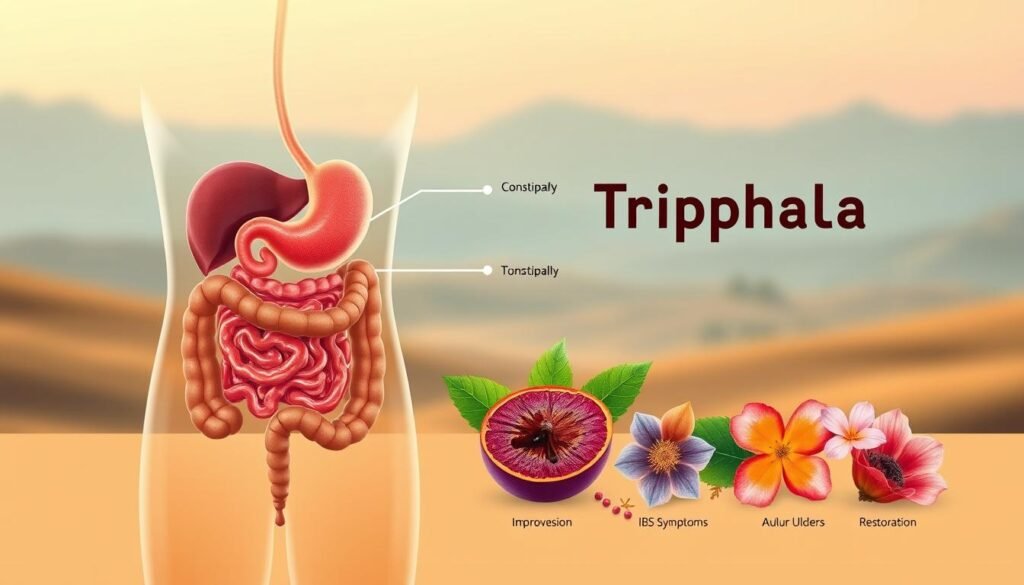
The evidence is even less certain for IBS and ulcers. A review of Triphala and functional gastrointestinal disorders describes possible mechanisms and promising preclinical findings, but it does not establish Triphala as a proven IBS treatment. Ulcer-protective effects have mainly been studied in animals. See the review of Triphala and gastrointestinal disorders for a useful overview.
For everyday bowel health, basics still matter: enough fluid, fiber-rich foods, regular movement, and addressing medications or conditions that may be causing constipation. A supplement should not replace those steps.
Blood sugar, cholesterol, and weight: promising but secondary evidence
Triphala has also been studied for metabolic effects. A systematic review of 12 randomized trials involving 749 participants found signals for lower LDL cholesterol, total cholesterol, triglycerides, body weight, BMI, waist circumference, and fasting blood glucose under certain conditions. The review also stressed that larger, better-designed trials are needed.
These findings do not make Triphala a diabetes, cholesterol, or weight-loss treatment. If you take glucose-lowering medicine, the possibility of an additional blood-sugar effect is a reason to discuss Triphala with your clinician rather than experimenting with higher doses. The systematic review of metabolic outcomes provides the full evidence summary.
How to use Triphala more safely

Do not assume there is one correct Triphala dose
Powders, whole-fruit tablets, and concentrated extracts are not interchangeable by milligram. Human studies have used different formulations and doses, so a research dose should not be copied onto a different commercial product. Follow the directions on the exact label you buy, and do not increase the amount simply because the first dose feels gentle.
A four-week safety study in 20 healthy adults used 2,500 mg per day of a specific aqueous Triphala extract and reported no serious adverse effects, but that small study does not prove every formulation or long-term dose is safe. The useful takeaway is to respect formulation differences rather than chasing a universal number.
Two currently verifiable Triphala options
Banyan Botanicals Organic Triphala Tablets contain certified-organic amla, bibhitaki, and haritaki, with organic gum acacia as the tablet binder. The manufacturer lists 500 mg per tablet and suggests 1–2 tablets daily. This suits readers who prefer a simple whole-fruit tablet with clear labeling.
Triphala can still cause loose stools or cramping, and the manufacturer notes that this product is not intended to treat chronic constipation. Use its label rather than borrowing a dose from another brand or study.
- GENTLE DAILY DETOX & CLEANSE: Renowned as the most popular Ayurvedic formula, this "three-fruit" blend of Amla, Haritaki, and Bibhitaki works to naturally detoxify the body. Unlike harsh laxatives, our organic Triphala gently replenishes the system while assisting with internal cleansing.*
- DIGESTIVE SUPPORT & REGULARITY: Rich in natural antioxidants, tannins, and flavonoids, Triphala supports optimal digestion and nutrient absorption. It helps maintain healthy regularity and provides relief from occasional bloating by supporting a balanced gut microbiome.*
- PREMIUM ORGANIC GUM GUTS & IMMUNITY: Made from the highest quality USDA Organic Triphala powder, our tablets offer a convenient foundation for your daily wellness routine. This traditional formula supports both the digestive tract and a healthy immune system through its high Vitamin C content (Amla).*
- SUSTAINABLY SOURCED & 3RD PARTY TESTED: Banyan Botanicals is committed to producing the highest quality Ayurvedic products using Fair Trade, USDA certified organic herbs. Every batch is 3rd party tested in the USA for purity and safety, ensuring you receive a potent, clean supplement.
Himalaya USDA Organic Triphala is a different format: the current 90-caplet Amazon listing identifies a 688 mg Triphala product, while the manufacturer directs adults to take one caplet daily before food. Himalaya also states that the product is made in a cGMP facility and tested for identity, strength, and safety.
This may suit someone who wants a once-daily caplet. Manufacturer testing and organic certification still do not guarantee that every batch is free of all contaminants.
- Daily gut cleanse: Our organic Triphala supports digestion and provides gentle, occasional constipation relief for adults by promoting regularity with the wisdom of tradition*
- Helps reduce occasional bloating: Triphala tones the intestines to remove stagnant waste, providing occasional bloating relief to keep you comfortable*
- Three-part ayurveda blend: In addition to Triphala powder, our Triphala capsules contain Amla, Haritaki, and Vibhitaki, a combination that has been trusted and used for centuries in India
- Thoughtfully crafted: USDA Organic, vegan, and non-GMO, without any gluten, fillers, dairy, soy, or corn; an ideal Ayurvedic supplement for common dietary restrictions
Check quality, not just marketing
The FDA has warned that some Ayurvedic products have contained harmful levels of lead, mercury, or arsenic. That does not mean every Triphala product is contaminated, but it is a reason to favor clear ingredient labels and meaningful contaminant testing. If available, check a recent certificate of analysis for lead, arsenic, cadmium, and mercury.
Do not confuse “USDA Organic” with a heavy-metal guarantee. Organic certification addresses how agricultural ingredients are produced; it is not the same as a lot-specific contaminant screen. The FDA’s Ayurvedic product safety warning explains why this matters.
Side effects, medication interactions, and who should be cautious
- Loose stools or diarrhea: Triphala can increase bowel activity. Reduce the amount or stop if you develop persistent diarrhea, cramping, or worsening abdominal pain.
- Prescription medicines: Laboratory and animal studies suggest Triphala can affect some CYP enzymes involved in drug metabolism. The clinical importance is not fully known, so ask a clinician or pharmacist before combining it with regular prescription drugs, especially medicines that require close dose control.
- Diabetes treatment: Because some trials reported lower fasting glucose, people using glucose-lowering medicine should avoid treating Triphala as an add-on without medical guidance.
- Pregnancy, breastfeeding, and children: Safety data are limited. Product manufacturers advise clinician guidance during pregnancy or nursing, and routine use in children should not be assumed safe.
- Persistent digestive symptoms: Triphala should not delay evaluation for ongoing constipation, severe abdominal pain, GI bleeding, persistent diarrhea, unexplained weight loss, or other concerning symptoms.
Potential drug interactions are still being worked out. In vitro and animal research has found effects on enzymes including CYP1A2, CYP3A4, CYP2C9, and CYP2D6, but human interaction studies are lacking. See the Triphala drug-interaction study for the evidence and its limitations.
Conclusion
Triphala is better viewed as a traditional digestive supplement with emerging research than as a proven “detox” or gut-lining repair treatment. Its plant compounds have antioxidant and anti-inflammatory activity, and early human research suggests it can influence the microbiome and may affect bowel and metabolic measures. The strongest claims about repairing the gut barrier, treating IBS, or preventing ulcers still need better human trials.
If you choose to try Triphala, keep the goal practical: select a clearly labeled product, follow that product’s directions, pay attention to stool changes and abdominal symptoms, and check for medication conflicts. For persistent digestive problems, identifying the cause matters more than repeatedly increasing a supplement dose.
Frequently Asked Questions
Does Triphala “detox” the body?
Not in the dramatic cleansing sense used in many ads. Triphala may support bowel regularity in some people, but that is different from proving it removes unspecified toxins.
Can Triphala repair a leaky gut?
That has not been proven in humans. Laboratory and animal studies suggest antioxidant, anti-inflammatory, and barrier-related effects, but clinical evidence is too limited to claim that Triphala repairs intestinal permeability.
Can Triphala cause diarrhea?
Yes. Its laxative effect can become uncomfortable at higher amounts or in sensitive people. Loose stools, diarrhea, or cramping are signs to reduce the amount or stop.
Can I take Triphala with prescription medicine?
Do not assume there is no interaction. Preclinical research suggests possible effects on several drug-metabolizing enzymes, and some clinical studies suggest Triphala can lower blood glucose. A pharmacist or clinician can help check your specific medicines.