

Oura data is most useful when you compare it with your own baseline instead of judging a single night’s number in isolation. Sleep Score, Readiness, HRV, resting heart rate, temperature deviation, and respiratory rate can all add context, but none of them should be treated as a standalone diagnosis or a simple command to train harder, rest more, or assume you are getting sick.
A better way to read the app is to ask a few questions in order: How different is this result from your normal pattern? What happened during the previous day or evening? Did several metrics change together? Do you have symptoms? And does the change persist across multiple nights?
This guide explains what the major Oura metrics represent, what can move them, what an unusual value cannot prove, and how to respond without overreacting to normal night-to-night variation.
Key Takeaways
- Your personal baseline is usually more useful than comparing your HRV, resting heart rate, temperature, or respiratory rate with someone else’s numbers.
- Sleep and Readiness Scores summarize several inputs, but they are wellness tools rather than medical diagnoses or exercise clearance.
- One unusual night can reflect sleep disruption, training, alcohol, meals, stress, travel, illness, or ordinary variation.
- When several metrics move together and the pattern persists, the change deserves more attention than one isolated reading.
- Accuracy differs by metric. A wearable can estimate sleep and physiological trends without being interchangeable with clinical testing.
How Oura Turns Overnight Measurements Into Scores
Oura collects several physiological and movement-related signals and converts them into measurements, trends, and broader scores. Depending on the metric, the ring uses optical sensors, temperature sensing, and movement data to estimate or track information such as heart rate, heart rate variability, sleep, activity, nighttime temperature deviation, and respiratory rate.
The app then combines multiple inputs into larger summaries such as Sleep and Readiness. Oura’s current explanation of its Readiness contributors shows why it is better to think of the score as a combination of short- and longer-term signals rather than a direct measurement of a single physiological state.
This distinction matters. A Readiness Score can help you notice that several parts of your recent pattern have changed, but it does not tell you with certainty why they changed. Poor sleep, a demanding workout, alcohol, travel, stress, illness, and other factors can affect overlapping signals.
Who This Type of Tracker Is Useful For
A ring-based tracker can make sense for someone who wants passive, repeated measurements rather than occasional manual checks. The main value is not one impressive number on one morning. It is the accumulation of enough nights to establish a personal pattern that makes later deviations easier to interpret.
- ACCURACY - SMART SENSING - Oura tracks over 50 health metrics, including sleep, activity, stress, heart health, and women’s health metrics. Oura Ring 4 is powered by Smart Sensing, which adapts to you — delivering accurate, continuous data, day and night
- ACCURATE SIZING ESSENTIAL - Oura Ring 4 uses unique sizing different from standard jewelry rings; use the Oura Ring 4 Sizing Kit to find your perfect fit before purchasing

That type of tracking is less useful if you need diagnostic monitoring, do not want ongoing wearable-data collection, or expect a consumer device to replace formal medical testing. Full Oura functionality also depends on its membership model, so the ongoing cost and privacy tradeoff matter alongside the hardware itself.
The Rule That Makes Oura Data Easier to Read: Compare With Your Baseline
HRV is one of the clearest examples of why personal baseline matters. A systematic review of HRV reference values found substantial variation between individuals and across measurement methods. That makes it difficult to label one raw HRV number as universally good or bad.
Oura uses the same general logic in several parts of its own interpretation system. Its documentation on heart rate variability emphasizes comparison with your own historical pattern rather than comparison with another person’s value. Temperature deviations and several Readiness contributors are also interpreted relative to personal averages.
A practical reading framework looks like this:
| Step | Question to Ask | Why It Matters |
|---|---|---|
| 1 | How far is this from my normal pattern? | A personal deviation is usually more informative than an absolute number. |
| 2 | What changed recently? | Sleep loss, training, alcohol, meals, stress, travel, and schedule changes can affect several metrics. |
| 3 | Did other metrics move too? | A cluster of changes provides more context than one isolated signal. |
| 4 | Do I have symptoms? | How you feel can matter more than a wearable score when deciding whether something deserves attention. |
| 5 | Is the change persistent? | Repeated deviations are generally more meaningful than one unusual night. |
Understanding Your Oura Sleep Score
Your Sleep Score is designed to summarize more than total sleep time. Oura considers several aspects of the night, which may include sleep duration, timing, efficiency, latency, restfulness, and estimated sleep stages. The score can be useful for spotting patterns, but it should not be confused with a clinical sleep assessment.
Total Sleep Matters, but Avoid Chasing One Perfect Number
For general adult health, the American Academy of Sleep Medicine recommends that adults obtain at least seven hours of sleep per night on a regular basis. Individual needs vary, so there is no universal requirement that everyone must hit exactly 7.5 or 8 hours every night.
If your Oura data shows that shorter nights repeatedly coincide with poorer daytime functioning, that pattern may be more useful than trying to force your sleep into one ideal number. Consistency can also matter. A large shift in bedtime or wake time may influence how rested you feel even when total sleep looks acceptable.
Deep Sleep and REM Are Estimates, Not Targets to Max Out
Deep and REM sleep are important parts of normal sleep architecture, but fixed goals such as exactly 1.5 hours of each are too simplistic. Stage amounts vary with age, total sleep, recent sleep history, and individual differences.
Consumer wearables also estimate sleep stages rather than scoring them in exactly the same way as laboratory polysomnography. That means an isolated night showing unusually low REM or deep sleep should not automatically be interpreted as a health problem.
Latency, Awakenings, and Timing Need Context
Sleep latency is the estimated time it takes you to fall asleep. If it becomes consistently longer than your own usual pattern, look at practical context such as caffeine timing, stress, schedule changes, late meals, or an unfamiliar sleep environment.
Similarly, avoid treating a specific awakening percentage or a universal bedtime such as 11 p.m. as a rule everyone should meet. The more useful question is whether your sleep is becoming noticeably more fragmented or poorly timed relative to your normal pattern and whether that change is affecting how you function.
HRV and Resting Heart Rate: Read Them Together, Not as Simple Good-or-Bad Scores
What HRV Actually Tells You
Heart rate variability measures variation in the timing between heartbeats. It is influenced by autonomic nervous system activity, but also by age, fitness, recent exercise, alcohol, sleep, illness, respiration, measurement conditions, and many other factors.
That is why “higher is always better” is not a reliable rule. A higher HRV than your own usual value may fit a well-recovered period, while a temporary drop may follow a hard training block, poor sleep, alcohol, stress, or illness. But the number alone does not identify which of those explanations is correct.
How to Use Resting Heart Rate
Nighttime resting heart rate can provide another useful point of comparison. A night that is higher than your established pattern can occur after strenuous exercise, alcohol, sleep disruption, illness, emotional stress, or other changes.
It becomes more informative when you pair it with other information. For example, a higher-than-usual resting heart rate combined with lower-than-usual HRV, poorer sleep, and feeling unwell deserves more attention than a slightly elevated resting heart rate on an otherwise normal night.

HRV Down and RHR Up Does Not Automatically Mean You Need a Rest Day
Those changes can support a recovery-focused interpretation, but they should not act as automatic training instructions. Consider your symptoms, injury status, training plan, recent workload, and how large the deviation is from your normal range.
A Readiness Score is best treated as one input in that decision rather than permission to train hard or a command to stop exercising.
Body Temperature and Respiratory Rate: Useful Context With Important Limits
Oura Temperature Is Not the Same as a Thermometer Reading
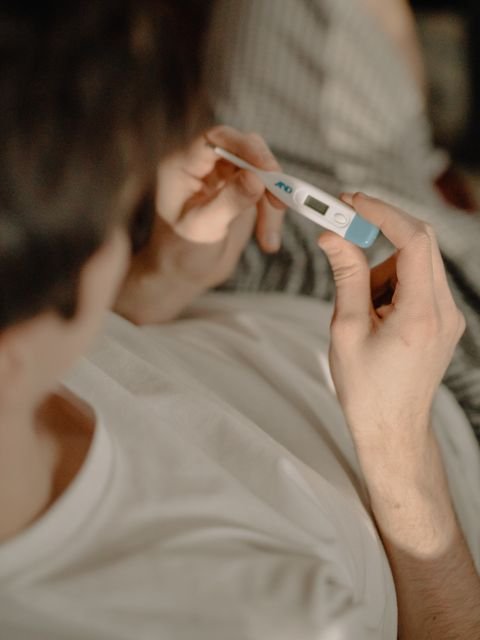
Oura reports changes in nighttime skin temperature relative to your personal baseline. Its body-temperature documentation makes this distinction important: a ring-based deviation is not the same as a core body-temperature measurement and should not be interpreted as confirmation of fever.
Temperature can shift for many reasons, including environmental conditions, physiological changes, exercise, illness, and menstrual-cycle-related variation. The value becomes more useful when you consider it alongside other metrics and symptoms rather than assigning a cause from temperature alone.
What Respiratory Rate Can and Cannot Tell You
Oura estimates average nighttime respiratory rate from patterns in its cardiac signal. Its respiratory-rate methodology can help explain how the feature works, but an elevated value does not identify a specific condition by itself.
Respiratory rate may shift during illness or other physiological changes, but one night’s increase cannot diagnose infection, allergies, anxiety, sleep apnea, or another respiratory disorder.
What About Menstrual-Cycle Changes?
Temperature patterns can vary across the menstrual cycle, so repeated data may help some users notice personal patterns. That does not mean cycle phase should automatically dictate exercise intensity.
A systematic review of menstrual-cycle phase and exercise performance found that group-level effects were small, variable, and based on generally low-quality evidence. Individual response is more useful than a universal instruction to train harder during one phase and reduce training during another.
How to Interpret an Unusual Night
When the app shows a surprising score or metric, resist the urge to immediately explain it. Work through the pattern instead.
- Compare with your baseline. Is the value mildly different or far outside your normal range?
- Review the previous day or two. Think about training, alcohol, meals, caffeine, stress, travel, sleep timing, and illness exposure.
- Check several metrics together. One change is easier to dismiss than a coordinated shift across sleep, HRV, RHR, temperature, and respiratory rate.
- Consider symptoms. Feverishness, chest symptoms, dizziness, marked fatigue, shortness of breath, or other concerning symptoms deserve more weight than a wearable score.
- Look for persistence. One odd night may be ordinary variability. A repeated unexplained pattern is more useful information.
- Respond proportionately. You may simply monitor the next few nights, adjust a modifiable behavior, reduce optional training stress, or seek medical guidance depending on the severity and context.
This approach helps separate “something changed” from “I know why it changed.” Wearables are usually much better at the first question.
What Oura Can Measure Well—and What It Can Only Estimate
Wearable accuracy is not one all-or-nothing property. A device can perform well for some measurements and less precisely for others.
A multi-night polysomnography validation study of Oura Ring Gen3 using Sleep Staging Algorithm 2.0 found encouraging agreement for several global sleep measures in generally healthy adults, while performance still differed by metric and sleep stage.
That evidence is useful, but its scope matters. It does not prove that every current Oura Ring 4 estimate, algorithm, sleep stage, or derived score is clinically exact. Nor does validation of one measurement automatically validate every interpretation the app can generate from that measurement.
| Metric | Useful For | What Not to Assume |
|---|---|---|
| Sleep duration | Tracking overall sleep quantity and changes over time | That every minute matches laboratory scoring exactly |
| Sleep stages | Looking at broad patterns across repeated nights | That one night’s stage estimate confirms a sleep problem |
| HRV | Comparing autonomic-related trends with your own baseline | That one raw number defines recovery or stress |
| Resting heart rate | Spotting departures from your normal nighttime pattern | That a higher reading identifies a specific cause |
| Temperature deviation | Detecting changes from personal nighttime skin-temperature baseline | That it confirms fever or infection |
| Respiratory rate | Tracking changes in average nighttime breathing rate | That an increase diagnoses a respiratory condition |
Turning Oura Trends Into Practical Decisions
The goal is not to obey every score. It is to use the data to ask better questions.
If several poor nights follow late alcohol use, a schedule change, or a demanding training period, you have a plausible behavior pattern worth testing. Change one or two factors and see whether the trend moves back toward baseline.
If a low Readiness Score appears after an otherwise normal day and you feel fine, you may simply monitor it. If Readiness is low alongside unusually elevated resting heart rate, reduced HRV, disrupted sleep, temperature changes, and symptoms, taking the pattern more seriously is reasonable.
Likewise, a high score does not override pain, illness, unusual fatigue, or other reasons not to train hard. Wearable data should add context to your decision, not replace judgment.
Privacy Matters Because Wearable Data Is Personal Data
Oura’s current privacy policy describes health, reproductive-health, and other personal information as sensitive data and explains how information may be processed, shared in permitted circumstances, and disclosed when legally required.
The company also states that it does not sell or share personal data for cross-context behavioral advertising. That should not be simplified into “Oura never shares data.” The policy includes service providers, legal requirements, user-directed sharing, and other defined situations.
If privacy is important to you, review connected services, exports, account settings, and policy updates periodically. The usefulness of long-term tracking has to be weighed against the fact that long-term tracking also creates a substantial personal-data history.

Frequently Asked Questions
Is a higher HRV always better?
No. HRV varies greatly between people and depends on many physiological and measurement factors. Your own established range and direction over time are usually more useful than comparing your raw value with someone else’s.
What should I do after one unusually low Sleep or Readiness Score?
Check your recent sleep, training, stress, meals, alcohol, travel, and other context. Then look at whether HRV, resting heart rate, temperature, respiratory rate, or sleep changed at the same time. If you feel normal and the pattern does not persist, one unusual score may simply reflect ordinary variation.
Can Oura tell me I am getting sick?
Oura can show physiological changes that sometimes occur around illness, such as changes in temperature, HRV, resting heart rate, respiratory rate, or sleep. Those changes are not specific enough to diagnose infection or reliably predict illness before symptoms.
How accurate are Oura sleep stages?
Research on Oura Gen3 has shown useful agreement with polysomnography for several sleep measures, but accuracy differs by metric and sleep stage. Sleep staging from a consumer wearable remains an estimate rather than a substitute for formal clinical sleep testing.
Should a low Readiness Score automatically change my workout?
No. Use it as one piece of information. Consider how you feel, recent training load, pain or injury, symptoms, and your wider plan before deciding whether to train normally, modify the session, or recover.
When should I discuss persistent changes with a healthcare professional?
Consider professional evaluation when unexplained changes continue, become substantial, or occur alongside concerning symptoms. Wearable trends can provide useful context to describe what you have noticed, but they should not be used to diagnose the cause on their own.
The Most Useful Way to Read Your Oura Data
Oura becomes more useful when you stop asking whether one number is “good” and start asking whether your pattern has meaningfully changed.
Use your personal baseline first. Add recent behavior and circumstances. Look for agreement across several metrics. Consider symptoms. Then judge whether the change disappeared after one night or persisted long enough to deserve a response.
That approach lets Sleep Score, Readiness, HRV, resting heart rate, temperature, and respiratory rate do what consumer wearable data does best: reveal patterns worth paying attention to without pretending that every change has a precise medical explanation.