


Adaptogens are often marketed as natural solutions for stress, fatigue, poor sleep, and low energy. Some claims have real research behind them, but others stretch the evidence far beyond what studies actually show.
The most useful way to think about adaptogens is not as miracle herbs, but as a broad group of plants and fungi studied for possible effects on the body’s response to stress. Evidence varies widely by herb, extract, dose, and health goal, so the word adaptogen alone tells you very little about whether a supplement will work.
Below, we’ll separate four common adaptogen myths from what current research supports, then look at safer ways to choose and use these products.
Key Takeaways
- Adaptogens are not instant stress relievers. Effects depend on the specific herb, preparation, person, and outcome being studied.
- Ashwagandha and rhodiola have human research behind some uses, but the evidence is not equally strong for every claimed benefit.
- Different adaptogens are not interchangeable. One herb studied for stress may have very different effects and safety concerns from another studied for fatigue.
- “Natural” does not automatically mean safe. Herbs can cause side effects and interact with medications or health conditions.
- Product quality matters because extracts, plant parts, concentrations, and testing can vary substantially between supplements.
Helpful Products at a Glance
For adults specifically considering ashwagandha, NOW Foods Ashwagandha Extract provides a standardized 450 mg serving, but it should still be treated as an optional supplement rather than a replacement for sleep, stress management, or medical care.
- AYURVEDIC ADAPTOGEN*: Ashwagandha is used as a general tonic and adaptogen, helping the body adapt to temporary normal stress.* NOW Ashwagandha is a standardized extract (450 mg per serving). Take 1 capsule 2 to 3 times daily.
- Free radical scavenger/Immune system support: Preliminary data suggest that Ashwagandha supports a healthy immune system.

What Does “Adaptogen” Actually Mean?
The term adaptogen has historically been used for substances thought to help the body cope with physical or psychological stress without producing one narrow, drug-like effect. Early researchers proposed criteria such as relatively low toxicity, broad stress resistance, and a tendency to help normalize disrupted body functions.
Modern researchers have explored possible effects on systems involved in stress regulation, including the hypothalamic-pituitary-adrenal, or HPA, axis. This network helps control hormones involved in the stress response. However, researchers should not assume that every herb labeled an adaptogen works through exactly the same pathway or produces the same result.
A scientific review of adaptogens discusses several proposed stress-response mechanisms, including signaling connected with the HPA axis and cellular stress proteins. These mechanisms are useful for understanding the theory, but human outcomes still need to be evaluated herb by herb. See the research review on adaptogens.
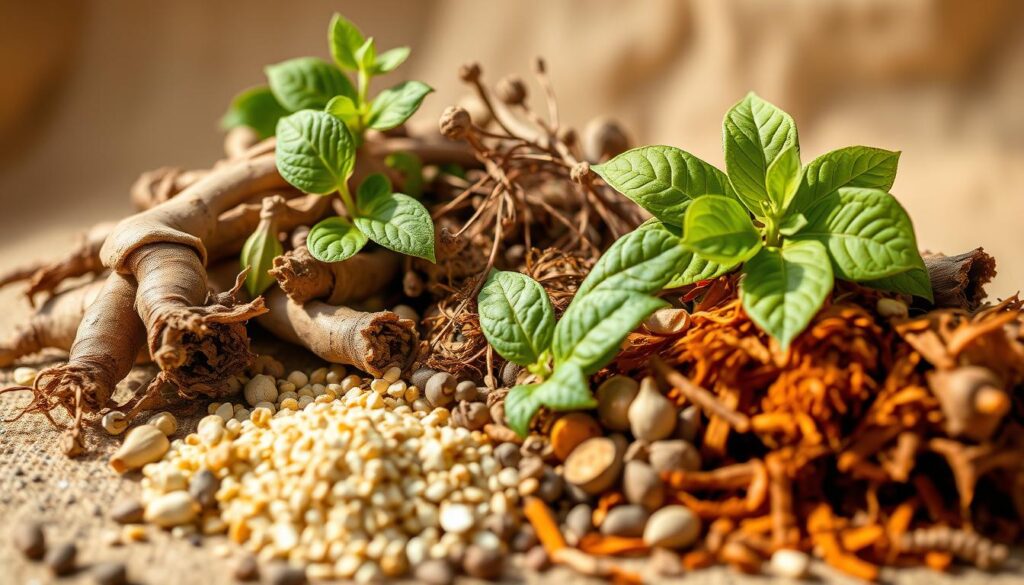
Myth 1: Adaptogens Work Almost Immediately
Reality: There is no universal timeline for adaptogens. Some studies measure changes after several weeks, while certain herbs and outcomes have been studied over shorter or longer periods.
Ashwagandha, for example, has been studied for stress and sleep using particular extracts over defined study periods. The National Center for Complementary and Integrative Health (NCCIH) says some ashwagandha preparations may help with stress and insomnia, but studies are often small and use different preparations. :chatgpt-content-reference{index=”0″}
That means a label promising that an adaptogen will “balance cortisol,” restore energy, or dramatically improve sleep within a fixed number of days should be viewed cautiously. The result from one standardized extract cannot automatically be applied to every powder, gummy, tea, or capsule containing the same plant.
Myth 2: Adaptogens Have No Scientific Evidence Behind Them
Reality: Some individual adaptogens have human clinical research, but the evidence ranges from promising to uncertain. Traditional use can help researchers decide what to study, but it is not the same as proof from controlled human trials.
Ashwagandha is one of the better-studied examples. NCCIH reports that certain preparations may be useful for stress and insomnia, while evidence remains insufficient for many other promoted uses. This distinction matters because advertising may attach a much longer list of benefits to the herb than research supports. :chatgpt-content-reference{index=”1″}
Rhodiola rosea has also been studied for physical and mental fatigue. Some trials have reported benefits, but systematic reviews have noted inconsistent findings, small studies, and methodological limitations. In other words, rhodiola is not “just folklore,” but neither should every fatigue or performance claim be treated as settled science. :chatgpt-content-reference{index=”2″}

Myth 3: Any Adaptogen Will Give You the Same Benefits
Reality: Adaptogens are not interchangeable. Their chemical compounds, studied uses, doses, side effects, and evidence differ.
For example, ashwagandha has more direct human research related to stress and sleep than many herbs sold under the adaptogen label. Rhodiola has been researched more often for fatigue and mental performance under stressful conditions, although results are mixed. Ginseng has its own research base and safety profile.
Reishi mushroom is also commonly included in commercial “adaptogen” blends, but marketing often moves faster than good human evidence for claims such as improved sleep or stress resilience. A product containing reishi should therefore be evaluated on its actual formulation and evidence rather than assuming it provides the same benefits as ashwagandha or rhodiola.
Choose the herb for the goal, not the trend
- Stress or sleep concerns: Ashwagandha has some supportive evidence, but benefits depend on the preparation and it is not appropriate for everyone.
- Stress-related fatigue: Rhodiola has been studied for mental and physical fatigue, although reviews describe the overall evidence as inconsistent.
- General energy: Do not assume that an “adaptogen blend” will improve energy simply because it contains several herbs.
- Immune or mushroom products: Check the exact mushroom species, plant or fungal material used, extract information, and evidence for the specific claim.
An example of a straightforward ashwagandha product
If ashwagandha fits your goal after reviewing its safety considerations, a single-herb product can be easier to evaluate than a large proprietary blend. The current Amazon listing for NOW Foods Ashwagandha Extract identifies it as a standardized 450 mg extract in vegan capsules. The listing also shows the 240-capsule product as currently in stock and provides a usable product image. :chatgpt-content-reference{index=”3″}
The advantage of a simple formula is clarity: you know which adaptogen you are taking and can more easily notice benefits or unwanted effects. The limitation is equally important—being standardized does not mean the supplement is proven to work for every stress, sleep, energy, or hormone-related concern.
- AYURVEDIC ADAPTOGEN*: Ashwagandha is used as a general tonic and adaptogen, helping the body adapt to temporary normal stress.* NOW Ashwagandha is a standardized extract (450 mg per serving). Take 1 capsule 2 to 3 times daily.
- Free radical scavenger/Immune system support: Preliminary data suggest that Ashwagandha supports a healthy immune system.
- Certifications/classifications: Non-GMO, kosher, dairy free, egg free, nut free, soy free, vegan/vegetarian, made without gluten
- GMP quality assured: NPA A-rated GMP certification means that every aspect of the NOW manufacturing process has been examined, including our laboratory/testing methods (for stability, potency, and product formulation).
Myth 4: Adaptogens Are Basically Natural Versions of Caffeine
Reality: Caffeine is a stimulant with fairly rapid and recognizable effects on alertness. Adaptogens are a much broader group, and their effects cannot be reduced to simple stimulation.
Rhodiola, for example, is sometimes described as energizing because it has been studied for fatigue and mental performance. That does not make its action equivalent to a cup of coffee. Ashwagandha, meanwhile, may cause drowsiness in some people rather than increased alertness.
Individual response also matters. If an herbal product makes you restless, unusually sleepy, dizzy, or otherwise unwell, do not assume the reaction is proof that the supplement is “working.”

Product Quality Matters More Than the Word “Adaptogen”
Two supplements carrying the same herb name can contain very different ingredients. One may use a concentrated extract while another contains powdered root. Combination products can make comparison even harder, especially when a proprietary blend does not clearly state how much of each ingredient is present.
When comparing products, look for:
- The full botanical name.
- The plant part used, such as root or leaf.
- The amount per serving.
- Extract or standardization information when relevant.
- Clear ingredient quantities instead of hidden proprietary blends.
- Independent quality or contaminant testing when available.
- Simple directions and safety information.
For mushroom products, also check whether the manufacturer clearly states what material is used rather than relying on broad claims about “mushroom potency.” Specific composition data are more useful than assuming every fruiting-body or mycelium product will provide a particular health outcome.
Adaptogen Safety: Who Needs Extra Caution?
Natural supplements can still affect medications, hormones, blood pressure, blood sugar, the immune system, and other body functions. Safety also varies from one herb to another, so there is no single interaction list that covers every adaptogen.
Ashwagandha is a useful example. NCCIH notes possible stomach upset, diarrhea, vomiting, and drowsiness, along with rare reports of liver injury. It should be avoided during pregnancy and breastfeeding, and it may interact with medicines for diabetes, high blood pressure, thyroid conditions, seizures, sedation, and immune suppression. :chatgpt-content-reference{index=”4″}
Check with a clinician or pharmacist before starting an adaptogen if you:
- Take prescription medications or several supplements.
- Are pregnant, trying to become pregnant, or breastfeeding.
- Have thyroid, autoimmune, liver, kidney, cardiovascular, or hormone-sensitive conditions.
- Are preparing for surgery.
- Are considering an herbal supplement for a child or teenager.
Stop using a new supplement and seek medical advice if you develop concerning symptoms such as a significant allergic reaction, persistent vomiting, unusual bleeding, severe dizziness, yellowing of the skin or eyes, or another unexpected reaction.
How to Use Adaptogens More Sensibly
Start by defining the problem you are actually trying to solve. “I want an adaptogen” is less useful than “I want to improve sleep,” “I am dealing with fatigue,” or “I want better ways to manage daily stress.” That makes it easier to compare the herb’s evidence with your goal.

Next, change one thing at a time when practical. Taking several new herbs together makes it difficult to know which one helped or caused a side effect. Follow the labeled directions for the specific product rather than applying a dose from an unrelated study or another manufacturer’s extract.
Most importantly, treat supplements as optional additions to the basics. Consistent sleep, regular movement, adequate nutrition, appropriate medical care, and practical stress-management habits usually matter more than finding the perfect adaptogen.
Conclusion
Adaptogens sit somewhere between centuries of traditional herbal use, developing modern research, and aggressive wellness marketing. That makes simple claims such as “adaptogens work” or “adaptogens are useless” equally unhelpful.
Ashwagandha and rhodiola show why a more careful approach works better. Both have human research behind certain uses, yet neither has strong evidence for every benefit attached to it online. Other herbs and mushrooms have their own evidence and safety profiles.
Choose a supplement based on the specific herb, extract, goal, evidence, and safety considerations—not simply because the label says adaptogen. And if your main concern is persistent fatigue, anxiety, sleep problems, or another ongoing symptom, finding and addressing the underlying cause should come before relying on an herbal product.
FAQ
Do adaptogens really lower cortisol?
Some studies of particular adaptogens have measured changes in cortisol or stress-related outcomes, but this does not mean every adaptogen reliably “balances cortisol.” Results depend on the herb, extract, dose, study population, and outcome measured.
How long does it take for an adaptogen to work?
There is no universal timeline. Clinical studies use different durations depending on the herb and condition being studied. Be cautious of products that promise a predictable transformation within a fixed number of days.
Which adaptogen has the strongest evidence?
There is no single best adaptogen for every purpose. Ashwagandha has useful human research for stress and insomnia, while rhodiola has been studied for fatigue and mental performance. Evidence should be matched to the specific goal rather than ranking all adaptogens together.
Can adaptogens replace sleep, diet, exercise, or stress management?
No. Supplements may provide additional support for some people, but they do not replace adequate sleep, nutrition, exercise, treatment of medical conditions, or effective ways of managing ongoing stress.
Can adaptogens interact with medications?
Yes. The interaction depends on the specific herb. Ashwagandha, for example, may interact with medicines that affect blood pressure, blood sugar, thyroid function, seizures, sedation, or immune activity. Check the individual herb with a clinician or pharmacist rather than assuming an entire adaptogen category is safe.
Are adaptogen blends better than single-herb supplements?
Not necessarily. Blends may be convenient, but they can make it harder to judge dose, evidence, side effects, and which ingredient is producing an effect. A clearly labeled single-herb product can be easier to evaluate when you are trying an adaptogen for the first time.



Don’t Miss These Picks