

Does your body feel tired while your mind is still racing? After hours of sitting, working, or running errands, tight muscles can make it harder to settle into bed. A few gentle stretches may help you feel more comfortable and ready to rest.
This 3-minute nighttime stretch routine combines Cat-Cow, Child’s Pose, and Reclining Knee-to-Chest. Together, these simple movements target tension in your back, shoulders, and hips while encouraging slow, relaxed breathing.
You don’t need special equipment, advanced flexibility, or a long yoga session. A comfortable floor surface and three quiet minutes are enough to get started. Although stretching isn’t a proven cure for insomnia, it can become a helpful part of your bedtime routine.
Key Takeaways
- Only three minutes: Follow three gentle stretches and finish with a short breathing pause.
- Targets everyday tension: The movements focus on your spine, lower back, shoulders, hips, and glutes.
- May support better rest: Research suggests yoga and relaxation practices can improve sleep quality in some people, but this exact routine hasn’t been clinically tested.
- Comfort comes first: Move slowly, use cushions when needed, and never push through pain.
- Make it a habit: Pair stretching with dim lights, a regular bedtime, and a quiet environment.
Helpful Products at a Glance
For floor stretching, the Gaiam Thick Yoga Mat (10mm, Green) provides extra cushioning for your knees and back. Its thick foam may feel less stable than a firmer mat during standing exercises.
- Extra-Thick Cushioning for Joint Comfort : Made with 10mm (2/5") high-density NBR foam, this mat delivers plush cushioning that helps reduce pressure on knees, hips, and joints—ideal for beginners, low-impact yoga, Pilates, stretching, floor exercises, and home workouts on hard surfaces.
- Comfort-Focused Surface for Controlled Movement : Textured foam surface helps reduce slipping on most hard floors during dry workouts and everyday exercise. The softer, cushioned feel prioritizes comfort and shock absorption over firmness, making it a great choice for floor-based and low-impact routines.

Can Stretching Before Bed Really Help You Sleep?
Gentle stretching can help release some of the muscle tension that builds up during everyday activities. If you’ve spent hours at a desk, driven a long distance, or been on your feet all day, you might notice stiffness in your back, shoulders, or hips.
Slow movement and relaxed breathing give you a chance to shift your attention away from daily worries. Instead of checking your phone or thinking about tomorrow’s tasks, you focus on how your body feels.

What does the research say?
According to the Hospital for Special Surgery (HSS), gentle bedtime stretching may ease muscle tension and help people rest more comfortably. Its physical therapists recommend keeping stretches comfortable rather than pushing into pain.
The National Center for Complementary and Integrative Health (NCCIH) also reports that yoga may improve sleep quality in some groups. However, research hasn’t established that three minutes of stretching will make everyone fall asleep faster or experience deeper sleep.
The practical benefit is simple: If stretching helps you relax and feel less stiff, it may make your bedtime routine more comfortable. Think of it as a useful wind-down habit, not a guaranteed sleep treatment.
Your 3-Minute Nighttime Stretch Routine: Step by Step
Here’s the complete routine. The movements are gentle enough for many beginners and don’t require complicated positions.
Choose a quiet space with enough room to move. Wear comfortable clothing, keep your breathing natural, and avoid forcing any stretch.
| Movement | Time | Main Focus |
|---|---|---|
| Cat-Cow | 60 seconds | Spine mobility |
| Child’s Pose | 45 seconds | Back and shoulders |
| Reclining Knee-to-Chest | 60 seconds | Hips and glutes |
| Quiet breathing | 15 seconds | Relaxation |
1. Cat-Cow Stretch — 60 Seconds
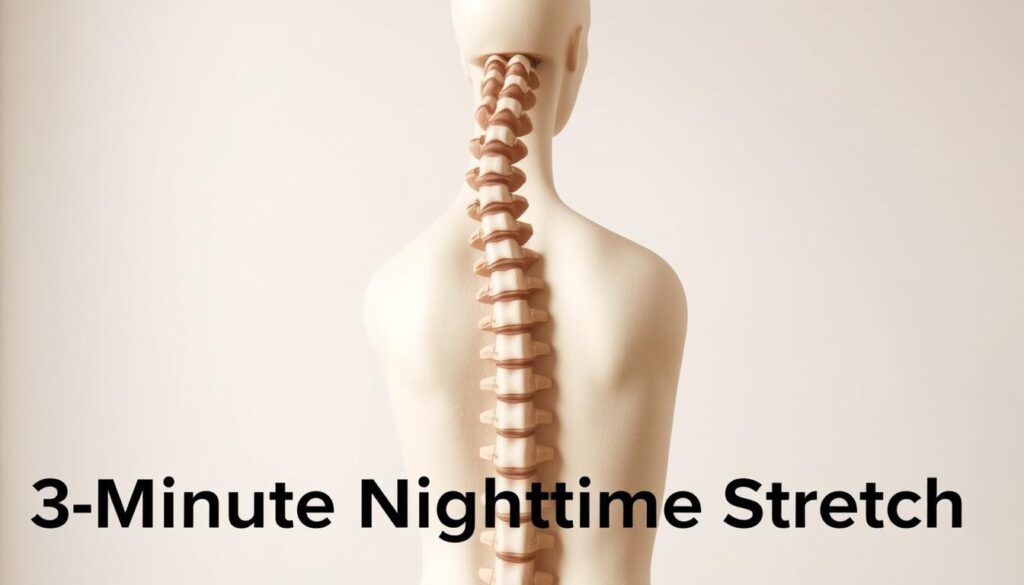
Cat-Cow gently moves your spine between a rounded and an arched position. It’s especially useful when your back feels stiff after sitting or standing for long periods.
How to do it:
- Start on your hands and knees, with hands beneath shoulders and knees beneath hips.
- Breathe in as you gently lift your chest and tailbone, allowing a small arch in your back (Cow).
- Hold comfortably for about 10 seconds while breathing normally.
- Slowly round your back toward the ceiling and tuck your chin slightly (Cat).
- Hold for another 10 seconds, keeping your neck relaxed.
- Repeat the two positions three times, for approximately one minute.
Form tip: Your movement should come from your spine, not from throwing your head backward. Keep your elbows comfortable and avoid exaggerated arches.
If your wrists hurt, try placing your forearms on a firm supportive surface or shorten the movement. If you cannot kneel comfortably, you can perform a smaller Cat-Cow movement while sitting in a sturdy chair.
2. Child’s Pose — 45 Seconds
Child’s Pose is a gentle resting position that may help ease tension around your lower back, hips, and shoulders.
How to do it:
- From hands and knees, move your hips slowly toward your heels.
- Keep your knees at a comfortable distance apart.
- Extend your arms forward without straining your shoulders.
- Rest your forehead on a folded towel or cushion if it doesn’t comfortably reach the floor.
- Stay for 45 seconds, breathing slowly and keeping the stretch mild.
Form tip: Don’t force your hips to touch your heels or your forehead to touch the floor. You should feel supported, not compressed.
If kneeling is uncomfortable, skip this pose and sit in a chair. You can gently lean forward with your forearms resting on a table or pillows, keeping your neck relaxed.
3. Reclining Single Knee-to-Chest — 60 Seconds
This final stretch focuses on your hips, glutes, and lower back. It also gives you a chance to finish the routine while lying down.
How to do it:
- Lie on your back with your head comfortably supported.
- Bend your right knee and gently bring it toward your chest.
- Hold behind your thigh or around your shin without pressing directly on the knee joint.
- Keep the opposite knee bent with your foot on the floor if that feels better for your back.
- Hold for 30 seconds, then repeat with your left leg for another 30 seconds.
Form tip: Pull only until you feel a mild stretch. Your shoulders, neck, and jaw should remain relaxed.
If your hip or knee hurts, reduce how far you bring the leg toward your chest. A folded towel behind the thigh may help you reach without straining.
Finish With 15 Seconds of Quiet Breathing
Place both feet on the floor, rest your arms beside you, and take two or three comfortable breaths. Notice whether your back, shoulders, or hips feel more relaxed.
That’s your complete three-minute routine. There’s no need to add more stretches unless you have extra time and they feel helpful.
Breathing and Body Position: How to Stretch Comfortably
The way you move matters more than how far you stretch. Slow, controlled movements help prevent unnecessary strain and make the routine easier to repeat.
Use calm, natural breathing
Try breathing in gently for three seconds and breathing out for five seconds. This is an optional rhythm, not a requirement. If it feels uncomfortable, return to your usual breathing.
Avoid holding your breath during a stretch. You should be able to breathe and speak comfortably throughout the movements.
Keep your joints supported
Start Cat-Cow with hands beneath shoulders and knees beneath hips. This gives you a comfortable starting position before your spine begins moving. During Child’s Pose, let your hips move only as far back as they comfortably can.
During the reclining stretch, keep your head supported and avoid twisting your body to bring your knee closer.
Remember these simple checks:
- Neck: Keep your head relaxed without forcing your chin up or down.
- Shoulders: Allow them to stay soft rather than lifting toward your ears.
- Back: Move within a comfortable range without forcing a deep arch.
- Knees: Use padding or choose a seated variation if kneeling causes discomfort.
- Breathing: If you start holding your breath or tensing your muscles, ease off.
Make Your Bedtime Stretch More Comfortable
You don’t need to buy anything to follow this routine. A stable carpeted floor, an exercise mat you already own, and folded towels can provide enough support for many people.
However, if your knees feel uncomfortable against a hard floor, a cushioned exercise mat may make Cat-Cow and Child’s Pose more pleasant. The important features are adequate padding, a surface that doesn’t slide easily, and enough room for your movements.
An Optional Mat for Floor Stretching
The Gaiam Thick Yoga Mat (10mm, Green) measures approximately 72 by 24 inches and uses textured NBR foam. Its extra cushioning is particularly relevant for the kneeling and reclining portions of this routine.
The trade-off is its softness. Thick mats can feel less steady during balance exercises, so they aren’t automatically the best choice for every style of yoga. For these low-intensity floor stretches, you may appreciate the padding, but there’s no reason to replace a mat or carpet that already feels comfortable.
- Extra-Thick Cushioning for Joint Comfort : Made with 10mm (2/5") high-density NBR foam, this mat delivers plush cushioning that helps reduce pressure on knees, hips, and joints—ideal for beginners, low-impact yoga, Pilates, stretching, floor exercises, and home workouts on hard surfaces.
- Comfort-Focused Surface for Controlled Movement : Textured foam surface helps reduce slipping on most hard floors during dry workouts and everyday exercise. The softer, cushioned feel prioritizes comfort and shock absorption over firmness, making it a great choice for floor-based and low-impact routines.
- Soft Foam Feel with Easy Care : Crafted from low-odor NBR foam that’s easy to maintain—simply wipe clean with a damp cloth. Initial foam odor may be present when first opened and typically fades after airing out for 24–48 hours.
- Versatile for Home Fitness & Recovery : Popular for yoga, Pilates, stretching, physical therapy, core workouts, and general home fitness. The extra-thick foam provides comfort on wood, tile, or concrete floors and is well-suited for regular bodyweight use.
Can You Do These Stretches in Bed?
Some movements are easier to adapt to a bed than others. A firm mattress may support gentle mobility, but a very soft mattress can make hands-and-knees positions unstable.
- Cat-Cow: Use a stable floor or sturdy chair when the mattress feels too soft.
- Child’s Pose: A supported variation may work on a firm mattress, provided you can kneel and change positions safely.
- Knee-to-Chest: This is generally the easiest movement to perform while lying in bed.
If getting down to the floor or standing back up is difficult, use seated alternatives instead of risking a fall. Keep any support pillows positioned so they don’t make you lose your balance.
When Is the Best Time to Stretch Before Bed?
About 30–60 minutes before bedtime is a useful starting point. HSS recommends this window because it gives you time to stretch comfortably before becoming too tired to follow the routine.
Still, there’s no proven perfect minute. If you prefer stretching closer to bedtime, that’s fine as long as it feels relaxing and doesn’t make you more alert.
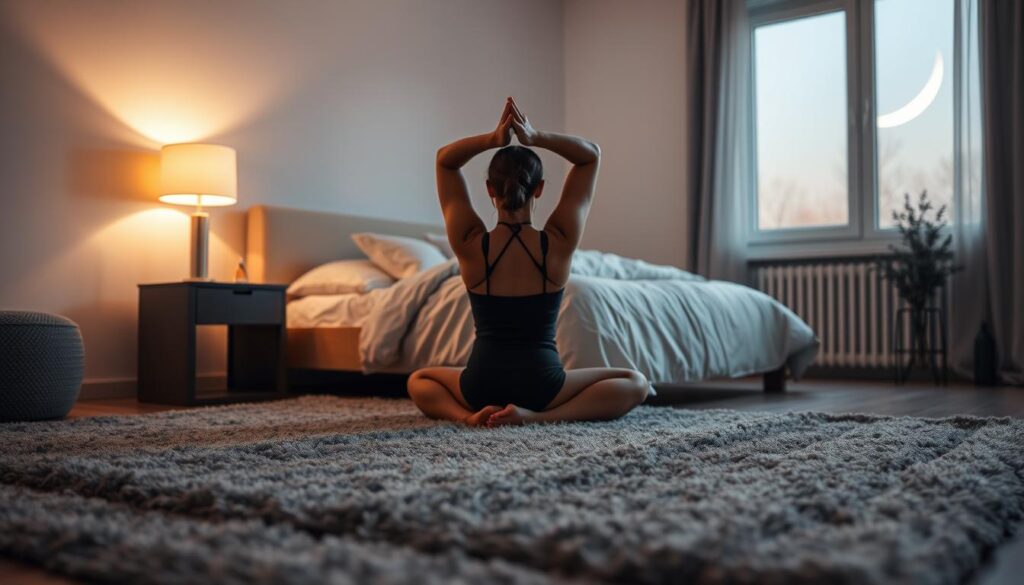
To make the habit easier to maintain:
- Dim the bedroom lights before starting.
- Put your phone aside or silence notifications.
- Pair stretching with an existing habit, such as brushing your teeth.
- Keep roughly the same bedtime and wake-up time each day.
- Keep the room cool, dark, and quiet enough for comfortable sleep.
If you miss your normal stretching time, don’t feel pressured to complete a longer session. One comfortable pose and a few quiet breaths can still provide a moment to unwind.
Common Nighttime Stretching Mistakes to Avoid
Bedtime stretching should feel easier than a workout. You don’t need to test your flexibility or push yourself into difficult positions.
1. Stretching too deeply
A mild pulling sensation can be normal. Sharp, burning, or increasing pain means you should stop. Stretching harder doesn’t necessarily make it more relaxing.
2. Bouncing or forcing your joints
Sudden bouncing and strong pulling can strain muscles or joints. Move into each position slowly and stay within a comfortable range.
3. Holding your breath
If you’re gripping your muscles or struggling to breathe normally, the stretch may be too intense. Reduce the movement until you feel comfortable again.
4. Ignoring existing injuries
Recent injuries, surgery, severe back pain, and certain joint or spine conditions may require different movements. Pregnant people and those with physical limitations may also need individual modifications.
Stop if stretching causes sharp pain, dizziness, numbness, or tingling. If these symptoms persist or return, seek medical evaluation rather than repeatedly trying the same painful movement.
5. Turning the routine into a workout
Fast repetitions, deep stretches, and exhausting exercises aren’t necessary here. Keep the movements light and controlled. Vigorous evening exercise affects people differently, so pay attention to whether it interferes with your sleep.
Which Muscles Does the Routine Target?
Each movement focuses on a slightly different area. Together, they provide gentle mobility without requiring an entire stretching workout.

- Cat-Cow: Moves the upper and lower spine and gently engages the muscles around your trunk.
- Child’s Pose: Provides a mild stretch through the back, shoulders, and hips, depending on your position.
- Knee-to-Chest: Focuses mainly on the hips and glutes, with possible gentle relief of lower-back tightness.
This sequence isn’t intended to stretch every major muscle. For example, it doesn’t provide a focused calf or hamstring stretch. If those areas are your main concern, you can explore additional options in the HSS bedtime stretching guide.
How to Build a Consistent Nighttime Stretching Habit
Consistency may help make stretching a familiar signal that your day is ending. You don’t need to complete it perfectly or force yourself through uncomfortable positions.
Start with three minutes on evenings when you feel comfortable. If doing the routine every night isn’t realistic, choose several evenings each week and build from there.
You can also adjust the routine according to how your body feels. Spend a little longer on a comfortable movement when you have time, or use a shorter seated variation after an especially tiring day.
Most importantly, notice the practical results. Are you less stiff? Do you feel calmer? Is the routine easy to maintain? Those observations are more useful than expecting a guaranteed change in sleep after a certain number of days.
Frequently Asked Questions
Can three minutes of stretching really improve sleep?
It may help you relax and ease muscle tension, which can make bedtime more comfortable. However, research hasn’t proven that this specific three-minute sequence improves sleep duration, deep sleep, or how quickly everyone falls asleep.
Is it better to stretch on the floor or in bed?
A stable floor with comfortable padding usually provides better support for Cat-Cow and Child’s Pose. Gentle reclining stretches may also work well in bed. Choose the option that allows safe, controlled movement.
Should I stretch every night?
You can practice nightly if the movements feel comfortable, but there’s no required number of sessions. Begin with a manageable schedule and adjust based on your needs.
Can this routine help with lower-back pain?
Gentle mobility may feel helpful for mild stiffness, but it won’t address every cause of back pain. Avoid movements that increase symptoms, and have persistent or worsening pain assessed by a healthcare professional.
What if Child’s Pose hurts my knees?
Try padding beneath your knees or placing a folded towel between your thighs and calves. If that doesn’t help, replace the pose with a supported seated forward lean. Don’t force yourself to kneel through pain.
Can nighttime stretching replace insomnia treatment?
No. Stretching can be part of a relaxing sleep routine, but persistent insomnia often needs more targeted help. NCCIH explains that cognitive behavioral therapy for insomnia (CBT-I) is strongly recommended for adults with chronic insomnia.
Should I combine stretching with other healthy sleep habits?
Yes. A regular sleep schedule, a comfortable bedroom, limited late-day caffeine, and a relaxing wind-down period can all support healthy sleep. Stretching works best as one optional part of that larger routine.
Conclusion: Give Yourself Three Quiet Minutes Before Bed
You don’t need an elaborate routine to make bedtime feel calmer. One minute of Cat-Cow, 45 seconds of Child’s Pose, one minute of Knee-to-Chest stretching, and 15 seconds of relaxed breathing add up to a simple three-minute practice.
Keep your movements gentle, use support when needed, and stop if anything hurts. Try the routine as part of your evening wind-down and pay attention to how your body responds.
The goal isn’t perfect flexibility or instant sleep. It’s to create a comfortable, repeatable moment of relaxation before you turn out the lights.