
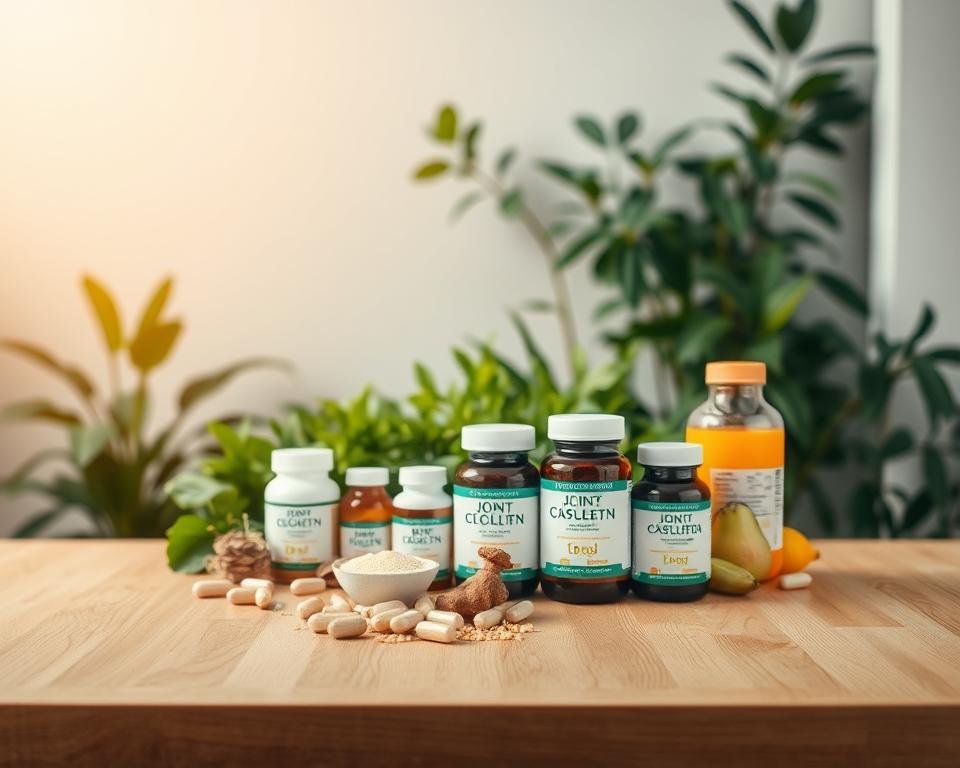

Joint Food with Tamasteen™ is a multi-ingredient joint-support supplement built around a 300 mg proprietary botanical complex containing tamarind seed, turmeric, and mangosteen extracts. That complex has been evaluated in a randomized, placebo-controlled human study, which gives this product a more relevant evidence base than a formula supported only by research on unrelated individual ingredients.
That still does not mean Joint Food is proven to relieve every type of joint pain or that every ingredient in the bottle has been shown to contribute a meaningful benefit. The most relevant study involved adults with mild-to-moderate knee osteoarthritis, lasted 56 days, and evaluated the proprietary botanical combination rather than every component of the finished Joint Food formula.
There is another important detail: Joint Food should not be evaluated as a traditional glucosamine-and-chondroitin supplement. The current formula centers on Tamasteen and includes several additional ingredients, so older descriptions built around glucosamine, chondroitin, and specific high-dose ingredient amounts no longer represent the product being sold now.
Key Takeaways
- Joint Food with Tamasteen comes as 60 capsules, providing approximately a 30-day supply at two capsules per day.
- The current formula centers on 300 mg per day of Tamasteen, a proprietary blend of tamarind seed, turmeric, and mangosteen extracts.
- A randomized 56-day study evaluated a corresponding 300 mg botanical composition in adults with mild-to-moderate knee osteoarthritis.
- The study is relevant to the core botanical blend, but it does not prove that Joint Food works for everyone or for every type of joint problem.
- The formula also contains Boswellia, MSM, type II collagen, bromelain, hyaluronic acid, vitamin C from acerola cherry, and CMO/cetyl myristoleate, but the individual amounts of most of these ingredients are not clearly disclosed in the product information reviewed here.
- Joint Food may appeal more to buyers who want a broad multi-ingredient formula than to people who prefer fully disclosed amounts for every ingredient.
Joint Food Product Snapshot
| Detail | Current Information |
|---|---|
| Product | Joint Food with Tamasteen™ |
| Brand | Nordic Healthy Living |
| Format | Capsules |
| Package | 60 capsules |
| Approximate supply | 30 days |
| Daily capsule burden | 2 capsules |
| Main proprietary component | Tamasteen™ |
| Verified Tamasteen amount | 300 mg daily |
| Glucosamine | Not part of the currently presented formula |
| Chondroitin | Not part of the currently presented formula |
The current formula includes Tamasteen plus Boswellia serrata, bromelain, type II collagen, MSM, natural vitamin C from acerola cherry, hyaluronic acid, and CMO/cetyl myristoleate. What is not sufficiently clear from the current public product information is the exact individual amount of most of those additional ingredients.
That matters because ingredient names alone do not tell you whether a formula closely matches the doses or preparations studied in clinical research. Buyers who want to inspect the current presentation before ordering can check the current Joint Food listing and label.
Joint Food Claims vs. What the Evidence Can Actually Show
| Claim or Formula Feature | What Is Verified | What the Evidence Actually Shows | Main Limitation | Practical Buyer Meaning |
|---|---|---|---|---|
| Tamasteen is clinically studied | Joint Food supplies 300 mg daily of the proprietary botanical complex. | A randomized trial of the 300 mg botanical combination studied adults with mild-to-moderate knee osteoarthritis for 56 days. | One studied population does not represent every type of joint pain or every buyer. | This is more relevant than relying only on generic ingredient research, but it is not a guarantee of benefit. |
| The whole finished formula is proven | The finished supplement contains several ingredients beyond Tamasteen. | The identified human trial primarily supports the studied botanical composition. | It does not establish the independent contribution of every additional ingredient in Joint Food. | Do not assume that every component has been validated simply because one proprietary blend has human data. |
| More ingredients mean a stronger formula | Joint Food contains multiple joint-support ingredients. | Joint-supplement evidence varies widely by ingredient, formulation, duration, and study quality. | Most individual ingredient amounts are not clearly verified. | Ingredient count should not be your main buying criterion. |
| The product repairs cartilage | No verified evidence establishes this claim. | Symptom changes in a clinical study are not the same as proving cartilage regrowth or disease reversal. | Structural disease modification requires much stronger evidence. | Judge Joint Food as an optional support supplement, not as a cartilage-rebuilding treatment. |
The most useful way to interpret Joint Food is to separate four different questions: What does the label contain? Which component has actually been studied? How relevant is that study to you? And how much of the rest of the formula can be meaningfully evaluated from the available information?
A clinical trial tied closely to a proprietary component is more useful than simply citing generic research on turmeric or MSM. But it still does not justify extending the result to every consumer, every joint condition, or every additional ingredient in the bottle.
What Is in Joint Food? Formula and Dose Review
The defining part of the current formula is Tamasteen, a proprietary combination centered on tamarind seed extract, turmeric root extract, and mangosteen extract. The manufacturer states that Joint Food supplies 300 mg of Tamasteen per day.
That 300 mg amount matters because it corresponds to the dose used in the identified NXT19185 clinical study. This creates a more direct connection between the marketed formula and the research than you would get from a product that merely contains familiar botanical names without a related studied preparation.
The uncertainty begins with the rest of the formula. Boswellia, MSM, type II collagen, bromelain, hyaluronic acid, vitamin C, and CMO are named, but their individual quantities were not sufficiently clear in the currently available product information. Without those amounts, it is difficult to compare each ingredient fairly with research that used specific doses or preparations.
That does not make those ingredients useless. It simply limits how confidently they can be evaluated. Formula transparency matters because seeing an ingredient on a label is not the same as knowing whether its amount, form, or standardization resembles what has been studied.
What Does the Tamasteen Study Actually Tell Us?
The most product-relevant evidence comes from a randomized, double-blind, placebo-controlled trial of NXT19185, a botanical composition containing tamarind seed, turmeric, and mangosteen extracts. Participants had mild-to-moderate knee osteoarthritis and took 300 mg daily for 56 days.
The study reported improvements in several symptom and function measures compared with placebo. That is encouraging enough to make the proprietary complex worth discussing seriously rather than dismissing it as just another collection of plant extracts.
However, the study was conducted in a specific population over a relatively short period. It should not be interpreted as evidence that Joint Food will relieve shoulder pain, back pain, sports injuries, inflammatory arthritis, unexplained swelling, or every other condition people may casually describe as “joint pain.”
It also does not establish that Joint Food rebuilds cartilage, reverses osteoarthritis, or prevents future deterioration. Symptom improvement and structural disease modification are very different claims.
What About Turmeric, Boswellia, MSM, and the Other Ingredients?
Turmeric illustrates why formulation details matter. Research often uses specific curcumin extracts, doses, and absorption strategies, and those products are not automatically interchangeable. The NIH’s NCCIH notes substantial variation in turmeric products and continuing uncertainty around both effectiveness and safety for specific uses. Its guidance on turmeric evidence and safety is a useful reminder that one turmeric-containing supplement cannot simply borrow the results of every curcumin study.
The same principle applies to Boswellia, MSM, collagen, bromelain, hyaluronic acid, and similar ingredients. A broad review of dietary supplements for osteoarthritis found that results differ substantially among products and ingredients, and statistically positive findings do not always translate into large or clinically important improvements.
For Joint Food, the key limitation is straightforward: the individual amounts of most of these additional ingredients are not clearly verified. That makes it difficult to say whether they meaningfully add to the formula or simply broaden the ingredient list.
Why the Current Formula Should Not Be Compared With Old Glucosamine Products
Joint Food is currently a Tamasteen-centered formula rather than a glucosamine-and-chondroitin product. That distinction matters because glucosamine and chondroitin have their own body of research, their own dosing questions, and their own guideline disagreements.
NCCIH describes the evidence for glucosamine and chondroitin as mixed, with differences among studies, formulations, and clinical recommendations. That history is another reason to avoid calling any familiar joint ingredient universally effective simply because it has been researched.
If you previously encountered a Joint Food description built around large glucosamine and chondroitin doses, do not use that older ingredient profile to judge the product currently being sold.
What Can We Learn From Customer Reviews?
Customer reviews can tell you whether people find the capsules easy to use, whether they dislike the serving routine, or whether they believe the purchase was worthwhile. They are much less useful for proving that a supplement treats osteoarthritis or produces a predictable improvement in pain or mobility.
Joint supplement reviews are especially difficult to interpret because symptoms can change with activity, sleep, exercise, weight change, medication, physical therapy, natural fluctuation, and many other factors. Without a controlled comparison, it is impossible to know how much of an individual testimonial is attributable to the supplement itself.
For that reason, this review does not rely on claims that “most users improve,” percentages of satisfied buyers, or anonymous success stories.
Who Joint Food May Suit
Joint Food may be reasonable to consider if you want a multi-ingredient joint-support supplement and prefer a formula whose main proprietary botanical component has at least been evaluated in a randomized human study at the same stated 300 mg daily amount.
It may also appeal to someone who prefers taking one combined supplement rather than buying separate turmeric, Boswellia, MSM, collagen, and other products individually.
The product makes less sense if your priority is complete dose transparency. Because most of the additional ingredient amounts are not clearly established, buyers who want to compare every component directly with clinical research may prefer a simpler formula with fully disclosed doses.
Who Should Be Cautious or Consider Another Approach?
A supplement review should not treat every case of joint discomfort as a shopping problem. Persistent, unexplained, rapidly worsening, swollen, hot, injured, or function-limiting joint symptoms deserve proper assessment rather than repeated supplement experimentation.
Joint Food may also be a poor fit if you already take several supplements containing overlapping botanicals or joint-support ingredients. More ingredients are not automatically better, and stacking products can make total intake harder to track.
Pregnant or breastfeeding individuals and people using prescription medications should be especially careful with multi-ingredient botanical products. NCCIH notes pregnancy and safety considerations around turmeric products, and the complete interaction picture for the entire Joint Food formula cannot be established from the currently available information.
If you take regular medication, particularly when several prescriptions or supplements are involved, reviewing the complete current label with a pharmacist or clinician is more useful than relying on a generic interaction list online.
Safety, Interactions, and Realistic Expectations
The most realistic expectation is that Joint Food is an optional supplement, not a substitute for diagnosis, exercise-based management, weight management where relevant, physical therapy, medication, or other evidence-based care recommended for a diagnosed condition.
There is also no verified basis for promising a specific response time. The relevant Tamasteen-related study lasted 56 days, but that does not mean buyers should expect noticeable results at a particular week or assume that a lack of early improvement proves the product cannot help.
Short-term human research also does not establish safety for indefinite use. If you develop new symptoms after starting a multi-ingredient supplement, stop treating the product as a routine purchase decision and seek appropriate guidance.
Is Joint Food Worth Buying?
Joint Food has one meaningful advantage over many broad joint-support formulas: its central 300 mg botanical complex has product-relevant randomized human research behind it. That gives the formula a stronger starting point than supplements that rely entirely on unrelated ingredient studies.
The tradeoff is transparency. Most additional ingredient amounts are not clearly verifiable, so it is difficult to determine whether the Boswellia, MSM, collagen, bromelain, hyaluronic acid, vitamin C, and CMO portions make a meaningful difference or simply add breadth to the ingredient panel.
For a buyer who values a studied proprietary botanical blend and prefers a two-capsule daily multi-ingredient formula, that may be acceptable. For someone who wants exact individual doses, simpler ingredients, or an easier way to compare cost against published research, it may be less appealing.
Before buying, check six things: the current Supplement Facts panel, the exact daily serving, any allergen warnings, medication cautions, the current price per daily serving, and whether you already use overlapping supplements.
Frequently Asked Questions
What is in the current Joint Food formula?
The current Joint Food formula centers on 300 mg per day of Tamasteen, a proprietary blend of tamarind seed, turmeric, and mangosteen extracts. It also names Boswellia, bromelain, type II collagen, MSM, vitamin C from acerola cherry, hyaluronic acid, and CMO/cetyl myristoleate.
Does Joint Food contain glucosamine or chondroitin?
No. Glucosamine and chondroitin are not part of the currently presented Joint Food with Tamasteen formula. Descriptions built around large glucosamine and chondroitin doses refer to a materially different formulation and should not be used to judge the current product.
Has Joint Food’s main botanical complex been studied?
Yes. A corresponding 300 mg tamarind, turmeric, and mangosteen botanical composition was evaluated in a randomized, double-blind, placebo-controlled 56-day study involving adults with mild-to-moderate knee osteoarthritis.
Does that mean Joint Food is proven to work?
No. The trial makes the proprietary botanical complex more evidence-relevant than a formula supported only by generic ingredient claims, but it does not guarantee benefit for an individual buyer or establish effectiveness for every joint condition.
How many Joint Food capsules are taken each day?
The 60-capsule bottle provides approximately a 30-day supply, corresponding to two capsules per day.
How long should someone try Joint Food before deciding whether it helps?
There is no verified timeframe that can predict an individual’s response. The product-relevant clinical study lasted 56 days, but that study duration should not be converted into a promise that buyers will notice benefits within a specific number of weeks.
Can Joint Food interact with medications?
Potential interactions cannot be ruled out because this is a multi-ingredient botanical supplement. Anyone taking regular medication should check the complete current label and discuss possible interactions with a pharmacist or clinician when appropriate.
Is Joint Food better than buying individual ingredients separately?
That depends on what you value. Joint Food offers the convenience of a combined formula and has human research tied closely to its main proprietary complex. Separate products may offer clearer dose transparency and make it easier to compare individual ingredients with published research.
Final Verdict
Joint Food with Tamasteen is more interesting than a typical kitchen-sink joint supplement because its central 300 mg botanical complex has a randomized human study that closely matches the stated daily amount. That is a genuine strength.
The main limitation is equally important: the individual amounts of most of the additional ingredients are not clearly established, and research on the proprietary complex cannot be used to prove that every component of the finished product adds a meaningful benefit.
For an adult who understands those limits, wants a multi-ingredient joint-support supplement, and values having some product-relevant human evidence behind the core blend, Joint Food may be reasonable to consider. Buyers who want complete dose transparency, a simpler formula, or a product that can be compared ingredient-by-ingredient with published research may prefer a different approach.


Don’t Miss These Picks