

Feeling stressed, distracted, or tense? Sometimes, taking a few minutes to focus on your breathing can help you feel more settled. Breathwork for beginners is a simple way to practice relaxation without special equipment, expensive classes, or a complicated routine.
Breathwork means changing the pace or pattern of your breathing on purpose. Gentle techniques may help ease stress, relax tense muscles, and support better sleep. Although a breathing session can feel comforting, it is not a replacement for mental health therapy or medical treatment.
In this guide, you’ll learn a five-minute starter routine, six useful breathing techniques, and simple ways to practice safely at home, at work, or before bed.
Key Takeaways
- Start small: Five minutes of gentle breathing is enough to begin learning the technique.
- Slow breathing may reduce stress: Research suggests it can support relaxation and modestly improve certain measures, including blood pressure.
- Match the exercise to your goal: Box breathing can help you focus, while slow breathing with longer exhales may help you unwind.
- No equipment is required: A chair, a quiet moment, and comfortable breathing are all you need.
- Never force your breath: Shorten or skip breath holds if they cause discomfort, and stop if you become dizzy.
Helpful Products at a Glance
For beginners who struggle to follow breathing counts, the Mindsight Breathing Buddha provides visual breathing cues. It’s an optional guide, not a requirement for relaxation.
- 🧠 WHAT IT'S FOR: Daily guided breathing to help calm & focus your mind during the day or promote a peaceful night sleep, improving overall wellness. Continued practice can help manage or reduce stress & anxiety in all ages and can help improve symptoms of depression. A simple & fun meditation tool that can also cultivate mindfulness to help you live in the present moment.
- 🧠 HOW TO USE IT – 3 easy to use breathing modes OR as a calming night light. Simply follow fade-in, fade-out color prompts that simulate the popular 4/7/8 'calming breath', 5/5 'balance breath', or 4/4/4/4 'box breathing'. Green Buddha - Inhale , Purple Buddha – Hold, Blue Buddha – Exhale. Lightly tap on surface to adjust brightness.

What Is Breathwork and How Does It Work?
Breathwork is the practice of deliberately changing your breathing rhythm. Some exercises use slow inhales and longer exhales, while others include counting or short pauses. Many traditional techniques come from pranayama, a breathing practice associated with yoga.
Your breathing is connected to the autonomic nervous system, which controls automatic functions such as heart rate and digestion. It has two important branches:
- Sympathetic nervous system: Helps prepare your body to respond to stress or danger, often increasing your heart rate and breathing speed.
- Parasympathetic nervous system: Supports recovery, digestion, and relaxation when the body no longer needs a strong stress response.
Gentle, slower breathing can influence this system and support what researchers call the relaxation response. However, the effect is not automatic or identical for everyone. The aim is comfortable breathing, not forcing your body into a particular state.
Science-Backed Benefits of Breathwork
Breathing exercises have been studied for stress, anxiety, blood pressure, and sleep. The findings are encouraging, although some studies are small or use different techniques, making firm conclusions difficult.
1. May reduce stress and anxiety
Slow breathing gives your attention a simple task and may help your body relax. A systematic review of breathing exercises found improvements in anxiety or stress in several studies, but larger, high-quality trials are still needed.
2. May support healthier blood pressure
Research suggests breathing exercises can produce modest reductions in blood pressure for some people. These changes do not mean breathwork prevents heart attacks or replaces blood pressure medication.
The National Center for Complementary and Integrative Health (NCCIH) notes that studies have limitations, including short follow-up periods.
3. May help with focus and sleep
Counting breaths can give a busy mind something steady to follow. Some people also find slow breathing helpful before bed because it encourages a calmer routine.
However, evidence for treating insomnia with specific breathing patterns remains limited. Breathing exercises are best viewed as one part of healthy sleep habits.
Breathwork for Beginners: Your 5-Minute Starter Routine
You don’t need to master several exercises before starting. This five-minute routine combines gentle belly breathing, optional box breathing, and a short body scan.
Before you begin
- Choose a comfortable chair or lie on your back.
- Relax your shoulders, jaw, and hands.
- Wear loose clothing that doesn’t restrict breathing.
- Breathe gently through your nose if comfortable.
- Keep the pace natural rather than taking unusually large breaths.
Follow this minute-by-minute routine
- Minute 0–1: Belly breathing. Place one hand on your chest and another on your belly. Breathe in gently and feel your lower ribs and belly expand. Exhale slowly without pushing the air out.
- Minute 1–3: Box breathing. Inhale for four counts, pause for four, exhale for four, and pause for four. If either pause feels uncomfortable, skip the holds and simply inhale for four and exhale for four.
- Minute 3–4: Longer exhales. Try inhaling gently for four counts and exhaling for six. Shorten both counts if necessary. You don’t need to hold your breath.
- Minute 4–5: Natural breathing and body scan. Stop counting. Notice your forehead, jaw, neck, and shoulders. Allow tense muscles to soften as you breathe normally.
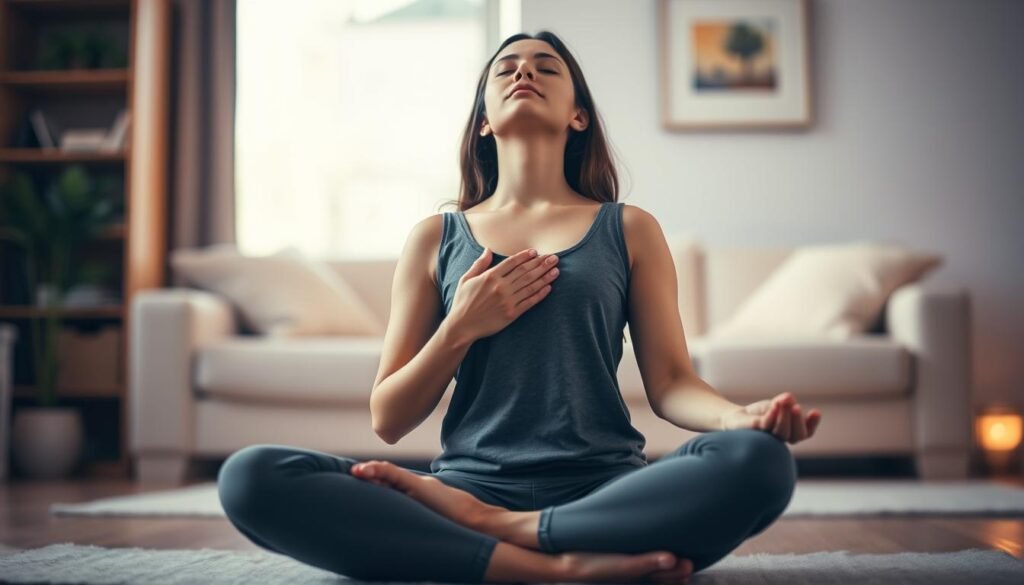
What should you feel? You may notice calmer thoughts, less muscle tension, or a more comfortable breathing rhythm. You may also notice very little during your first few sessions. Both experiences are normal.
If five minutes feels too long, begin with 60 seconds. The goal is to practice comfortably, not to complete every count perfectly.
Six Breathing Techniques Worth Learning
Different techniques give you options for different situations. Begin with diaphragmatic breathing and explore the others gradually.
1. Diaphragmatic breathing
Also called belly breathing, this technique encourages gentle movement of your diaphragm, the main muscle used for breathing.
- Sit or lie comfortably with one hand on your belly.
- Inhale gently and allow your lower ribs and belly to expand.
- Exhale slowly, letting your belly relax.
- Continue for one to three minutes.
2. Box breathing
Follow four equal stages: inhale, hold, exhale, and hold again. A common pattern is 4-4-4-4. Counting may help anchor your attention before a meeting or during a stressful day. Skip the holds if they feel difficult.
3. 4-7-8 breathing
Inhale through your nose for four counts, hold for seven, and exhale gently through your mouth for eight. This pattern is often used to unwind before sleep.
The seven-count hold can feel demanding. Beginners may prefer breathing in for three or four counts and breathing out for five or six without holding. See the Cleveland Clinic’s instructions for the traditional method.
4. Pursed-lip breathing
Inhale gently through your nose for about two counts. Then exhale through lightly pursed lips for about four counts, as though blowing out a candle slowly.
This method can help some people manage breathlessness, including people with certain lung conditions, but medical guidance may be needed.
5. Alternate nostril breathing
Also known as nadi shodhana, this yoga technique alternates airflow between nostrils.
- Close your right nostril gently with your thumb.
- Inhale through your left nostril.
- Close the left nostril and release the right.
- Exhale through the right nostril, then inhale through it.
- Switch again and exhale through the left.
Repeat slowly for one or two minutes without holding your breath. It may support relaxation and attention, but claims about balancing brain hemispheres or clearing energy pathways are not scientifically established.
6. Five-finger breathing and lion’s breath
Five-finger breathing: Trace upward along one finger as you inhale and downward as you exhale. Continue across your hand. The movement provides a helpful focus when you’re distracted.
Lion’s breath: Inhale gently, open your mouth, extend your tongue comfortably, and exhale with a soft “ha.” This playful yoga exercise may help you notice and relax tension around your face and jaw. Avoid forceful breathing.
Which Breathing Exercise Should You Choose?
The most useful technique is one you can practice comfortably and remember when you need it.
| Goal | Technique to try | Starting time |
|---|---|---|
| Work stress | Box breathing or gentle equal breathing | 1–2 minutes |
| Relaxation before sleep | Diaphragmatic breathing with longer exhales | 3–5 minutes |
| Morning focus | Alternate nostril breathing | 2–3 minutes |
| Shoulder and jaw tension | Five-finger breathing with a body scan | 1–3 minutes |
| Everyday practice | Gentle diaphragmatic breathing | 5 minutes |
For a stressful meeting, you might quietly count four gentle inhales and exhales without breath holds. Before bed, try a longer exhale while lying comfortably.
These are starting suggestions, not guaranteed effects. If a particular exercise increases anxiety, return to natural breathing and try a different approach.
How to Make Breathwork a Daily Habit
Consistency can make the exercises feel more familiar. Choose an easy time to practice, such as after brushing your teeth, before your first work task, or when preparing for bed.
Start with five minutes daily, or divide your practice into shorter sessions. You can also use a simple timer, a written breathing pattern, or a free guided audio session. The Othership beginner’s guide offers additional ways to learn and practice.
When a visual breathing guide may help
Some beginners find counting distracting, especially when they’re tired or trying to relax. A visual breathing guide provides changing light cues that you can follow without watching a clock.
The Mindsight Breathing Buddha is a USB-rechargeable breathing light with visual modes for 5-5 breathing, 4-7-8 breathing, and box breathing. It can sit on a desk or nightstand as a reminder to practice.
Its limitation is that preset patterns may not match your comfortable breathing pace, particularly when they include holds. Use only the patterns that feel easy. You can get the same basic breathing practice without buying a device.
- 🧠 WHAT IT'S FOR: Daily guided breathing to help calm & focus your mind during the day or promote a peaceful night sleep, improving overall wellness. Continued practice can help manage or reduce stress & anxiety in all ages and can help improve symptoms of depression. A simple & fun meditation tool that can also cultivate mindfulness to help you live in the present moment.
- 🧠 HOW TO USE IT – 3 easy to use breathing modes OR as a calming night light. Simply follow fade-in, fade-out color prompts that simulate the popular 4/7/8 'calming breath', 5/5 'balance breath', or 4/4/4/4 'box breathing'. Green Buddha - Inhale , Purple Buddha – Hold, Blue Buddha – Exhale. Lightly tap on surface to adjust brightness.
- 🧠 WHO IT’S FOR – adults & kids who might benefit from a gentle daily reminder to 'pause & reset'; visual learners who might prefer guided open-eyed meditation (those who find closing eyes harder to focus); beginning to advanced Meditation practitioners; those interested in Mindfulness; Teachers, Students & Counselors.
- 🧠 WHERE TO USE IT - fits perfectly on desk or nightstand or wherever you might benefit from a reminder. Practice at home, work, school .. or as part of a relaxing wind down routine before bed.
Breathwork Safety: What Beginners Should Know
Gentle breathing exercises are generally well tolerated, but they can sometimes cause dizziness, tingling, anxiety, or uncomfortable breathlessness. Breathing too quickly or deeply can lower carbon dioxide levels in your blood and produce symptoms of hyperventilation.
To keep your practice comfortable:
- Do not force deep breaths. Breathe gently rather than trying to fill your lungs completely with every inhale.
- Skip uncomfortable holds. Breathing in and out smoothly is a useful alternative.
- Practice seated or lying down if you sometimes feel lightheaded.
- Stop if symptoms appear. Return to natural breathing if you feel dizzy, nauseated, anxious, or unusually breathless.
- Never practice breath-holding underwater or while driving. Avoid intense breathing techniques in situations where fainting could cause injury.
Who should speak with a healthcare professional first?
Seek individual guidance before practicing breath holds or intense techniques if you have heart disease, uncontrolled high blood pressure, asthma, COPD, epilepsy, or another condition that affects your breathing or circulation. Pregnant people and those recovering from surgery should also ask about suitable modifications.
If breath-focused exercises bring up severe anxiety, panic, or distressing memories, stop and consider working with a qualified mental health professional. Seek urgent medical care for severe breathing difficulty, chest pain, or fainting rather than trying to manage these symptoms with breathwork.
Should Beginners Try Advanced Breathwork?
You may encounter practices such as holotropic breathwork or rebirthing breathwork. These often involve prolonged, rapid, or continuous breathing and may produce intense physical sensations and emotional reactions.
Claims that such sessions release stored trauma or treat mental health conditions are not firmly established. They also carry greater risks than gentle breathing exercises, particularly for people with certain health conditions.
If you’re considering a session, ask about the facilitator’s training, health screening, emergency procedures, and the evidence behind their claims. For beginners, there is no need to progress to intensive techniques. Gentle practice may already meet your goals.
Frequently Asked Questions
How often should beginners practice breathwork?
Try three to five minutes daily at first. Increase to five or ten minutes if the exercises remain comfortable. Short sessions throughout the day are also reasonable. You don’t need to reach a particular number of rounds to benefit from practice.
How soon can breathwork reduce stress or anxiety?
Some people notice a calmer feeling during or shortly after a session. Others need more practice before the technique feels natural. Long-term improvements vary, and breathwork alone may not adequately address persistent anxiety.
Can breathing exercises lower high blood pressure?
Some studies have found modest blood pressure reductions with regular breathing exercises. However, results differ, and the long-term effects on cardiovascular outcomes remain uncertain. Continue prescribed treatment and medical monitoring.
Can I practice if I have asthma or COPD?
Some people with lung conditions can benefit from appropriately taught breathing techniques, particularly pursed-lip breathing. Ask your healthcare professional which exercises are suitable for your condition. Avoid uncomfortable breath holds and forceful breathing.
Can children and teenagers practice breathwork?
Children and teens can try simple, gentle exercises such as tracing fingers while breathing slowly. Keep sessions short, comfortable, and age-appropriate. Avoid prolonged breath holds and intense techniques, and seek professional advice for significant breathing or anxiety symptoms.
What if counting breaths makes me more anxious?
Stop counting and return to your usual breathing rhythm. You can focus on feeling your feet against the floor, listening to nearby sounds, or noticing the movement of your hands instead. Breathwork should not feel like a task you must complete perfectly.
Conclusion: Start With Five Comfortable Minutes
Breathwork for beginners doesn’t need to be intense or complicated. A few minutes of gentle breathing can give you a practical way to pause, focus, and relax during a busy day.
Start with the five-minute routine once a day this week. Notice how you feel before and after each session. Keep the techniques you enjoy, shorten anything uncomfortable, and build your routine gradually.
The goal isn’t to control every breath. It’s to develop a simple, comfortable habit you can return to whenever you need a moment of calm.