
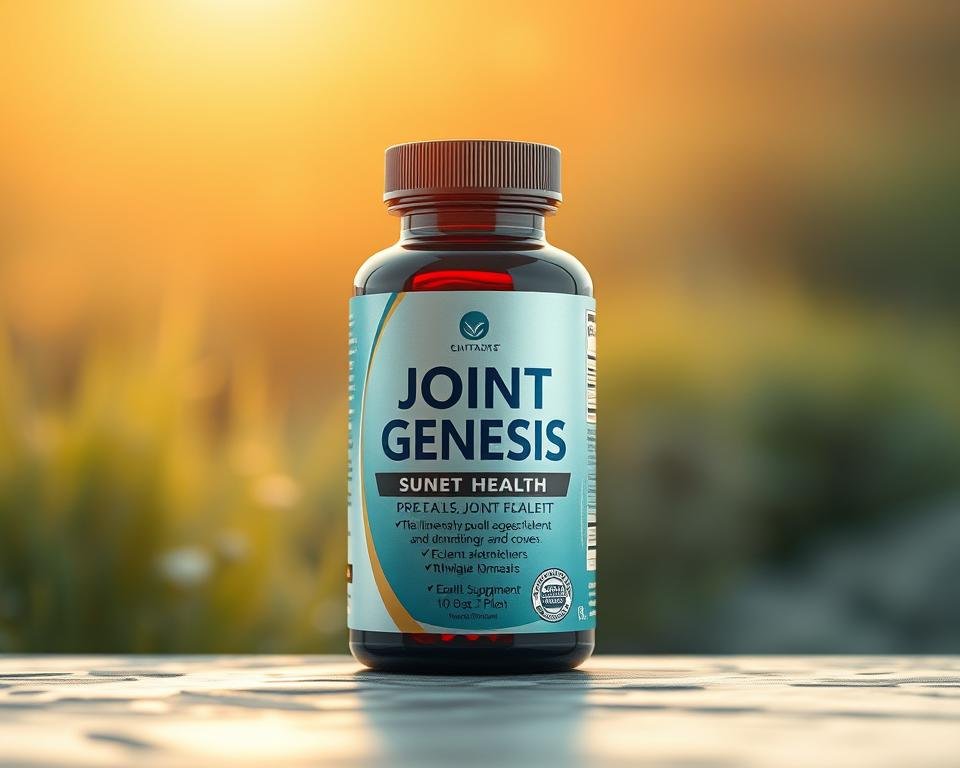

Joint Genesis is a multi-ingredient supplement marketed for joint support. Its formula includes several ingredients that have been studied individually, including oral hyaluronic acid, ginger, Boswellia, and pine bark extract. That gives the formula some scientific context, but it does not prove that Joint Genesis itself improves joint pain, stiffness, mobility, or joint health.
The most useful way to judge this supplement is to separate three questions: Is there evidence for the finished product? Do its ingredient forms and doses resemble those used in relevant human research? And does the potential benefit justify the cost and safety considerations for your situation?
Quick Verdict
Joint Genesis has a more interesting ingredient profile than many supplements built around vague proprietary blends, but the main limitation is important: convincing human clinical evidence for the complete Joint Genesis formula was not established. Several ingredients have some research behind them, yet the strength and relevance of that research vary considerably.
For someone specifically looking for a combined joint-support supplement, Joint Genesis may be worth comparing with simpler formulas. It is less convincing for anyone expecting proven arthritis treatment, rapid pain relief, cartilage repair, or predictable mobility improvements.
Key Takeaways
- Joint Genesis combines several ingredients that have been studied separately for joint-related outcomes.
- Ingredient research does not establish that the complete Joint Genesis formula produces the same results.
- Available label material has shown ginger, Boswellia, an 80 mg hyaluronic-acid matrix, pine bark extract, and black pepper extract, although formulation details should be checked on the current bottle before purchase.
- Human research on oral hyaluronic acid exists, but doses, formulations, study populations, and outcomes vary.
- Evidence for ginger and Boswellia is mixed or limited enough that they should not be described as proven joint-pain treatments.
- No current Amazon.com listing was verified strongly enough to support an Amazon product link or shortcode.
Joint Genesis at a Glance
Joint Genesis is marketed as a once-daily joint-support supplement. Recently surfaced label material has shown the following amounts per serving:
- Ginger root powder — 200 mg
- Boswellia serrata extract — 100 mg
- Hyaluronic acid matrix — 80 mg
- French maritime pine bark extract — 150 mg
- Black pepper extract/piperine — 5 mg
These amounts are useful for evaluating the formula, but they should not be treated as permanently fixed. Supplement formulas can change, and commercial pages do not always present product information consistently. Check the current label before making a buying decision.
What Joint Genesis Claims to Do
The product is marketed around the idea of supporting joint comfort, lubrication, and mobility through a combination of hyaluronic acid and plant-derived ingredients. That sounds plausible at a broad level because several components have been studied for joint-related outcomes.
The problem comes when ingredient mechanisms are presented as if they prove the complete formula will deliver a specific result. Claims such as restoring joint fluid, rebuilding cartilage, reversing joint aging, or addressing the root cause of joint pain require much stronger product-specific evidence than ingredient summaries can provide.
What Evidence Exists for Joint Genesis Itself?
The most important limitation in this review is that a convincing human clinical trial of the complete Joint Genesis formula was not established. That means the product should not be described as clinically proven.
This distinction matters because supplement research exists at different levels. A study can examine an isolated ingredient, a particular standardized extract, or a proprietary formulation. Results from one form cannot automatically be transferred to another formula containing a different dose or preparation.
The evidence for supplements used in osteoarthritis varies considerably, and many products are supported more by ingredient-level research than by high-quality evidence on the finished supplement.
Claim vs Evidence: What Is Actually Supported?
| Claim or Question | What the Evidence Supports | Main Limitation |
|---|---|---|
| Does Joint Genesis have researched ingredients? | Yes. Several ingredient types in the formula have been studied individually. | Individual studies do not prove the complete product works. |
| Does oral hyaluronic acid have human research? | Yes. Oral hyaluronic acid has been studied across multiple formulations and doses. | Research varies in formulation, dose, population, and outcome. |
| Does ginger have evidence for joint symptoms? | Some studies have evaluated ginger for osteoarthritis-related symptoms. | Evidence quality and clinical significance remain uncertain. |
| Does Boswellia have evidence? | Some trials suggest potential effects on osteoarthritis symptoms. | Studies are generally small, and extracts are not interchangeable. |
| Is the complete Joint Genesis formula clinically proven? | No convincing product-specific human trial was established. | Most of the scientific case is indirect. |
Joint Genesis Ingredients and Dosages
The formula becomes easier to judge when each ingredient is considered in terms of evidence, dose, formulation, and relevance rather than simply asking whether it has ever appeared in a study.
Hyaluronic Acid Matrix
Hyaluronic acid is best known as a naturally occurring component of connective tissues and joint fluid. It is also used medically in forms that are very different from oral supplements, so research on injected hyaluronic acid should not be treated as evidence for capsules.
A systematic review of oral hyaluronic acid found human research using roughly 30 to 300 mg per day across different products and study designs. That tells us oral hyaluronic acid has been studied, but it does not show that every product or every dose has equivalent effects.
The Joint Genesis label material reviewed for this article showed an 80 mg hyaluronic-acid matrix. That amount sits within the broad range seen in oral research, but dose overlap alone is not enough. Molecular characteristics, supporting ingredients, treatment duration, study population, and the exact formulation all matter.
French Maritime Pine Bark Extract
Pine bark extracts have been studied for a range of health uses, including joint-related outcomes. However, results from a specific branded or standardized extract should not automatically be applied to every pine bark ingredient.
This matters because older supplement marketing often cites percentage improvements from individual trials without explaining the studied dose, extract, population, or endpoint. Those numbers can sound more precise than the evidence actually allows.
Joint Genesis should therefore be evaluated based on the exact extract and dose shown on its current label rather than assuming that all pine bark research applies directly to the formula.
Ginger
Ginger has been studied for knee osteoarthritis and other inflammatory or pain-related conditions. According to NCCIH guidance on ginger, some research suggests possible benefits, but limitations in study quality and consistency make strong conclusions difficult.
The available Joint Genesis label material showed 200 mg of ginger root powder. That should not automatically be compared with trials using concentrated extracts or different preparations. Two products can both say “ginger” on the label while delivering very different amounts of active compounds.
Ginger can also cause gastrointestinal effects in some people and may be relevant to medication interactions, which becomes more important in a multi-ingredient supplement.
Boswellia Serrata
Boswellia is one of the more frequently researched botanical ingredients in joint supplements. Current evidence on Boswellia includes studies reporting improvements in some osteoarthritis outcomes, but the overall evidence base remains limited by small trials and variation between extracts.
The available Joint Genesis label material showed 100 mg of Boswellia serrata extract standardized to 65% boswellic acids. That is useful information, but it does not establish equivalence to proprietary Boswellia extracts used in specific clinical trials.
Standardization percentage alone also does not tell you that a supplement will reproduce the outcome of another product.
Black Pepper Extract / Piperine
Black pepper extract is commonly added to supplements because piperine can affect the absorption and metabolism of certain compounds. That does not mean a 5 mg dose automatically makes every ingredient in Joint Genesis substantially more effective.
Piperine effects are compound-specific, and its influence on drug metabolism is another reason people using prescription medicines should be cautious about assuming a multi-herb formula is automatically compatible with their regimen.
Do the Doses Match the Research?
This is where many supplement reviews become too generous. Finding a study on an ingredient is only the first step. A useful comparison asks whether the product contains a similar form, dose, and preparation to the one that was studied.
For Joint Genesis, the answer differs by ingredient. The 80 mg hyaluronic-acid matrix falls within the broad oral-hyaluronic-acid dose range seen in human research, but that does not establish equivalent performance. Ginger research often uses preparations that are not directly comparable with 200 mg of root powder. Boswellia studies may involve proprietary extracts with different compositions. Pine bark research can also depend on the exact extract used.
That leaves Joint Genesis with a reasonable ingredient rationale but a weaker evidence bridge from “this ingredient has research” to “this exact formula should produce the same result.”
Who May Consider Joint Genesis?
Joint Genesis may make sense to consider if you specifically want a combined supplement instead of buying several ingredients separately and you understand that the formula is supported mainly by indirect ingredient-level evidence.
It is more suitable for someone comfortable with uncertainty than for someone looking for a predictable treatment effect. The value proposition is convenience: several joint-support ingredients are bundled into one daily product.
Before buying, use a simple checklist:
- Is the current formula clearly shown on the bottle?
- Do the doses resemble those used in relevant studies?
- Does the evidence apply to the same ingredient form?
- Are there medication or health-condition concerns?
- Does the price still make sense given the lack of strong finished-product evidence?
Who Should Skip It or Ask a Clinician First?
Joint Genesis is a poor fit for anyone expecting it to diagnose, treat, or reverse a joint condition. Persistent pain, swelling, stiffness, locking, instability, redness, or worsening symptoms can have causes that need proper medical evaluation rather than another supplement.
Extra caution is also reasonable for people taking prescription medicines, using other herbal products with overlapping ingredients, preparing for surgery, or managing conditions where changes in drug metabolism or bleeding risk may matter.
People already using ginger, Boswellia, hyaluronic acid, or similar joint formulas should also compare labels to avoid unnecessary duplication.
Safety, Side Effects, and Interactions
“Natural” does not mean interaction-free. Joint Genesis combines several ingredients, which makes it harder to judge tolerance based on any single component.
Ginger can cause digestive symptoms in some users. Boswellia may also cause gastrointestinal effects. Piperine can affect the metabolism of certain compounds. NCCIH also notes more broadly that dietary supplements can cause side effects and interact with medications.
If you take regular medication, especially multiple prescriptions, it is more useful to review the full ingredient list with a pharmacist or clinician than to evaluate each ingredient in isolation.
Price, Guarantee, and Value
Current commercial pages show differing package structures and offers, so a single price should not be treated as universally current. The same applies to refund terms.
Some sales pages advertise a long refund window, including 180-day language. That can make a purchase feel less risky financially, but a refund policy is a commercial term, not evidence that the supplement works.
The better value question is whether the convenience of a combined formula justifies paying more than you might pay for a simpler product containing one or two ingredients with clearer dose information.
For a buyer comfortable with indirect evidence and interested in a multi-ingredient formula, the convenience may have value. For a buyer who prioritizes the strongest evidence-to-cost ratio, a simpler strategy may be easier to evaluate.
What Real Customer Feedback Can and Cannot Tell You
Commercial and promotional pages contain many positive Joint Genesis testimonials, but that is not the same as having a transparent, representative review sample.
Without a clearly defined group of verified purchasers, a known date range, consistent review criteria, and visibility into negative experiences, statements such as “most users improve” are not dependable.
Customer feedback can still be useful for learning about issues such as capsule size, shipping, taste, packaging, or individual tolerance. It is much less reliable for proving that a supplement produces a medical or biological effect.
Is Joint Genesis Worth Buying?
Joint Genesis is easier to justify as a convenience-focused joint supplement than as an evidence-backed treatment. Its formula includes several ingredients with human research behind them, but there is a meaningful gap between ingredient evidence and proof for the complete product.
If you want a combined formula and are comfortable with that uncertainty, it may be reasonable to compare Joint Genesis with other options after checking the current label, price, refund terms, and medication compatibility.
If your main requirement is strong product-specific clinical evidence, predictable symptom improvement, or clearly proven value over simpler formulas, Joint Genesis does not currently offer enough verified evidence to make that case confidently.
Other Joint-Support Approaches to Compare
Joint Genesis is not the only way to approach joint supplementation. Some products use glucosamine, chondroitin, and MSM, while others focus on a single ingredient such as hyaluronic acid or Boswellia.
Those approaches should not be treated as interchangeable. A simpler formula can sometimes make dose and evidence comparisons easier, while a broader formula can be more convenient. The better fit depends on which ingredient strategy you actually want to evaluate.
Non-supplement approaches also matter. Exercise, strength work, weight management where appropriate, physical therapy, and proper evaluation of persistent joint symptoms may have more practical value than repeatedly switching between supplements.
Frequently Asked Questions
Does Joint Genesis itself have clinical trials?
No convincing human clinical trial of the complete Joint Genesis formula was established. Most of the scientific case comes from research on individual ingredients rather than the finished product.
Does oral hyaluronic acid have human research?
Yes. Human studies of oral hyaluronic acid exist, but doses and formulations vary. That means research on one preparation cannot automatically prove that another formula will have the same effect.
What does research say about ginger for joint symptoms?
Ginger has been studied for osteoarthritis-related symptoms, but the evidence remains mixed and limited by differences in product type, dose, and study quality.
What does research say about Boswellia?
Some studies suggest Boswellia extracts may help certain osteoarthritis symptoms, but the evidence base is still limited, and different extracts should not be assumed to work the same way.
Can Joint Genesis interact with medications?
Potentially. Ginger, Boswellia, piperine, and other supplement ingredients may matter for medication safety. Anyone taking prescription drugs should review the full formula with a clinician or pharmacist rather than assuming compatibility.
How long does Joint Genesis take to work?
There is not enough verified product-specific evidence to give a reliable timeframe. Individual ingredient studies cannot establish how quickly the complete Joint Genesis formula will produce noticeable effects.
Is Joint Genesis available on Amazon?
A current, unambiguous Amazon.com listing with a verified product identity and ASIN was not established during review. Availability can change, so buyers should verify the seller, label, and product identity carefully before purchasing.
Does the refund guarantee prove Joint Genesis works?
No. A refund policy can affect purchase risk, but it does not provide clinical evidence of effectiveness. Terms should also be checked at the time of purchase because commercial offers can change.
Final Verdict
Joint Genesis has a plausible joint-support formula built around ingredients that have varying levels of human research. Its strongest point is convenience: several recognizable supplement ingredients are combined into one product.
Its biggest weakness is the evidence gap. Ingredient studies do not prove that Joint Genesis itself delivers the same outcomes, and several dose and formulation comparisons remain uncertain.
For a buyer who understands those limits and wants a multi-ingredient supplement, Joint Genesis may be worth comparing with simpler options. For someone looking for clinically established treatment, rapid relief, cartilage repair, or predictable improvement, the available evidence does not support those expectations.




Don’t Miss These Picks