
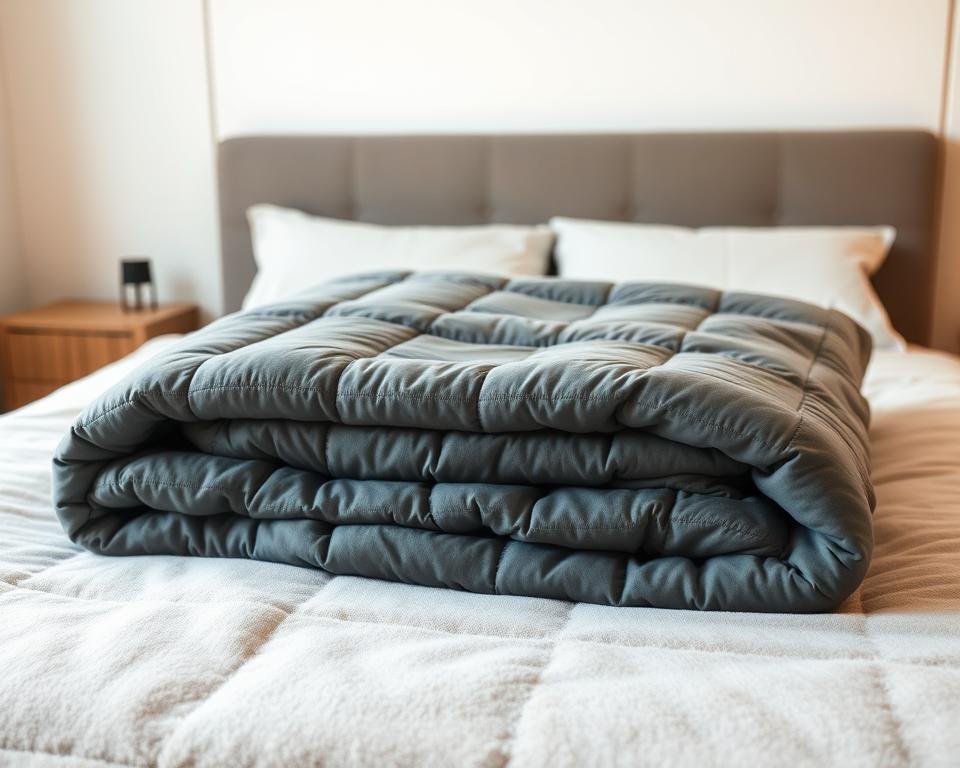

Rocabi is best judged as a traditional weighted blanket, not as a treatment for anxiety, insomnia, or another health condition. Historically, Rocabi sold bead-filled weighted blankets with removable covers and several adult weight options, but current Rocabi availability and current product specifications could not be confirmed reliably enough to recommend it as an active purchase today.
If you already own a Rocabi blanket or find a legitimate current listing, the more useful question is whether this style of weighted bedding fits you. It may appeal to someone who enjoys firm, evenly distributed pressure and likes the convenience of a removable cover. It makes less sense for hot sleepers, people who dislike heavy bedding, anyone who has difficulty moving or removing a blanket independently, or first-time buyers who simply want to test whether weighted bedding feels comfortable.
The evidence around weighted blankets is also more restrained than many product descriptions suggest. Some research has found encouraging results for anxiety and certain sleep outcomes, but findings are mixed, study sizes are often small, and the evidence does not establish that Rocabi itself improves sleep or treats anxiety.
Rocabi Weighted Blanket: What Can Be Verified?
Rocabi has historically sold traditional weighted blankets built around a bead-filled inner blanket and removable-cover format. Older product records reference glass-bead filling, multiple adult weight choices, Queen- and King-style configurations, and removable plush or cotton-style covers.
The problem is freshness. Those historical records are not enough to establish what Rocabi sells now, whether the same configurations remain available, or whether older specifications still apply. Exact current dimensions, weight choices, cover materials, washing instructions, price, warranty terms, and availability should therefore be checked against a current primary product listing before buying.
That distinction matters because several older Rocabi descriptions conflict on details such as pocket dimensions. Rather than treating an old specification as current fact, it is safer to focus on the broader construction style that is consistently documented: a traditional weighted insert divided into smaller sections to distribute bead weight, paired with a removable cover.
| What appears historically supported | What still needs current confirmation |
|---|---|
| Traditional bead-filled weighted insert | Current filler specification |
| Removable-cover design | Current cover materials and included cover |
| Multiple adult weight options were previously sold | Current weight and size choices |
| Queen- and King-style versions appeared in older listings | Current dimensions |
| Rocabi previously offered plush and cotton-style cover choices | Current cover availability |
| Premium-positioned traditional weighted-blanket format | Current price, warranty, returns, and care instructions |
Who Rocabi Makes Sense For — and Who Should Skip It
The most useful way to judge Rocabi is to start with your tolerance for weighted bedding rather than with promises about better sleep.
| Rocabi-style weighted bedding may make sense if… | You may want to skip it if… |
|---|---|
| You already know you enjoy noticeable pressure while resting. | You have never tried weighted bedding and are unsure whether you like the sensation. |
| You value a removable cover for easier routine cleaning. | You want the lightest, simplest bedding to wash and move. |
| You prefer a traditional bead-filled design. | You dislike heavy or restrictive-feeling bedding. |
| You tend to sleep cool or can choose a suitable cover. | You already struggle with overheating at night. |
| You can comfortably reposition and remove a heavy blanket yourself. | Mobility, strength, breathing, or temperature-regulation issues make heavy bedding difficult to manage. |
| You are paying for construction and cover convenience rather than expecting a medical effect. | Your main goal is to treat anxiety, insomnia, or another health condition. |
This framework also changes how to think about value. Someone who already knows they enjoy weighted blankets may reasonably care about cover feel, weight distribution, cleaning convenience, and construction. A first-time buyer has a different problem: finding out whether sleeping under substantial weight is comfortable at all. Paying a premium does not necessarily make that experiment more informative.
How to Think About Weight, Size, and Cover Choice
The familiar suggestion to choose a weighted blanket at roughly 10% of body weight is better treated as a common convention than a universal medical prescription. Weighted blanket safety considerations from Somerset NHS Foundation Trust emphasize following manufacturer guidance and considering the individual user’s ability to move, breathe comfortably, regulate temperature, and remove the blanket safely.
That means heavier is not automatically better. A blanket that produces pleasant pressure for one person may feel restrictive to another. Your preferred sleeping position, strength, mobility, and tolerance for pressure matter more than chasing a particular percentage.
Size matters for a different reason. Weighted blankets are often intended to concentrate their weight around the person rather than drape far over the sides of a bed like a conventional comforter. Before buying any current Rocabi model, compare its actual dimensions with how you plan to use it: alone in bed, shared on a larger mattress, or mainly while sitting on a sofa.
Cover choice can change the experience substantially. Plush fabrics generally feel warmer and softer, while lighter woven covers may be more appealing to someone concerned about heat. Because current Rocabi cover options were not confirmed, check the actual listing rather than assuming older minky, cotton, or other variants are still available.
Build Quality, Glass Beads, and Everyday Comfort
Rocabi’s historical design followed a familiar traditional weighted-blanket formula: small internal sections hold weighted filling so the load is spread across the blanket instead of collecting in one area. Glass beads are commonly used because they can provide substantial weight without requiring the bulk of some larger plastic fillers.
That construction has practical advantages, but it does not prove better sleep. Smaller divided sections may help keep filler distributed, and a removable cover can simplify routine cleaning, yet those are usability features rather than therapeutic evidence.
There is also an unavoidable tradeoff with bead-filled blankets: weight. A 20- or 25-pound blanket is still a 20- or 25-pound object when you lift it, rotate it, remove its cover, or carry it to another room. People who like the pressure may see that as part of the appeal; people who struggle with heavy bedding may find maintenance frustrating.
Noise is usually less about the mere presence of glass beads and more about how the blanket is constructed and moved. Because no current Rocabi listing or buyer-feedback set was verified, it would be misleading to claim that Rocabi is especially quiet compared with other weighted blankets.
Does a Weighted Blanket Actually Help With Sleep or Anxiety?
There is some encouraging research, but the answer is not simply yes or no.
A 2024 systematic review of research on weighted blankets and sleep and anxiety found potentially beneficial results in some psychiatric populations. At the same time, the authors noted limitations including small samples, variation between studies, and concerns about study quality.
Another 2024 review of evidence on weighted blankets for anxiety and insomnia found a small pooled anxiety benefit in the populations studied, while the primary pooled insomnia result was not clearly significant. The number of trials was limited, and the studies were not consistent enough to justify treating weighted blankets as an established therapy.
That distinction is especially important in a product review. Research on weighted blankets as a category does not demonstrate that Rocabi specifically improves sleep, reduces anxiety, or performs better than another weighted blanket.
It is also unnecessary to explain the product through confident claims about serotonin, melatonin, cortisol, or nervous-system changes. The more defensible conclusion is simpler: some people may find firm, distributed pressure calming or comfortable, and research suggests possible benefits in certain groups, but the clinical evidence remains limited.
What Rocabi Can and Cannot Realistically Do
What it may offer
- A pronounced weighted sensation for people who enjoy pressure while resting.
- A traditional bead-filled blanket format.
- Historically, the convenience of a removable cover.
- A comfort-focused bedtime or relaxation preference rather than a medical intervention.
What it should not be expected to do
- Treat anxiety or an anxiety disorder.
- Treat insomnia.
- Improve Restless Leg Syndrome.
- Reliably change serotonin, melatonin, or cortisol.
- Guarantee faster sleep onset or better sleep quality.
- Replace evaluation or treatment when sleep or anxiety problems are persistent or severe.
This is one of the most important buying distinctions. If the appeal is the physical sensation of weighted bedding, Rocabi’s traditional design may be relevant. If the purchase is mainly driven by a hope that the blanket will treat an ongoing sleep or mental-health problem, the evidence does not support treating it as a dependable solution.
Heat, Cleaning, Mobility, and Other Practical Tradeoffs
Heat
Any substantial blanket can affect how warm you feel in bed. A plush cover can add another insulating layer, which may be comfortable in a cold room but frustrating for someone who already sleeps hot.
If temperature is a major concern, pay close attention to the fabric and construction of whatever current Rocabi configuration you find. Do not assume an older cooling, cotton, bamboo, or plush option is still available without checking the present listing.
Cleaning
A removable cover is useful because the cover usually takes the brunt of everyday contact. The heavy insert itself can be far more awkward to clean and handle.
Current Rocabi care instructions were not verified, so follow the label or manufacturer’s current instructions rather than older online descriptions. A weighted insert can be too heavy for some home washing machines even when the fabric itself is technically washable.
Mobility
This is easy to overlook when comparing fabrics and weights. A weighted blanket needs to be manageable not only while you are lying still but also when you roll over, get out of bed, remove it, fold it, or reposition it.
If its weight interferes with those basic movements, the blanket is not a good fit regardless of how appealing the pressure feels initially.
Safety and Suitability Considerations
A weighted blanket should never make it difficult for the user to breathe freely, change position, or get out from underneath it. Somerset NHS guidance stresses that the person using a weighted blanket should be able to remove it or free themselves appropriately, and that additional caution is warranted when breathing, mobility, circulation, or temperature regulation may be affected.
That makes extra caution sensible for people with significant mobility limitations, reduced strength, certain respiratory concerns, or difficulty communicating discomfort. The same applies when a weighted blanket is being considered for a child.
Pediatric sleep claims deserve particular care. An American Academy of Neurology guideline discussing weighted blankets and sleep in children with autism did not find evidence supporting routine use to improve sleep outcomes in the trial it reviewed. Adult findings should not simply be extended to children.
If a person has a medical condition that could affect breathing, movement, circulation, or temperature control, professional guidance is more appropriate than choosing a heavier blanket based on a general rule.
Price and Value: When Paying More Makes Sense
Because a current Rocabi price could not be confirmed, it would be misleading to judge the product against a specific dollar figure. The better question is what would justify paying more for a traditional weighted blanket at all.
A premium can make sense when it buys features you will actually notice: a cover material you prefer, secure internal weight distribution, convenient attachment points, a removable cover, dimensions that suit how you sleep, and construction that matches your intended use.
The premium is harder to justify when your main goal is simply to discover whether you like weighted bedding. A lower-cost blanket can answer that basic comfort question without requiring a large initial spend.
There is another value limit worth keeping in mind: a more expensive blanket does not automatically produce a stronger health effect. Construction quality and comfort may justify a higher price, but clinical benefit should not be assumed to increase with cost.
Rocabi Pros and Cons
Potential Advantages
- Traditional weighted-blanket format that may appeal to people who enjoy firm pressure.
- Historically offered a removable-cover design.
- Glass-bead weighting appeared in older Rocabi product records.
- Historically available in several heavier adult configurations.
- Useful buyer appeal is based more on comfort and construction than on complicated technology.
Potential Drawbacks
- Current Rocabi availability and specifications are unclear.
- A traditional weighted insert can be cumbersome to move and clean.
- Plush configurations may feel too warm for hot sleepers.
- Heavy bedding is unsuitable for some people with mobility or health limitations.
- Research on weighted blankets does not establish Rocabi as a treatment for anxiety or insomnia.
- A premium-priced blanket may be unnecessary for someone who has never tried weighted bedding.
Final Verdict: Buy It If / Skip It If
Consider Rocabi if you find a legitimate current listing, confirm the specifications match what you want, already know you enjoy substantial weighted pressure, can handle the blanket safely, and place real value on features such as a removable cover or traditional bead-filled construction.
Skip it if you are buying primarily to treat anxiety or insomnia, tend to overheat, dislike restrictive bedding, have difficulty moving heavy blankets, or simply want to test weighted bedding for the first time at the lowest reasonable cost.
The biggest issue today is not whether Rocabi once made a credible traditional weighted blanket. It did. The bigger issue is whether the exact Rocabi model you are considering is still current, correctly represented, and worth its asking price. Verify the present product details first, then judge it as bedding designed for pressure and comfort rather than as a medical or sleep treatment.
Frequently Asked Questions
How heavy should a weighted blanket be?
There is no single medically proven weight that is right for everyone. Roughly 10% of body weight is a commonly encountered convention, but the safer approach is to follow the current manufacturer’s guidance and choose a blanket you can move and remove comfortably.
Can weighted blankets treat anxiety or insomnia?
No. Research has found some encouraging anxiety and sleep-related results in certain populations, but the evidence is limited and mixed. Weighted blankets should not be treated as established therapy for anxiety disorders or insomnia.
Is Rocabi a good choice for hot sleepers?
That depends heavily on the current cover material and your heat tolerance. Traditional weighted blankets can feel warm, and plush covers may add insulation. Check the fabric on the exact model you are considering rather than relying on older Rocabi cover descriptions.
Can the Rocabi weighted blanket be machine washed?
Current Rocabi care instructions were not confirmed. Follow the care label or current manufacturer instructions for the exact blanket. Removable covers are generally easier to wash than heavy weighted inserts, and some inserts may exceed the practical capacity of a home washing machine.
Do glass beads make a weighted blanket noisy?
Glass beads do not automatically make a blanket loud. Noise depends on the pocket construction, amount of bead movement, surrounding fabric, and how the blanket is handled. There is not enough current Rocabi-specific evidence to claim it is quieter than competing blankets.
Who should use extra caution with a weighted blanket?
Anyone who may have difficulty breathing comfortably, moving beneath the blanket, regulating temperature, or removing it independently should be cautious. Health or mobility concerns can change whether weighted bedding is appropriate.
Are weighted blankets proven to improve sleep in children with autism?
No. Clinical guidance has not established weighted blankets as a reliable way to improve sleep outcomes in children with autism. Pediatric use should not be based on adult evidence or general marketing claims.



Don’t Miss These Picks