

Immuno 150 is best viewed as a broad, high-potency multivitamin, mineral, and botanical supplement rather than a targeted cold or flu product. Its main advantage is convenience: one five-capsule serving combines substantial amounts of several vitamins and minerals with plant minerals, amino acids, fruit extracts, antioxidants, and a long list of botanicals.
The main tradeoff is transparency. The core vitamins and minerals are disclosed individually, but many fruit, amino-acid, and herbal ingredients are grouped into relatively small blends without showing how much of each ingredient you actually get. That makes it difficult to judge whether individual botanicals are present in amounts comparable with products or preparations used in research.
Immuno 150 may make sense if you specifically want a broad all-in-one formula and are not already taking overlapping supplements. It is less compelling if you prefer simpler formulas, adjustable doses, fewer capsules, or fully disclosed amounts for every botanical ingredient.
The most important buying rule: do not judge Immuno 150 by how many ingredients appear on the label. Judge it by whether you need the nutrients it supplies, whether those amounts fit with your existing supplements, how much transparency you want, and whether the convenience justifies the cost.
What Is Immuno 150 and What Does It Claim to Do?
Immuno 150 is a 150-capsule dietary supplement sold as a broad nutritional formula. The current serving is five capsules, which provides 30 servings per bottle.
Unlike a simple vitamin C, vitamin D, or zinc supplement, Immuno 150 combines a large multivitamin/mineral base with plant-mineral material, psyllium, D-ribose, amino acids, fruit extracts, antioxidant ingredients, herbs, choline, inositol, bioflavonoids, and several other compounds.
That breadth is important because it changes how the product should be evaluated. A long ingredient list can be convenient, but it also creates more opportunities for unnecessary overlap with other supplements and makes it harder to determine what individual components are contributing.
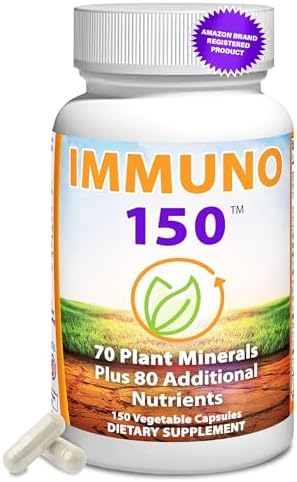
- Everything Your Body Needs: Immuno 150 is a convenient and affordable, all-in one complete mineral and vitamin complex for all age groups that includes 70 minerals with 80 nutrients that promote energy, immunity, and optimal vitality. 30 servings per bottle.
- Plant-Sourced Essential Minerals: Contains 70 hydrophilic minerals for vital building blocks, plus Omega 3-6-9 EFAs, CoQ10 and more to support joints, vision, and circulatory wellness, creating a strong foundation for overall well-being.
- Antioxidant Power for Immune Support: Vitamins A, C, and E support immune function, while 9 antioxidant superfruits combat free radicals. High ORAC Antioxidant Value of 42,000+ offers enhanced oxidative protection
- Focused Nutrients for Targeted Wellness: CoQ10 supports cellular renewal, lutein and lycopene support vision, while Vitamin B12 aids in supporting the brain and liver. Amino acids support protein metabolism.
It is also important not to treat broad nutritional or immune-support marketing as proof that the finished product prevents illness. Immuno 150 contains nutrients involved in normal physiological and immune function, but that is different from showing that this particular combination reduces infections, prevents colds, or shortens illness.
What Is Actually in Immuno 150?
The current formula is much broader than a typical immune-support supplement. A five-capsule serving provides substantial amounts of several vitamins and minerals, including 500 mg vitamin C, 30 mcg vitamin D, 24 mg zinc, 40 mg niacin as niacinamide, 60.3 mg vitamin E, and 600 mcg vitamin B12.
It also supplies 1,125 mcg vitamin A, 9 mg each of thiamin, riboflavin, and vitamin B6, 667 mcg DFE folate, 300 mcg biotin, 50 mg pantothenic acid, 100 mcg selenium, 1 mg copper, 2 mg manganese, 200 mcg chromium, 100 mg potassium, and smaller amounts of calcium and magnesium.
Those disclosed nutrients are the easiest part of the formula to assess because their quantities are stated directly. The harder part is interpreting the numerous additional ingredients bundled into multi-ingredient complexes.
The Less Transparent Part of the Formula
Immuno 150 includes a 600 mg SenTraMin plant-mineral ingredient, 500 mg psyllium husk, 200 mg D-ribose, and a 150 mg Amino Acid Complex containing multiple amino acids.
It also contains a 60 mg Super Fruit Antioxidant Complex with ingredients such as elderberry extract, cranberry extract, pomegranate, aronia berry, maqui berry, acai extract, mangosteen, goji berry, and noni.
A separate 35 mg antioxidant complex includes aloe vera concentrate, lycopene, lutein esters, and CoQ10. The 31 mg Herbal Complex contains a much longer list that includes turmeric, milk thistle, green tea extract, ginkgo biloba, grape seed extract, Korean ginseng, eleuthero, white willow bark, cat’s claw, royal jelly, and several others.
The limitation is straightforward: 31 mg is shared across numerous herbal ingredients, and 60 mg is shared across numerous fruit ingredients. Because the individual amounts are not disclosed, you cannot reliably compare a specific herb in Immuno 150 with the dose used in a study or with the amount supplied by a dedicated single-ingredient supplement.
That does not mean the blends are useless. It means the label does not provide enough information to make confident dose-specific claims about most of those components.
How Strong Is the Evidence Behind the Formula?
The strongest evidence case for Immuno 150 comes from treating its disclosed vitamins and minerals as nutrients, not from treating the entire product as a proven immune treatment.
Vitamin C, vitamin D, zinc, selenium, and several other nutrients are involved in normal physiological functions, including aspects of immune function. That establishes why adequate intake matters. It does not establish that consuming substantially more than the Daily Value automatically produces greater protection against respiratory illness.
For example, Immuno 150 provides 500 mg of vitamin C per serving. According to vitamin C intake and safety guidance from the NIH Office of Dietary Supplements, vitamin C is an essential nutrient, but high intake should not be interpreted as a guarantee of extra resistance to illness.
This distinction matters because supplement reviews often make a reasoning error: they move from “this nutrient plays an important role in the body” to “therefore this product will prevent illness.” Those are not the same claim.
High Daily Value Does Not Automatically Mean Better Results
Several nutrients in Immuno 150 are supplied at well over 100% of the Daily Value. Vitamin B12, for example, is listed at 25,000% of the Daily Value. Vitamin E is listed above 400%, and vitamin C above 500%.
Those numbers can look impressive on a label, but percentage Daily Value is not a performance score. A higher percentage does not by itself mean stronger immunity, more energy, or a better supplement.
The more useful question is whether you have a reason to consume that amount and whether it overlaps with nutrients you are already getting from food, fortified products, or other supplements.
What the Evidence Does Not Prove About Immuno 150
No independently verified finished-product clinical evidence was established here showing that Immuno 150 prevents colds, reduces infection frequency, shortens respiratory illness, or produces broad clinical benefits from the full combination.
That distinction becomes especially important with the botanical blends. Research on one isolated ingredient cannot automatically be transferred to a commercial formula containing a small undisclosed amount of that ingredient alongside many others.
The National Center for Complementary and Integrative Health makes this broader point in its dietary supplement evidence and safety guidance: products used in research may differ from products sold commercially, and supplement ingredients can vary in dose, formulation, and combination.
For Immuno 150, this means evidence about vitamin C, zinc, elderberry, green tea, turmeric, ginseng, or another individual ingredient should not be presented as proof that the finished five-capsule formula produces the same outcome.
It also means the lack of finished-product evidence should not be exaggerated in the opposite direction. It does not prove the product is ineffective. It simply limits how confidently anyone can claim what the complete formula does beyond supplying the nutrients and ingredients listed on the label.
Formula Transparency and Dose Quality
Immuno 150 has two very different levels of transparency.
The vitamin and mineral portion is relatively straightforward because specific amounts are provided. You can see that a serving contains 500 mg vitamin C, 24 mg zinc, 40 mg niacinamide, 30 mcg vitamin D, 100 mcg selenium, and the other listed nutrients.
The fruit, antioxidant, amino-acid, and herbal complexes are harder to judge because individual component amounts are not shown.
| Formula Area | What You Can Evaluate | Main Limitation |
|---|---|---|
| Vitamins and minerals | Individual quantities and Daily Values | Still need to consider total intake from other sources |
| Amino Acid Complex | 150 mg total blend amount | Individual amino-acid amounts are not disclosed |
| Super Fruit Antioxidant Complex | 60 mg total and ingredient list | Individual fruit/extract quantities are unknown |
| Anti-Aging Antioxidant Complex | 35 mg total and ingredient list | Individual ingredient quantities are unknown |
| Herbal Complex | 31 mg total and long botanical list | Cannot determine meaningful dose of each herb |
This is one of the biggest factors in the buying decision. If you mainly want vitamins and minerals, the disclosed portions can be evaluated fairly well. If the long botanical list is a major reason you are considering the product, the lack of individual doses makes that part of the formula much harder to assess.
Safety, Side Effects, and Supplement Stacking
For a broad formula like Immuno 150, the biggest practical safety question is not simply whether each ingredient appears commonly in supplements. It is what your total daily intake looks like once food, fortified products, medications, and other supplements are included.
Zinc Deserves a Total-Intake Check
Immuno 150 provides 24 mg zinc per serving. NIH zinc intake and upper-limit guidance lists an adult upper intake level of 40 mg per day from total intake.
The 24 mg in Immuno 150 is therefore below that adult upper limit by itself. The concern is stacking. Someone who also uses a zinc lozenge, separate zinc supplement, or another high-potency multivitamin could move much closer to or above that level.
Niacin Is a More Noticeable Label Issue
The formula provides 40 mg niacin as niacinamide. NIH supplemental niacin upper-limit guidance lists an adult upper limit of 35 mg per day for supplemental niacin.
That does not mean 40 mg of niacinamide automatically causes toxicity. Niacinamide also differs from nicotinic acid in its tendency to cause flushing. But the amount is high enough that it deserves attention, especially if another supplement also contains niacin.
Vitamin C Is High but Below the Adult Upper Limit by Itself
The 500 mg vitamin C serving is well above typical adult daily requirements but below the adult upper intake level of 2,000 mg per day when considered on its own. Higher total vitamin C intake can cause gastrointestinal symptoms in some people, so combining multiple high-dose sources may not add practical value.
The Long Botanical List Adds Complexity
Immuno 150 contains numerous herbal and plant-derived ingredients in relatively small blends. Because the individual doses are not disclosed, it is difficult to quantify product-specific interaction risk for each botanical.
That is a good reason for people who use prescription medications, take several supplements, are preparing for surgery, are pregnant or breastfeeding, or are managing a significant health condition to review the full ingredient list with a qualified clinician or pharmacist before use.
A broad ingredient list should not be assumed to be harmless simply because many components are plant-derived.
Who Immuno 150 May Suit — and Who May Want to Skip It
The most useful way to judge Immuno 150 is to decide which side of the convenience-versus-control tradeoff you fall on.
| Decision | Who Fits | Why |
|---|---|---|
| Consider | You want one broad multinutrient formula and are comfortable taking five capsules daily. | The product consolidates many nutrients and other ingredients into one routine. |
| Consider carefully | You already use one or more supplements. | Zinc, niacin, vitamin C, vitamin D, vitamin E, selenium, and other nutrients can overlap. |
| Skip | You want fully disclosed botanical doses. | Several complexes list total blend weights rather than individual amounts. |
| Skip | You only want one or two specific nutrients. | A broad five-capsule formula adds many ingredients you may not need. |
| Skip | You expect a supplement proven to prevent colds or flu. | Finished-product evidence supporting that expectation was not established. |
A Practical Six-Step Buying Check
- Check what you already take. Compare Immuno 150 with your multivitamin, fortified foods, zinc products, vitamin D, B-complex supplements, and other overlapping products.
- Look at the disclosed doses first. Pay particular attention to zinc and supplemental niacin rather than being distracted by the total ingredient count.
- Separate disclosed nutrients from blends. Do not assume that every botanical on the label is present in a substantial amount.
- Keep expectations realistic. Supplying nutrients is not the same as proving prevention or treatment of illness.
- Decide how much convenience matters. Five capsules may be reasonable for someone who wants an all-in-one product but unnecessary for someone who prefers a minimal routine.
- Compare the cost with what you actually need. A targeted approach can make more sense if you are only trying to address one or two nutritional gaps.
How It Compares With Simpler Immune-Support Options
The main alternative to Immuno 150 is not necessarily another supplement with an equally long ingredient list. For many buyers, the more relevant comparison is a simpler multivitamin/mineral formula or a targeted approach based on specific nutritional needs.
A simpler formula can make it easier to see exactly how much of each nutrient you are taking. It also gives you more control over dose stacking and makes it easier to adjust individual nutrients when dietary intake, laboratory testing, or professional guidance indicates a specific need.
Immuno 150 takes the opposite approach. It favors breadth and convenience. That can appeal to someone who wants one bottle covering many nutritional categories, but it also means accepting ingredients you may not specifically need and less transparency for several botanical blends.
Neither approach is automatically better. The deciding factor is whether you value an extensive all-in-one formula more than precise dose control.
Price, Value, and Buying Considerations
One bottle contains 150 capsules, but because the serving is five capsules, it represents a 30-day supply at the listed serving size.
The product has been positioned around the price range of a premium multinutrient supplement rather than a basic multivitamin. Exact Amazon pricing can change, so the useful comparison is not a fixed dollar figure but what you receive for one month of use.
If you genuinely want the broad formula, the price may be easier to justify because one product replaces the need to purchase several categories separately. If you only care about a few core nutrients, much of the ingredient breadth may have little practical value to you.
Before buying, you can check the current Immuno 150 listing for current availability and purchasing terms.
Also check the seller and return conditions before ordering. Amazon’s supplement return rules and any separate manufacturer money-back policy should not be assumed to be identical.
Final Verdict: Is Immuno 150 Worth It?
Immuno 150 is a legitimate broad multinutrient product with a clearly disclosed core vitamin and mineral formula, but that does not make it a proven illness-prevention supplement.
Its strongest case is convenience. A single daily serving supplies many vitamins, minerals, plant-derived ingredients, amino acids, fruit extracts, and botanicals without requiring several separate bottles.
Its biggest weaknesses are equally clear: five capsules per serving, substantial amounts of several nutrients, potential overlap with other supplements, and limited dose transparency for many of the ingredients that make the label look distinctive.
Consider Immuno 150 if you specifically want a broad all-in-one formula, understand what you are already getting from other supplements, and are comfortable with the undisclosed individual doses inside several complexes.
Skip it or choose something simpler if you want precise control over individual nutrients, already take a high-potency multivitamin, prefer fewer capsules, or are mainly buying it because you expect the long ingredient list to prevent colds or other illnesses.
The better buying decision is not based on whether 150 ingredients sound impressive. It is whether this particular combination solves a nutritional problem you actually have without adding unnecessary dose overlap or uncertainty.
Frequently Asked Questions
What is actually in Immuno 150?
Immuno 150 contains a broad multivitamin and mineral base plus plant minerals, psyllium, D-ribose, amino acids, fruit extracts, antioxidant ingredients, botanicals, choline, inositol, bioflavonoids, and other compounds. The current five-capsule serving includes 500 mg vitamin C, 30 mcg vitamin D, 24 mg zinc, and 40 mg niacinamide.
How many Immuno 150 capsules are taken per serving?
The current serving size is five capsules. A 150-capsule bottle therefore provides 30 servings.
Does Immuno 150 disclose the amount of every herb?
No. The product discloses the total weight of several complexes, but not the individual amount of every ingredient inside them. For example, the Herbal Complex totals 31 mg across numerous botanicals.
Does Immuno 150 contain echinacea or Andrographis?
Neither echinacea nor Andrographis appears on the current verified active-ingredient list reviewed for this formula. Elderberry is present within the Super Fruit Antioxidant Complex, but its individual dose is not disclosed.
Does the vitamin C in Immuno 150 mean it can prevent colds?
No. Vitamin C is an essential nutrient and supports normal physiological functions, including immune function, but its presence in Immuno 150 does not establish that the finished product prevents colds or other respiratory infections.
Is 24 mg of zinc a high amount?
It is a substantial supplemental amount but remains below the adult upper intake level of 40 mg per day by itself. The more important issue is total zinc intake from food and any other supplements you use.
Can Immuno 150 be taken with another multivitamin?
Combining it casually with another high-potency multivitamin is not ideal because several nutrients may overlap. Compare the labels carefully, especially for zinc, niacin, vitamin C, vitamin D, vitamin E, selenium, and other nutrients supplied in both products.
Why does the 40 mg niacin amount matter?
Immuno 150 provides 40 mg niacin as niacinamide, while the adult upper intake level for supplemental niacin is 35 mg per day. That does not mean the product automatically causes harm, but it is a good reason to check how much additional niacin you receive from other supplements.
Is Immuno 150 worth the price?
It is easier to justify if you specifically want a broad all-in-one supplement and value convenience. It is harder to justify if you only need a few nutrients, prefer fully disclosed botanical doses, or already take overlapping supplements.
Where can Immuno 150 be purchased?
The product has an active Amazon listing. Because pricing, seller conditions, availability, and return terms can change, check the current listing rather than relying on a fixed price quoted elsewhere.


Don’t Miss These Picks