
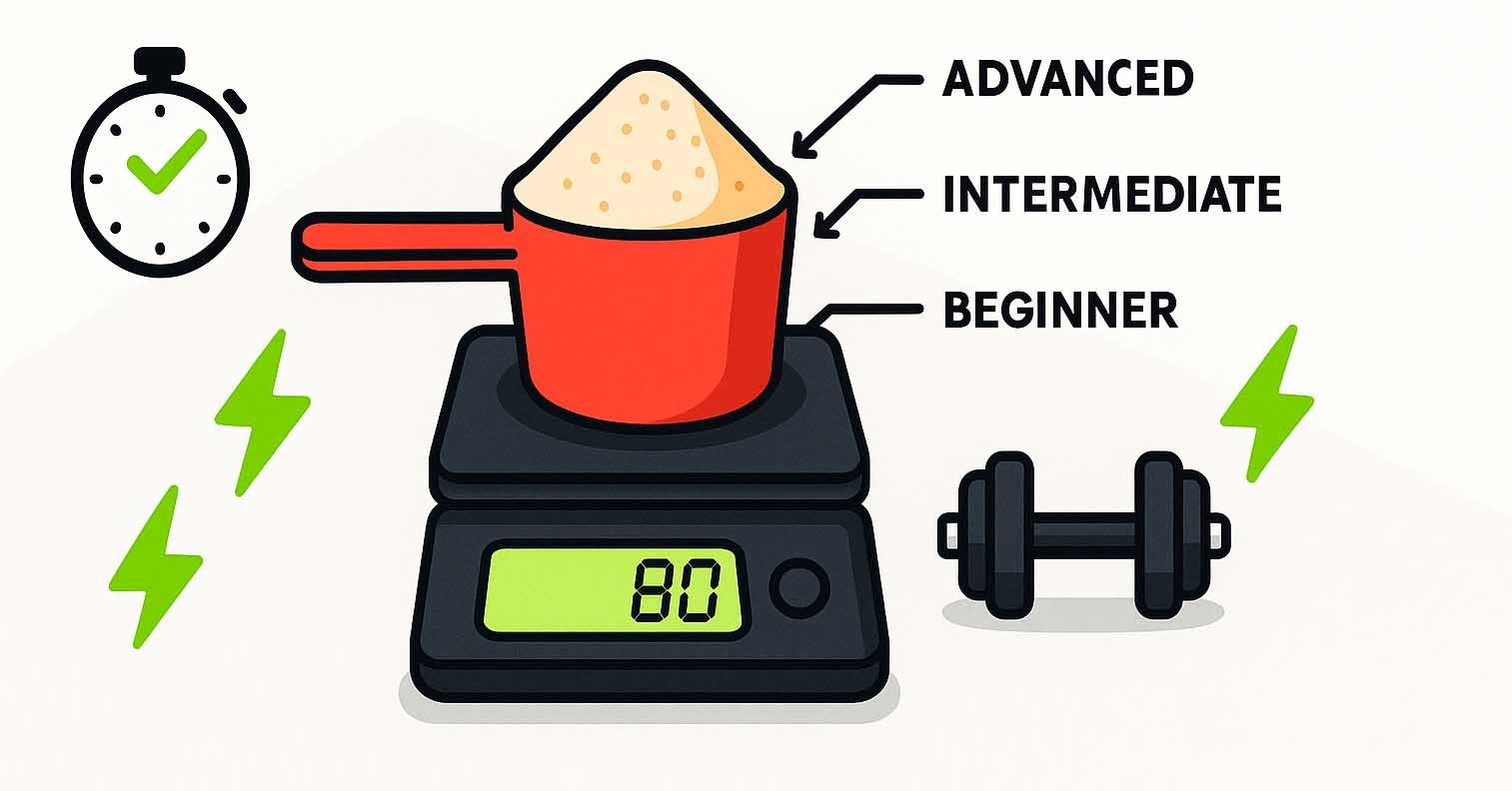

There is no universal “perfect scoop” of pre-workout. One scoop can contain very different amounts of caffeine and other ingredients depending on the product, so the number of scoops matters less than what that serving actually contains.
Start by reading the labeled serving size and the caffeine amount per serving. Then account for coffee, energy drinks, medications, and other caffeine you have consumed that day. Your sensitivity to stimulants, workout time, health considerations, and the manufacturer’s directions should also shape the decision.
In some cases, less than a full serving may be reasonable if the label allows it, especially when you are unfamiliar with a stimulant-based formula. What you should not do is increase the serving simply because another person uses more, because you have a harder workout planned, or because a research study used a higher caffeine dose.
What Does “One Scoop” of Pre-Workout Actually Mean?
A scoop is simply the measuring tool included with that particular product. It is not a standardized unit across the supplement industry.
One brand might define a serving as one scoop weighing several grams, while another formula could use a different scoop size and a very different concentration of caffeine and other ingredients. Two scoops that look similar can therefore deliver very different amounts of stimulants.
That is why the Supplement Facts panel matters more than the physical scoop. Look for the serving size in grams, the number of scoops that make up one serving, and the listed amounts of individual ingredients.
If the product says that one serving equals one scoop, that applies only to that specific formula. It does not mean one scoop is an appropriate serving for another pre-workout.
How to Read a Pre-Workout Label Before Taking It
The most useful place to start is the caffeine line. Caffeine is often responsible for much of the noticeable energy and stimulation people associate with pre-workout, and it is also one of the ingredients most likely to cause unwanted effects when intake becomes too high for the individual.
The FDA’s guidance on caffeine intake cites 400 mg per day as an amount not generally associated with negative effects for most adults. That figure applies to total daily caffeine intake, not to a recommended pre-workout dose, and it does not mean 400 mg before exercise is appropriate for everyone.
Count caffeine from all sources, including coffee, tea, energy drinks, soft drinks, other supplements, and some medications. Individual sensitivity also varies considerably, so someone can experience unpleasant effects well below a general population-level daily amount.
Next, look beyond caffeine. A transparent label that lists individual ingredient quantities is more useful for evaluating what you are taking than a blend that hides several ingredients behind one combined total. Even then, listed amounts need context. Different ingredients work in different ways, and a larger number on the label does not automatically mean a better formula.

Pre-Workout Serving Decision Framework
Instead of asking, “Should I take half a scoop or a full scoop?” work through these five checks.
1. Check the Labeled Serving
Find the manufacturer’s serving size, preparation directions, and maximum-use instructions. Confirm whether one serving equals one scoop, multiple scoops, or a specific weight in grams.
Do not exceed the labeled maximum in an attempt to match a dose you saw in a study or another person’s routine.
2. Check Caffeine Per Serving
Identify the amount of caffeine in the serving you plan to use. This is especially important with concentrated stimulant formulas, where one serving can account for a large portion of a person’s total daily caffeine intake.
Exercise research sometimes uses caffeine according to body weight. The NIH review of exercise-performance supplements notes that research often uses roughly 2–6 mg of caffeine per kilogram of body weight. The ISSN position stand on caffeine and exercise also discusses performance benefits in body-mass-relative ranges.
Those research doses should not be converted into a scoop calculator for commercial pre-workouts. A multi-ingredient product has its own labeled serving limit, and increasing scoops increases every ingredient in the formula, not just caffeine.
3. Add Other Caffeine and Stimulants
A pre-workout serving does not exist in isolation. If you have already had coffee, an energy drink, or another stimulant-containing supplement, that exposure still counts.
This can make a serving that normally feels manageable produce more jitters, nausea, anxiety, palpitations, or sleep disruption on another day.
4. Consider Your Sensitivity and Health Factors
People respond differently to caffeine. Regular caffeine use, medications, medical conditions, pregnancy, breastfeeding, and individual sensitivity can all affect what amount is appropriate.
If you have a relevant medical condition, take medications that may interact with stimulants, are pregnant, trying to become pregnant, or breastfeeding, discuss caffeine and pre-workout use with a health professional rather than relying on a generic scoop recommendation.
5. Consider Workout Timing
Caffeine is commonly consumed before exercise because its stimulant effects can support alertness and performance in some people. Research often studies caffeine taken within roughly an hour before exercise, although the best timing depends on the caffeine source and formulation.
Timing also matters because caffeine taken later in the day can interfere with sleep. If an evening pre-workout helps one session but makes it harder to sleep afterward, the tradeoff may not be worthwhile.

What Common Pre-Workout Ingredients Actually Tell You
Pre-workout formulas often combine several ingredients with different evidence, timing, and dosing patterns. They should not all be judged by asking whether a single scoop contains a supposedly “perfect” acute dose.
Caffeine
Caffeine can improve several aspects of exercise performance, but responses vary. Higher intake does not necessarily create greater benefit, and larger doses can increase the likelihood of adverse effects.
The practical question is not how much caffeine you can tolerate. It is whether the amount in the product fits your total intake, sensitivity, training time, and reason for using it.
Beta-Alanine
Beta-alanine is commonly associated with a tingling sensation called paresthesia. That sensation does not prove that the product is producing a better workout.
More importantly, beta-alanine research generally involves repeated daily supplementation over several weeks rather than expecting one pre-workout dose to create the full training benefit immediately. The NIH review describes research using daily intake across a range of doses and durations.
That means a pre-workout should not automatically be judged ineffective simply because one scoop does not contain an arbitrary single-dose threshold.
Creatine
Creatine also works differently from a stimulant. Its benefits are associated with consistent supplementation and increased muscle creatine stores rather than needing to be consumed immediately before every workout.
The NIH review describes commonly used maintenance amounts around 3–5 grams per day after loading, along with protocols that build stores gradually without a loading phase.
If your pre-workout contains creatine, consider how it fits your total daily creatine intake rather than assuming that taking more pre-workout is the way to reach a creatine target.
Citrulline
Citrulline is frequently marketed for blood flow, “pump,” and exercise performance, but the evidence is less straightforward than many supplement labels suggest. The NIH describes the research as limited and conflicting.
Some studies use several grams before exercise, but that does not support claims that a certain amount always produces a noticeable pump, better endurance, or improved recovery.

When Might Less Than a Full Serving Make Sense?
A reduced serving can be a reasonable conservative approach when the product directions permit it and you have already checked the ingredient amounts.
This may be particularly relevant when you are trying an unfamiliar stimulant formula, know that you are sensitive to caffeine, have already consumed caffeine that day, or are training late enough that a full serving could interfere with sleep.
There is no universal rule that everyone must begin with exactly half a scoop. Half of one product might still contain more caffeine than a full serving of another. The better approach is to calculate what the reduced serving actually provides.
Likewise, a more demanding workout is not automatically a reason to take more. Increasing scoops can simultaneously increase caffeine, beta-alanine, sweeteners, and every other ingredient in the formula.
Signs Your Pre-Workout Serving May Be Too High
Unwanted stimulant effects can include:
- Jitters or trembling
- Anxiety or unusual nervousness
- Rapid or pounding heartbeat
- Palpitations
- Nausea or stomach upset
- Headache
- Dizziness
- Difficulty sleeping
The FDA notes that excessive caffeine can contribute to increased heart rate, palpitations, high blood pressure, insomnia, anxiety, jitters, nausea, upset stomach, and headaches.
If a particular serving repeatedly causes unwanted effects, the answer is not to keep using the same amount until your body “gets used to it.” Reconsider the serving, the timing, your total caffeine intake, or whether that product is a good fit at all.
What to Do If You Take Too Much Pre-Workout
Stop taking more of the product and avoid adding additional caffeine or stimulants.
Do not assume that potentially serious symptoms can be treated simply by drinking water, eating, or walking around. Poison Control’s guidance on pre-workout and dry scooping recommends individualized poison-control guidance when unwanted symptoms occur after exposure.
In the United States, webPOISONCONTROL or a poison center can help determine the appropriate next step based on the product, dose, timing, symptoms, age, and other factors.
Chest pain, significant breathing difficulty, seizures, collapse, severe or persistent cardiovascular symptoms, or other serious symptoms warrant urgent medical evaluation.
Why You Should Avoid Dry Scooping
Dry scooping means swallowing pre-workout powder without first mixing it as directed. It can create choking and inhalation risks and may expose you rapidly to a concentrated amount of stimulants and other ingredients.
Follow the product’s mixing and preparation instructions instead. Taking the powder dry does not provide a safety or performance advantage that justifies the added risk.

Do You Need to Cycle Pre-Workout?
There is no verified universal rule requiring everyone to use pre-workout for six to eight weeks and then stop for one or two weeks to “reset adrenal receptors.” That explanation should not be treated as established physiology.
Caffeine tolerance, dependence, and withdrawal can occur, but habitual use does not automatically eliminate the performance effect of caffeine. A systematic review and meta-analysis of habitual caffeine use found that habitual intake did not significantly change the overall ergogenic effect of acute caffeine supplementation across the included studies.
If you find yourself continually increasing stimulant intake because the original effect feels weaker, that is a good reason to reassess your caffeine habits rather than automatically adding more scoops. People who want to reduce regular caffeine intake may find gradual reduction more comfortable because withdrawal symptoms can be unpleasant.
Who Should Be Extra Cautious With Pre-Workout?
Extra caution is appropriate if you are highly sensitive to caffeine, already consume substantial caffeine from other sources, regularly train close to bedtime, have a medical condition affected by stimulants, or take medications that could interact with them.
Pregnancy, trying to become pregnant, and breastfeeding also change the context for caffeine use. FDA guidance recommends discussing individual caffeine limits and relevant health considerations with a health professional.
And not everyone needs a pre-workout supplement. If you already feel alert enough to train, adding a stimulant is optional rather than a requirement for an effective workout.
Frequently Asked Questions
Is One Scoop Always One Serving?
No. A scoop is specific to the product that comes with it. Check the label for the serving size in scoops and grams, because formula concentration and scoop volume differ between brands.
Should Body Weight Determine How Much Pre-Workout I Take?
Not by itself. Body weight is used in caffeine-performance research, but that does not mean a heavier person should automatically take more scoops of a multi-ingredient pre-workout. The product’s labeled serving and maximum, caffeine content, sensitivity, and total stimulant exposure remain more useful consumer safeguards.
Should a Beginner Automatically Start With Half a Scoop?
Not automatically. First check the product’s serving directions and caffeine amount. If the manufacturer allows a smaller serving and you are unfamiliar with the formula or sensitive to stimulants, using less than a full serving can reduce your initial exposure.
How Long Before Training Should I Take Pre-Workout?
Many caffeine studies use intake roughly 15–60 minutes before exercise, and around 60 minutes is common in the literature. However, timing depends on the formulation, caffeine source, and manufacturer’s directions. Consider sleep timing as well as workout timing.
Can I Take Pre-Workout on an Empty Stomach?
There is no strong reason to recommend fasting as universally better. Some people may experience stronger or less comfortable effects when taking stimulant products without food. Follow the label and pay attention to your own tolerance rather than using an empty stomach to intensify the effect.
Is It Okay to Take Pre-Workout Every Training Day?
There is no single schedule that is appropriate for everyone. Consider your total caffeine use, sleep, sensitivity, side effects, medications, health conditions, and whether you actually need the stimulant on each training day. There is also no evidence-based requirement for a fixed six-to-eight-week cycling schedule.
Final Takeaway
The safest way to decide how much pre-workout to take is to stop thinking in terms of a universal number of scoops. Read the serving size, identify the caffeine and other ingredient amounts, count your caffeine from the rest of the day, and consider your sensitivity, health factors, and workout timing.
If the label permits a smaller serving, using less can be a reasonable option when you want to limit stimulant exposure. Taking more simply because you are larger, training harder, or trying to reproduce a research dose is a poor substitute for reading the actual formula.
The right serving is the one that stays within the product’s directions and makes sense in the context of your total stimulant exposure and individual risk factors—not the biggest scoop you can tolerate.