
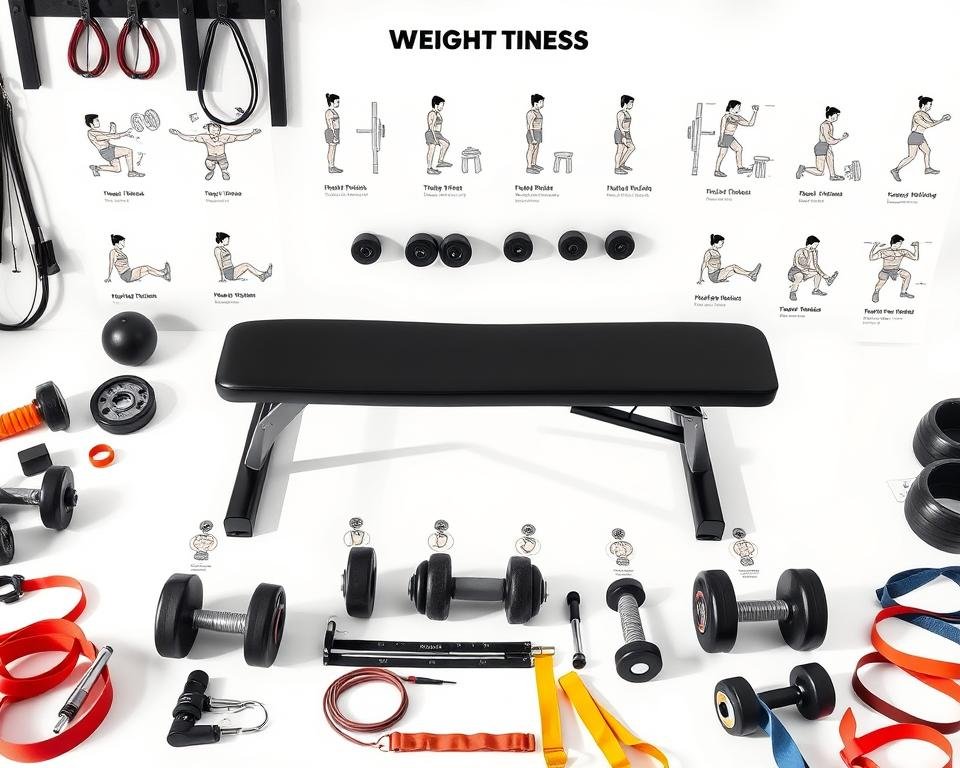

A weight bench and a pair of dumbbells can support a practical full-body home strength routine. A workout poster can make that routine easier to remember by keeping exercise options visible, but the poster itself is not the program. Results still depend on choosing appropriate movements, using suitable resistance, training consistently, and gradually increasing the challenge over time.
The most useful way to use a weight-bench exercise poster is as a reference, not as a substitute for instruction. Instead of trying to perform every exercise printed on the wall, build a smaller routine around a few movement categories, repeat those exercises long enough to track progress, and use the poster when you need a reminder or want to review other options.
Key Takeaways
- A bench and dumbbells can cover pushing, pulling, lower-body, shoulder, arm, and core exercises.
- A workout poster is most useful for exercise recall and organization; it cannot assess your technique or create an individualized program.
- A balanced routine does not need dozens of exercises. Start with a push, a pull, and a lower-body movement, then add accessories when they serve a clear purpose.
- Progress comes from gradually increasing training demands, not from constantly replacing exercises with new ones.
- Bench stability, equipment limitations, exercise suitability, and controlled technique matter more than copying every position shown on a chart.
What a Weight-Bench Exercise Poster Can and Cannot Do
A wall chart solves a simple problem: remembering exercise options without reaching for your phone, opening an app, or searching through a program during a workout. For someone who already understands the movements they use, that can make a home-gym setup feel more organized.
Its limitations are just as important. A static diagram cannot see whether your bench is stable, whether a movement causes pain, whether your range of motion is appropriate, or whether the resistance is too heavy. It also cannot decide how many sets you need, when to increase the load, or whether an exercise fits your current ability.
A useful distinction is to think of the tools this way: a poster is a reminder, a program provides structure and progression, and a qualified coach or detailed demonstration can provide deeper technique guidance. Those roles overlap, but they are not interchangeable.
How to Build a Balanced Bench-and-Dumbbell Workout
The easiest mistake is treating a long exercise list as a complete workout. More choices are not automatically better. A beginner or returning exerciser often gets more value from practicing a manageable group of movements consistently than from selecting a different combination every session.
A simple framework is:
- Choose one primary push. For example, a flat or incline dumbbell press.
- Choose one primary pull. A supported dumbbell row is one option when the bench setup allows it.
- Choose one lower-body movement. This might be a squat, split-squat variation, or another dumbbell movement that does not require using the bench as an unsupported stepping platform.
- Add shoulder work if useful. A seated press or controlled raise variation can fill this role.
- Add arm or core work only if you want it. These are accessories rather than mandatory parts of every workout.
This approach gives each exercise a job. It also makes progression easier to track because the core movements remain stable from session to session instead of being replaced simply for variety.
Best Bench Exercises by Movement Type
Chest and Horizontal Push
The dumbbell bench press is one of the most straightforward ways to use a weight bench. A flat bench position gives you a stable surface for pressing, while an adjustable bench may allow incline variations if the manufacturer designed it for those positions.
Keep the weight controlled and use a range of motion that feels appropriate for your shoulders and current mobility. There is no single elbow angle or grip that must be copied by every person. If you need a visual demonstration for an individual dumbbell movement, ACE’s dumbbell exercise library provides exercise-specific setup examples.
Back and Pulling
Rows help balance pressing work by adding a pulling movement. Depending on the exercise, the bench can provide hand, knee, chest, or seated support. The goal is not to chase the largest possible range of motion; it is to control the dumbbell through a range you can manage without losing your position.
If a poster shows several row variations, you do not need all of them in one workout. Pick one that fits your bench, available space, mobility, and current strength level, then keep it long enough to judge whether you are progressing.
Shoulders
An adjustable bench may support seated dumbbell presses, while lateral or front raises usually require little more than dumbbells and enough space to move safely. Shoulder exercises are useful additions, but they do not have to dominate the workout if pressing movements already provide substantial upper-body work.
A poster can remind you of variations, but avoid assuming that the exact arm path shown in a small diagram is the only acceptable technique. Individual comfort, joint position, equipment setup, and controlled execution still matter.
Lower Body
Dumbbells can be used for squats, split squats, lunges, Romanian deadlift variations, and other lower-body movements. The bench may sometimes serve as support for certain exercises when that use is consistent with the manufacturer’s instructions.
Do not automatically use a typical weight bench as a step-up platform. A lifting bench may be designed to support seated or lying loads rather than repeated stepping. If an exercise requires stepping onto an elevated surface, use equipment intended for that purpose unless your bench manufacturer specifically permits the use.
Arms and Core as Optional Accessories
Curls, triceps extensions, and similar arm exercises can be added after the primary movements. Core work can also be included, but there is no requirement to finish every workout with several isolation exercises simply because they appear on the poster.
For many home routines, three to five well-chosen movements are more useful than trying to cover every body part with multiple variations in a single session.
How to Progress Without Constantly Changing Exercises
Progressive resistance training means gradually increasing the training demand over time. That does not require changing the exercise every few weeks. In fact, keeping several core movements stable can make progress easier to measure because you can compare repetitions, load, sets, and technique quality from one session to the next.
A simple progression method is to choose a repetition range you can perform with controlled technique. When the current load becomes easier and you can complete the planned repetitions comfortably, you can consider adding a small amount of resistance, adding repetitions within your target range, adding a set, or using another appropriate way to make the exercise more demanding.
Resistance-training guidance from the American College of Sports Medicine supports regular, progressive resistance training while recognizing that programs should be adapted to individual goals, abilities, preferences, and safety considerations. That is a better framework than following a rigid rule that every reader must change exercises after a fixed number of weeks.
Keep technique quality in the decision. If increasing the load causes you to shorten the movement dramatically, lose control, or change your position just to finish the repetitions, the increase may be premature.
Sample Beginner-Friendly Weekly Structure
A beginner does not need a complicated body-part split. Two or three full-body sessions can provide a simple starting structure, depending on the person’s schedule, training history, recovery, and other activity.
A basic session could look like this:
- One dumbbell press variation
- One dumbbell row variation
- One lower-body movement
- One optional shoulder exercise
- One optional arm or core exercise
Another session can use the same structure with small changes only when they serve a purpose. For example, one day might use a flat press and another an incline press if the bench is designed for it. The important point is that the routine remains recognizable enough for you to track what is improving.
The U.S. physical activity guidelines recommend muscle-strengthening activity for adults on at least two days per week as broad public-health guidance. That does not mean every person needs the same number of exercises, sets, or repetitions, but it provides useful context for making resistance training a regular part of the week.
Form, Bench Setup, and Safety Considerations
Before using the bench, check that it is positioned on a stable surface and that any adjustable components are securely set. Follow the manufacturer’s instructions for intended positions, load limits, and permitted uses.
Choose exercises that fit your current ability rather than forcing your body into the exact position shown on a poster. Range of motion, grip, bench angle, and stance can differ between people. Controlled movement and an appropriate resistance matter more than copying a diagram precisely.
If a movement causes sharp pain, unusual joint discomfort, dizziness, or symptoms that make training feel unsafe, stop the exercise rather than trying to push through it. A structured program or qualified professional can be more useful than a wall chart when you are unsure which movements are appropriate for you.
How to Choose a Useful Weight-Bench Exercise Poster
More exercises do not necessarily make a poster more useful. A crowded wall chart may offer dozens of variations while making the movements you actually perform harder to find. Look for a layout that matches the equipment you own and the type of routine you plan to follow.
A practical poster-selection checklist includes:
- Relevant exercise coverage: It should include movements you can actually perform with your dumbbells, bench, and available space.
- Clear organization: Exercises should be easy to locate without scanning a cluttered wall of information.
- Appropriate physical size: Make sure the poster fits the wall space where you plan to use it.
- Durable format: Lamination or another durable finish can make sense in a frequently used workout area.
- Useful rather than excessive variety: A poster should support your routine, not encourage random exercise changes every session.
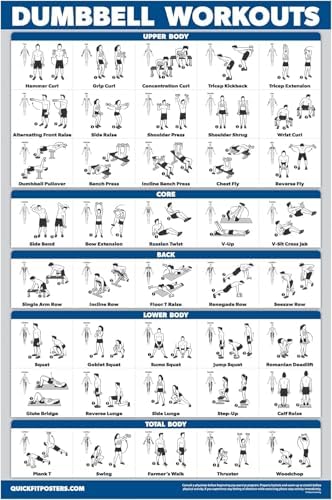
One current example is the Palace Learning Dumbbell Workout Exercise Poster. It is listed as an 18 x 24-inch laminated dumbbell exercise chart with 3 MIL lamination and a tear-resistant format. Those features make it relevant to someone specifically looking for a physical wall reference rather than another app or digital program.
Its value is primarily convenience. A chart mounted near your workout space can keep exercise ideas visible without requiring you to search for them between sets. That may suit someone who already understands the exercises in their routine and simply wants a faster way to recall options.
The limitation is instructional depth. A static wall chart has little room for explaining exercise regressions, individual range of motion, programming decisions, load progression, or technique adjustments. It should therefore be treated as a reference alongside an established routine, not as evidence that every displayed movement is appropriate for you.
If that type of physical reference fits your setup, you can view the Palace Learning Dumbbell Workout Exercise Poster on Amazon. Someone already using a structured app, written program, or trainer-created plan may not gain much from adding another exercise list.
- High-quality 3 MIL lamination for added durability
- Tear Resistant
- 18"x24"
When a Poster Is Not Enough
A wall chart works best when the reader already knows how to perform the exercises being referenced. If you are learning an unfamiliar movement, a detailed written explanation or video demonstration can provide more information than a single illustration.
A structured program is more useful when your main problem is deciding how many sets to perform, how often to train, how to progress, or how to balance exercises over several weeks. A poster can remind you that a row exists; it cannot decide whether that row belongs in your current program.
Qualified coaching becomes more valuable when you need individualized technique feedback, exercise modifications, help working around physical limitations, or guidance about whether a particular movement is suitable.
Frequently Asked Questions
Can a bench and dumbbells provide a full-body workout?
Yes. Dumbbells and a suitable bench can support pushing, pulling, shoulder, lower-body, arm, and some core exercises. You do not need to perform every possible variation to build a balanced routine.
How many exercises should a beginner choose?
A small group is usually easier to learn and track than a long list. One push, one pull, one lower-body movement, plus one or two optional accessory exercises can create a practical starting structure.
Do I need to change exercises every few weeks?
No fixed schedule is necessary for everyone. If an exercise is comfortable, appropriate, and still allowing measurable progress, there is no need to replace it merely because a certain number of weeks has passed.
How do I choose the right dumbbell weight?
Choose a load that allows you to complete your planned repetitions with controlled technique. If the weight forces you to lose control, dramatically shorten the movement, or prevents you from completing your intended minimum repetitions, reduce the load.
Does a workout poster replace a training program?
No. A poster can help you remember exercises, while a program determines how those exercises are organized, repeated, progressed, and balanced over time.
Is a poster better than an app or exercise video?
They serve different purposes. A poster is convenient for quick visual reference, while an app, written program, or video can provide more detail about technique, progression, and workout structure.
Is a laminated wall chart useful if I already have a routine?
It can be if you prefer keeping exercise options visible in your training area. If your current routine is already easy to follow and you rarely need exercise reminders, a poster may add little value.
Final Takeaway
A weight-bench exercise poster can make a home-gym routine easier to reference, but the most important work happens before you look at the wall. Choose a manageable group of push, pull, and lower-body movements, add accessories only when they have a purpose, and keep those exercises stable enough to measure progress.
Use the poster for visibility and recall. Use a structured progression plan for training decisions, and seek more detailed instruction when technique or exercise suitability is uncertain. That combination turns a bench, dumbbells, and a simple exercise chart into a more useful system without expecting the poster to do a job it cannot perform.


Don’t Miss These Picks