
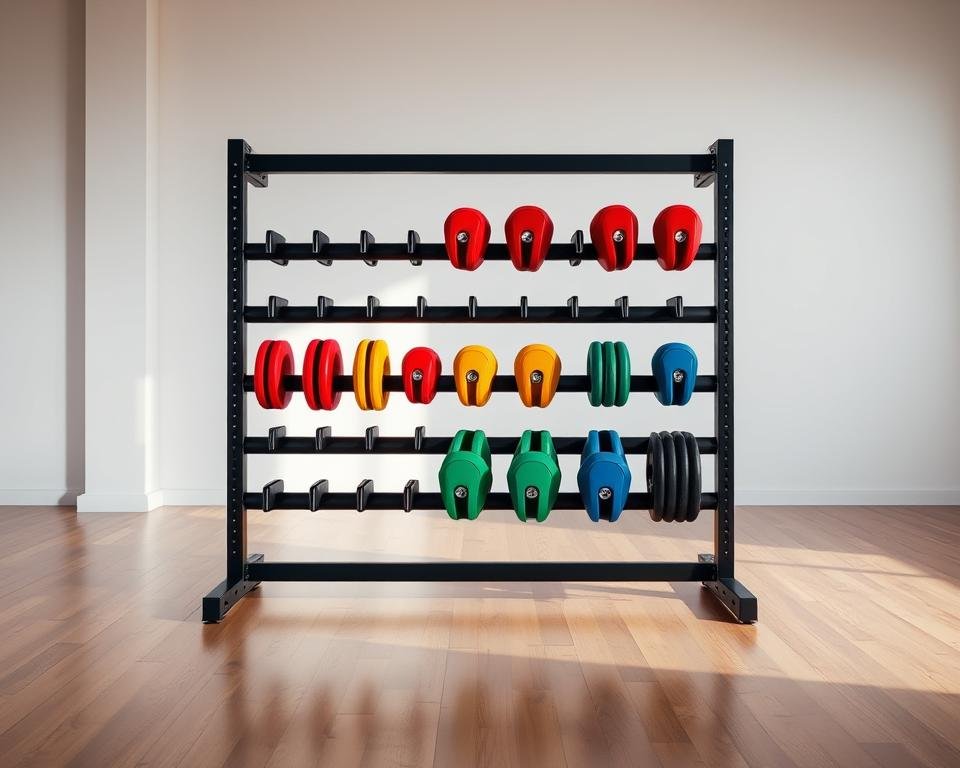

The PRx 4-Peg Weight Plate Storage makes the most sense when floor space is more valuable to you than maximum storage flexibility. Its wall-mounted design keeps Olympic plates off the floor, but the buying decision should come down to four things: your plate thickness, total plate inventory, access to a suitable wall stud, and how much you are willing to pay to reclaim floor space.
The biggest limitation is easy to overlook. Each storage peg is 8 inches long. That means thick bumper or crumb-rubber plates can use up the available peg space long before thinner iron or calibrated plates do. If you have a large bumper-plate collection, checking your actual plate thickness matters more than focusing on a large theoretical load number.
Quick Verdict
The PRx 4-Peg system is a strong fit for compact home gyms with a moderate Olympic plate collection and a suitable wall stud. It is less compelling for renters, budget-first buyers, or lifters storing a large number of thick bumper plates. You are mainly paying for floor-space recovery and an integrated wall-storage format rather than maximum plate capacity.
Key Takeaways
- PRx uses four 8-inch storage pegs arranged vertically on a wall-mounted frame.
- The manufacturer lists two 45 lb crumb-rubber plates per peg as a reference fit, or 360 lb across four pegs.
- Thinner plates may allow more individual plates to fit because physical plate thickness is often the limiting factor.
- PRx states that the unit mounts to one wall stud and includes mounting hardware.
- The product is most attractive when keeping the gym floor clear is a high priority.
- Buyers with large bumper collections, limited wall access, or a tight budget should compare other storage formats before ordering.
PRx 4 Peg Weight Storage: Product Snapshot
According to PRx’s official weight-storage specifications, the four-peg version measures 75.5 inches high, 3 inches wide, and 8.5 inches deep. The unit itself weighs 28 lb and is made from steel with a black powder-coat finish.
| Specification | PRx 4-Peg Weight Plate Storage |
|---|---|
| Storage format | Wall-mounted vertical plate storage |
| Overall size | 75.5 in H × 3 in W × 8.5 in D |
| Number of pegs | 4 |
| Peg length | 8 in |
| Peg diameter | 1.75 in |
| Plate opening | Designed for 2-inch Olympic plate openings |
| Maximum plate diameter | 18 in |
| Manufacturer reference capacity | Two 45 lb crumb-rubber plates per peg; 360 lb total |
| Mounting | One wall stud according to PRx |
| Hardware | Mounting hardware included |
| Manufacturing | Made in the USA according to PRx |
Those specifications tell you more about whether the system fits your gym than broad claims about strength or durability. In particular, the 8-inch peg length deserves more attention than most other numbers.
How Much Can It Actually Hold?
PRx lists two 45 lb crumb-rubber plates per peg as its reference fit. Across four pegs, that works out to eight 45 lb plates and 360 lb of plate weight. That is a useful manufacturer reference, but it should not be interpreted as a universal plate-count rule.
The reason is simple: plates with the same weight can have very different thicknesses. Thick crumb-rubber or bumper plates consume much more of an 8-inch peg than thin iron plates. A collection of thin plates may physically fit more individual plates on each peg even though PRx uses thick 45 lb crumb-rubber plates for its published example.
This is where buyers can make the wrong comparison. A large theoretical load number does not automatically tell you how useful a storage system will be. If the plates physically fill the peg, additional structural capacity does not help you store more of them.
A Better Capacity Check Before You Buy
Instead of asking only, “How many pounds can this hold?”, check the actual thickness of the plates you own. Compare the combined thickness of the plates you want on each level with the available 8 inches of peg length.
This is especially important if most of your collection consists of thick bumper plates. If you use thinner iron or calibrated plates, the same peg length can be much less restrictive.
Installation and Wall Requirements
PRx states that the storage system mounts to one wall stud and that mounting hardware is included. That is appealing for a tall storage system because you do not necessarily need to span several studs to position the frame.
Still, “one-stud mounting” should not be interpreted as permission to attach heavy equipment to any convenient section of drywall. Follow the current manufacturer instructions and confirm that the intended mounting location and wall structure are appropriate for the installation.
The fixed wall position is also part of the buying decision. A freestanding plate tree can be relocated when you reorganize the gym. Once a wall-mounted system is installed and loaded, changing its position involves more work.
What the PRx System Does Well
It Gives Floor Space Back to the Gym
The clearest advantage is spatial. A conventional plate tree claims a permanent footprint on the floor. The PRx system stores plates vertically against the wall, which can make a meaningful difference in a narrow garage gym, small training room, or folding-rack setup.
This matters most when floor space is already doing several jobs. If you need the same area for deadlifts, a bench, conditioning work, or moving a folding rack in and out, getting plates off the floor can be more useful than squeezing out the highest possible storage capacity.
The Four-Level Layout Keeps Plates Organized
Four separate storage positions also let you separate different plate sizes rather than stacking everything onto one post. That can make routine loading and unloading simpler, especially when several plate denominations are used frequently.
The benefit is organizational rather than transformational. A buyer with plenty of floor space may achieve equally practical storage with a less expensive freestanding option.
Where It Falls Short
Eight-Inch Pegs Can Be Restrictive for Thick Plates
The biggest limitation is physical depth. Thick bumper plates reach the end of an 8-inch peg quickly. PRx’s own reference of two 45 lb crumb-rubber plates per peg illustrates this clearly.
If your gym uses mostly thick bumpers and you have a large total plate inventory, calculate your required storage before ordering rather than assuming four pegs will accommodate everything.
It Requires Permanent Wall Placement
The wall-mounted format solves one problem by creating another constraint. You gain open floor area, but you need suitable wall access and must be comfortable drilling and mounting heavy gym equipment permanently.
This can be a poor fit for renters, frequently changing gym layouts, or rooms where the most convenient wall location does not have appropriate mounting access.
The Value Depends Heavily on Your Space
The PRx system is difficult to evaluate on price alone because much of what you are buying is the storage format. If a floor-standing rack would not interfere with your training area, paying more for wall storage may offer little practical benefit.
In a cramped gym, however, recovering even a small floor footprint can have real value. That is why the same product can feel justified in one garage and unnecessary in another.
Is It Right for Your Home Gym?
Worth It If
- You have limited floor space and keeping the training area open is a priority.
- Your Olympic plate collection is moderate rather than unusually large.
- Your plate thickness works within the 8-inch peg length.
- You have access to an appropriate wall stud at the desired storage location.
- You are comfortable with permanent wall mounting.
- You prefer one integrated vertical storage system rather than several separate plate holders.
Skip It If
- You store a large number of thick bumper or crumb-rubber plates.
- You rent or do not want to drill into the wall.
- Your available wall area does not have suitable mounting access.
- You frequently rearrange your gym.
- You already have useful rack-mounted plate storage.
- You have enough floor space for a less expensive freestanding plate tree.
PRx vs. Other Plate-Storage Options
The most useful comparison is not PRx versus another brand name. It is wall-mounted storage versus the storage formats available to you.
| Storage Type | Main Advantage | Main Tradeoff | Best Fit |
|---|---|---|---|
| PRx integrated wall storage | Keeps floor area clear | Fixed installation and limited peg depth | Compact gyms with suitable wall access |
| Separate wall-mounted pegs | Flexible placement | Multiple mounting points | Buyers wanting customizable wall storage |
| Freestanding plate tree | No wall drilling and easy relocation | Uses floor space | Renters and gyms with room to spare |
| Rack-mounted storage | Uses an existing rack structure | Can interfere with rack layout or movement | Buyers with compatible racks and spare mounting space |
If clearing the floor is the reason you are shopping, the PRx format has a clear advantage over a conventional plate tree. If floor space is not a problem, a freestanding system may solve the same organization issue with fewer installation constraints.
Is It Worth the Price?
The PRx 4-Peg system is easiest to justify when the saved floor space changes how comfortably you can use your gym. That is the value proposition—not an unsupported claim that the product is stronger or longer-lasting than every cheaper option.
Before buying, ask yourself three questions: Will your plate collection fit comfortably on four 8-inch pegs? Do you have a suitable permanent mounting location? And would a floor tree interfere enough with your training space to make wall storage worth paying more for?
If the answer to all three is yes, the PRx system has a clear use case. If you have open floor space, a large bumper collection, or need something movable, a different storage format may offer better practical value.
Alternatives With Clearer Amazon Availability
These alternatives address different buying constraints. Neither should be treated as an equivalent replacement for the PRx system.
Yes4All Wall Mounted Weight Plate Holder
The Yes4All option keeps the wall-mounted concept but uses separate plate-holder mounts instead of one tall integrated frame. That gives you more flexibility over where individual storage points are positioned.
It may suit buyers who want wall storage without committing to the PRx vertical layout. The tradeoff is that each holder needs an appropriate mounting location, so the installation approach is different rather than inherently simpler or safer.
- STURDY IN PLACE: With a flat surface and proper hardware, the bumper plate rack can securely mount to the wall to hold weight plates in place, ensuring stability and preventing accidents during storage
- PREVENT SLIP OFF: The weight plate holder is designed with a slight curve upwards as a locking mechanism to prevent weight plates from sliding off; The protective rubber pads reduce scratches and keep your workout area clean

CAP 2-Inch Olympic Plate Tree Rack
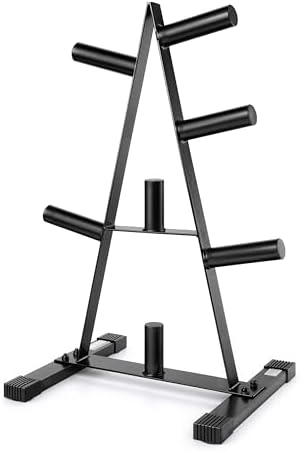
The CAP plate tree takes the opposite approach. It uses floor space instead of wall space and does not require permanent wall attachment.
This makes it the more natural option for renters, buyers without suitable stud access, or anyone who expects to reorganize the gym later. Its main compromise is exactly what the PRx system is designed to avoid: a dedicated floor footprint.
- HIGH-CAPACITY OLYMPIC PLATE TREE - Designed to securely organize Olympic plates with durable steel storage posts for reliable everyday weight storage. The compact 7-post configuration keeps plates organized, accessible, and has a weight capacity of 500 pounds.
- SPACE-SAVING VERTICAL STORAGE DESIGN - Compact vertical A-frame storage maximizes valuable floor space while keeping Olympic plates easy to access during strength training, weightlifting, bodybuilding, and home gym workouts.
Frequently Asked Questions
How long are the PRx storage pegs?
The four-peg PRx Weight Plate Storage uses 8-inch pegs with a 1.75-inch diameter. Plate thickness therefore plays a major role in determining how many individual plates fit.
How many 45 lb plates does PRx say it can hold?
PRx lists two 45 lb crumb-rubber plates per peg as its reference fit. Across four pegs, that equals eight 45 lb plates and 360 lb total.
Will it fit Olympic plates?
Yes. PRx states that the system is designed for standard Olympic plates with 2-inch collar openings and plates up to 18 inches in outside diameter.
Does the PRx plate storage need a wall stud?
According to PRx, the system mounts to one wall stud. Mounting hardware is included. Follow the current manufacturer instructions and confirm that your intended mounting location is suitable.
Is wall-mounted storage better than a floor plate tree?
Not automatically. Wall-mounted storage is more attractive when floor space is limited. A floor tree may be more practical if you have room available, cannot drill into the wall, or expect to move the storage later.
What warranty does PRx provide?
PRx publishes warranty coverage for its equipment and storage products, with conditions and exclusions that vary by component and type of coverage. Check PRx’s current warranty terms before buying rather than assuming the entire product carries an unconditional lifetime guarantee.
What is the PRx return policy?
PRx currently states a 30-day return window for eligible returns. Customers are responsible for return shipping, and a 10% restocking fee applies under the stated policy. Because policies can change or contain product-specific conditions, confirm PRx’s current return policy before ordering.
Final Verdict
The PRx 4-Peg Weight Plate Storage has a clear purpose: move Olympic plates off the floor without dedicating space to a conventional plate tree. For a compact home gym with a suitable wall stud and a moderate plate collection, that can be genuinely useful.
The deciding number is not a speculative maximum load. It is the 8-inch peg length. Thick bumper plates consume that space quickly, while thinner plates can make the system considerably more practical.
Choose the PRx system if clear floor space is valuable enough to justify permanent wall mounting and your actual plates fit comfortably within its storage depth. If you have a large bumper collection, cannot drill into the wall, or already have room for inexpensive freestanding storage, one of the alternative formats is likely the more sensible purchase.




Don’t Miss These Picks